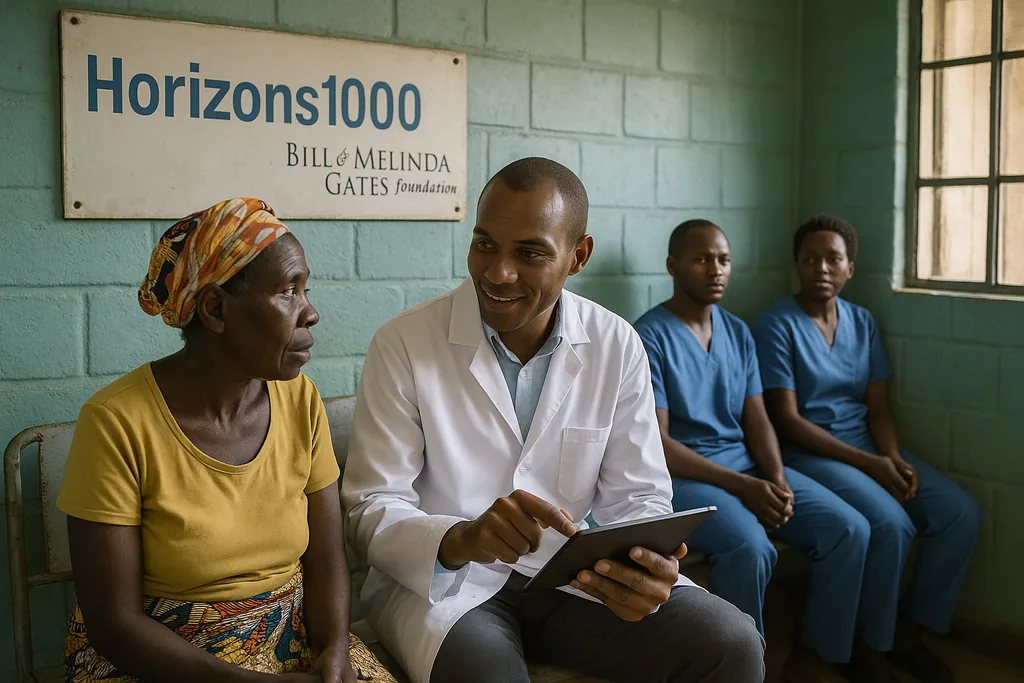
KIGALI — Rwanda will begin piloting artificial‑intelligence tools in more than 50 health clinics as part of a new Gates Foundation initiative launched this week with OpenAI. The program, called Horizons1000, has been seeded with roughly $50 million over two years and aims to ultimately support 1,000 clinics across Africa. Rwandan health officials and the funders say the tools are designed to reduce paperwork, speed routine decisions and strengthen clinicians' judgments rather than replace clinicians.
Pilot and partners
The Gates Foundation announced the initiative on Wednesday alongside OpenAI, saying the two organizations would jointly fund Horizons1000 with the stated goal of narrowing health‑care gaps in lower‑income countries. Bill Gates framed the program as an opportunity to close inequalities in access and quality of care, arguing in a foundation blog that AI could be “a game changer” where staffing and infrastructure are limited. Rwanda’s Ministry of Health confirmed that more than 50 clinics will be part of an initial trial phase; officials say the pilot sites were chosen to represent a range of urban and rural settings and to test how the technology performs under everyday clinical workloads.
What the tools are meant to do
Details about specific products and vendors remain limited in public materials, but the partners describe the class of tools being tested as administrative automation and clinical decision‑support systems. That means software to summarise patient histories, streamline record‑keeping and triage, and to flag possible diagnoses or medication issues for a human clinician to review. In interviews and statements shared with journalists, Rwanda’s Andrew Muhire, a senior official at the Ministry of Health, emphasized that the systems will be used to “strengthen rather than replace clinical judgment,” and to reduce the paperwork burden that consumes time in busy clinics.
Why Rwanda is a focus
Rwanda has long positioned itself as a testing ground for health innovations in Africa, with an established national health system and digital health infrastructure that includes wide adoption of electronic medical records and community health worker networks. Those strengths—combined with a stark staffing gap—make the country attractive for pilots. Rwanda currently has roughly one health care worker per 1,000 people, according to ministry figures cited in reporting, far below the World Health Organization’s commonly cited benchmark of about 4 health workers per 1,000. Funders say AI could help stretch scarce clinician time by automating routine tasks and by providing rapid decision aids that reduce delays in diagnosis and referral.
Language, data and safety challenges
Local technologists and digital‑health experts warn that a successful rollout depends on more than just funding. A frequent theme in interviews is language: many of the large commercial AI models today are trained on English‑centred web text, while roughly three‑quarters of Rwanda’s population primarily use Kinyarwanda. Audace Niyonkuru, CEO of the Kigali‑based AI firm Digital Umuganda, told reporters that deploying English‑only systems would create a barrier to effective care and that investment in Kinyarwanda language models and medical vocabularies is essential.
Beyond translation, clinicians and ethicists point to problems familiar from AI deployments elsewhere: model hallucinations (confident but incorrect outputs), bias in training data, and opaque explanations of why a system made a recommendation. Those failures carry clinical risk: a wrong triage suggestion or misinterpreted symptom summary could delay urgent care. There are also privacy and governance issues. Pilots will need clear protocols about who owns patient data, where it is stored and how it is audited—questions that are especially salient when global tech companies are partners in national health projects.
Legal and accountability questions
Recent litigation in the United States has highlighted legal uncertainty when AI tools make or influence harmful decisions. That background has pushed health ministries and funders to underline human oversight in pilot designs, but it has not removed the thorny accountability calculus: if software recommendations contribute to a misdiagnosis, who bears responsibility—the local clinician, the software vendor, the platform provider or the funder who drove the adoption? Public statements from the Gates Foundation and OpenAI stress evaluation, independent auditing and safety testing during the pilot phase, but lawyers and policy experts say regulatory frameworks will need to be developed or adapted.
Evaluation, ethical review and next steps
The Horizons1000 pilots are scheduled to run over the coming months with technical evaluations and outcome metrics built into the two‑year funding window. Funders say the tests will measure usability, accuracy, clinician time savings and patient outcomes, and that results will determine whether and how the tools are scaled across the continent. Rwanda’s health ministry describes the project as a “transformative opportunity” if the systems prove reliable and culturally adapted; at the same time, digital‑rights advocates want independent oversight and public reporting so lessons are transparent and accountable.
For clinicians on the ground the ideal outcome is practical: tools that free nurses and doctors from repetitive documentation and that provide quick, locally relevant clinical prompts in the language patients and staff use. For policymakers and funders the test will be whether such systems can safely lift quality and access without creating new dependencies on foreign data or technology stacks that are not locally governable.
Why this matters beyond Rwanda
Health systems across Africa face similar constraints of staff shortages, constrained budgets and uneven digital infrastructure. If Horizons1000 demonstrates robust gains—faster referrals, fewer administrative hours, better adherence to treatment protocols—that could influence how other funders and governments approach AI in public health. But the reverse is also true: any major failure would underscore the limits of transplanting models trained on high‑income country data into low‑resource settings without deep localization, language work and governance safeguards.
The next months will therefore be a test not only of technology, but of how global philanthropy, commercial AI developers and national health systems can design pilots that are accountable, language‑aware and driven by clinicians’ needs. The Gates Foundation and OpenAI have committed money and technical attention; Rwanda has offered clinics and a health ministry partner. Whether those ingredients produce safe, scalable improvements to frontline care depends on the pilots’ technical design, transparency, and the attention paid to local language, privacy and legal frameworks.
Sources
- Bill & Melinda Gates Foundation (Horizons1000 announcement and blog)
- OpenAI (program announcement and press materials)
- Rwanda Ministry of Health (statements from Andrew Muhire)




Comments
No comments yet. Be the first!