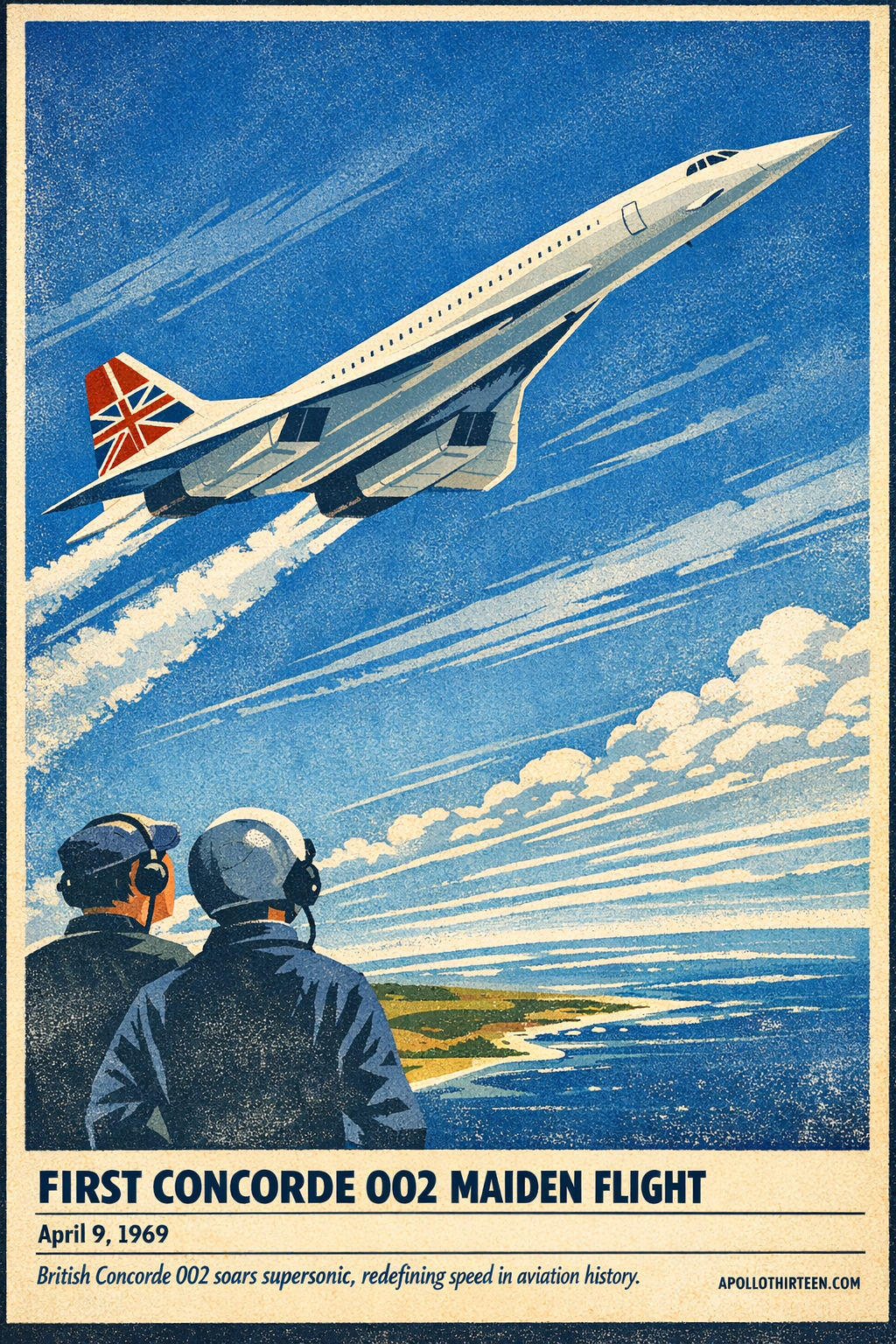
The Day That Changed Everything
Fifty-seven years ago today, the British sky over Filton near Bristol tore open with a new kind of promise. It was a thin, needle-edged promise: a white delta silhouette that seemed to slice the blue itself. On April 9, 1969, thousands of people had gathered on cold grass and wind-blown hillsides, craning necks and squinting through lenses, to watch a machine built for the future leave the ground. When Concorde 002 eased into the air and vanished toward RAF Fairford, it carried not just passengers in some distant future, but a wager — on bold engineering, national pride, and the audacity of speed.
The aircraft that climbed that day was British-built, registered G-BSST, the second prototype of an Anglo-French collaboration that had already rewritten the rules of aeronautics on paper and in sketches. Only five weeks earlier, her sibling — Concorde 001 — had flown from Toulouse. Now, the British machine had taken its turn. The flight lasted 22 minutes. For a handful of engineers and pilots aboard, it was a condensed lifetime: systems were checked, controls were coaxed through unfamiliar regimes, instruments whispered warnings, and a veteran test pilot soothed a temperamental bird down onto the grass. For a nation, the plane’s brief arc across the sky felt like the first note of a new age.
It is tempting to think of Concorde as style — the slender nose, the droop that would later become synonymous with the aircraft’s showmanship. But that April morning was substance: decades of physics wrestled into aluminum and turbine, questions about heat and shock waves answered with rivets and flight hours. On a small runway in Gloucestershire, Britain announced that it could bend the air to its will.
What Actually Happened
Concorde 002 rolled, taxied, and lifted off from Filton Airport on April 9, 1969. Her registration, G-BSST, and her crew would be recorded in the annals of aviation history: Chief Test Pilot Ernest Brian Trubshaw in command, John Cochrane as co-pilot, and Brian Watts serving as flight engineer. In the forward cabin, three flight test engineers — Mike Addley, John Allan, and Peter Holding — kept watch over instruments, logging data that would translate into safer procedures and refined designs.
The flight was short by the standards of routine airline hops: 22 minutes from takeoff to touchdown, ending at RAF Fairford roughly 50 miles northeast of Filton. The mission was deliberately concentrated — systems checks, handling assessments, and a first practical trial of the British-built airframe. Concorde 002 joined the research begun by Concorde 001 in Toulouse five weeks earlier, advancing a pace of testing that was almost breathless by aerospace standards.
Not everything went smoothly. Mid-flight the crew experienced the failure of two radio altimeters — instruments that tell pilots the precise height above ground and are crucial in the low-altitude phases of flight. The loss was serious, the kind of failure that would make many crews turn back. But Trubshaw, a seasoned former RAF pilot known for a steadiness that had earned him the pilot’s confidence, described the experience afterward as “wizard – a cool, calm and collected operation.” Despite the faulty altimeters and a slight bounce on landing, the team brought Concorde 002 down safely, to visible relief from the crowds and to the measured relief of engineers on the ground.
This maiden flight was not an isolated triumph. It came at the end of a long preparatory arc: studies for supersonic transport had been underway since the mid-1950s, formal Anglo-French cooperation began with a treaty in 1962, and full-scale construction of the two prototypes started in February 1965. Over the course of the program, Concorde 002 would log 836 hours and 9 minutes in the air, with 173 hours and 26 minutes spent at supersonic speeds — invaluable data that would refine the aircraft’s flight envelope and inform procedures for its commercial siblings.
To the public and politicians watching that day, the image was simple: Britain builds a plane that can fly faster than sound and does it with aplomb. To the engineers inside the aircraft and the tens of thousands at their benches across the country, the moment was the first in a long series of experiments that would convert equations into repeatable reality.
The People Behind It
If Concorde is remembered for its shape — a long cigar, a slender nose, and a delta wing that reads like a weapon rather than transport — it is worth recalling that shape was born of thousands of hands and a few steady heads.
At the controls that day was Brian Trubshaw, a man whose name is synonymous with early British Concorde flights. Trubshaw had flown jets in the Royal Air Force and then moved into test piloting, a job that requires the temperament of a stoic and the instincts of an artist. When instruments falter and systems misbehave, the test pilot becomes a conductor — coaxing, nudging, improvising. His “cool, calm and collected” characterization of the flight is not bravado; it is shorthand for the mindset engineers needed to validate designs that could otherwise only be proven in the air.
Alongside him were John Cochrane and Brian Watts; in the forward cabin, Mike Addley, John Allan, and Peter Holding kept watch on the burgeoning flood of telemetry. Behind them, literally and figuratively, were design bureaus on both sides of the Channel: the British Aircraft Corporation at Filton and Aérospatiale at Toulouse. The prototypes themselves were built in parallel — an unusual arrangement that underscored the political and technical nature of the partnership. Each side had its own manufacturing practices, tooling rhythms, and industrial cultures; global success depended on their ability to reconcile those differences down to the millimeter.
On the ground, the program supported a vast workforce: approximately 16,000 people employed across the program at its peak, with some 8,000 of those in and around Bristol. These were not just engineers and draftsmen but machinists, electricians, shop-floor technicians, and administrators — the often-unseen chorus whose skill turned plans into polished aluminum and glass. In a single generation, whole communities reshaped themselves around the reality that their labor could put a nation at the front of high-speed flight.
And politics was never far from the hangar door. Concorde was as much a diplomatic project as an engineering one. Memoranda and ministerial meetings decided not only technical alignments but also how to spell the aircraft’s name. A long-running dispute over whether to use the English “Concord” or the French “Concorde” — a minor linguistic quarrel on its surface — required intervention from ministers such as Tony Benn. That squabble speaks to how tightly politics and identity were woven into the program; the plane carried a flag as much as a flight number.
The people who built, flew, and defended Concorde were animated by more than technical curiosity. They believed, often fervently, that supersonic travel would change the rhythm of the world: London and New York a few hours apart, executives reshaping companies on overnight trips, artists and scientists moving faster than the seasons. For a handful of pilots and engineers, that dream was what they tested for on cold April mornings when the sea breeze off the Bristol Channel made their breath turn to steam.
Why the World Reacted the Way It Did
Concorde’s first British flight landed itself into a world already primed for spectacle. The late 1960s were a time of technological showdowns — rockets streaked toward the Moon, jetliners shrank distances into days, and nations vied for demonstrations of industrial might. For Britain, an island still reckoning with a changing global role after empire, Concorde was an advertisement: we can design, build, and operate cutting-edge technology at scale.
The public response in the towns around Filton and Fairford was immediate and visceral. Thousands of spectators came to see the aircraft in flight. Newspapers ran splashes. For many, the sight of that delta wing passing over the countryside was a morale boost in a decade marked by social upheaval and economic anxiety. For policymakers, the stakes were explicitly material: the program employed thousands and represented untold secondary economic benefits across suppliers, subcontractors, and regional economies. Cancelling Concorde would have been not merely an engineering setback but an economic shock, particularly to the Bristol region.
On the diplomatic stage, Concorde’s image was complex. Its existence was a symbol of Anglo-French cooperation at a time when such multinational industrial projects were anything but routine. The partnership carried its own tensions — national pride mixed with the pragmatism of shared costs and shared markets — yet publicly it was a neat contrast to the more splintered Cold War competition that defined other parts of the aerospace sector.
But expectation can be cruel. Early market forecasts were lavish, imagining as many as 350 aircraft being sold to major carriers and options approaching 100 for the manufacturers. That calculus assumed a world where airlines would be eager to pay premium fares for dramatic time savings, and where regulatory and environmental limits would bend to demand. The ensuing reality was harsher: only 20 Concordes were ever built, 14 of them entering commercial service. Noise, fuel costs, and operational constraints — not least the political resistance to overflight and sonic booms — limited the plane’s commercial footprint. For an industry that measures success in fleets and routes, Concorde was a technical success with a modest commercial footprint.
Still, on April 9, 1969, those realities were not at the foreground. The crowd watched with a sense that science was performing its novelist’s trick — conjuring new realities from thin air. And for those inside the industry, the day validated the enormous investments that had already been poured into research: the treaty signed in 1962, the years of wind-tunnel testing, and the complex choreography required to make two separate manufacturers build compatible prototypes.
What We Know Now
Looking back through the lens of modern physics and engineering, Concorde’s achievements are clearer and stranger in equal measure. The plane was not magic; it was a meticulously engineered solution to a set of very hard problems.
First: supersonic flight. When an aircraft moves faster than the speed of sound, it outruns the pressure waves its motion creates. These pressure waves coalesce into shock waves — abrupt, violent changes in pressure, temperature, and density in the air — that fundamentally alter lift and drag. The shock waves that form around Concorde were both friend and foe. They provided the unique lift characteristics exploited by the delta wing at high speed, but they also imposed what is known as wave drag, robbing the aircraft of efficiency. Minimizing that drag while maintaining stability and control was a central design challenge.
The delta wing, Concorde’s most distinctive feature, was a compromise born of these constraints. Unlike conventional swept wings on subsonic airliners, the slender delta performs well at high Mach numbers because it spreads lift across a wide planform and tolerates the shock-induced changes in pressure that occur at supersonic speeds. The trade-off was that at low speeds — takeoff and landing — the wing is less efficient, requiring higher angles of attack and specialized handling procedures. Hence the droop nose, a strikingly simple mechanical solution that improved pilots’ forward visibility during the slower phases.
Heat was another enemy. Friction with the air at Mach 2 generates significant surface heating; the skin of Concorde would warm as it climbed to cruise speed, enough to cause the airframe to expand by several inches. Engineers had to choose materials, clearances, and manufacturing tolerances that would accommodate thermal growth without compromising structural integrity or control. Fuel systems carried a double duty: fuel would be pumped between tanks not just for range and balance, but to move the center of gravity forward or aft as aerodynamic loads changed during supersonic cruise.
And then there was noise — not just the sonic boom but the roar communities heard near airports. The shock waves that form when flying supersonically create a double-thump heard on the ground as the plane passes, and that sound proved politically sensitive. Regulations restricting supersonic overland flight effectively confined Concorde to transoceanic routes where governments permitted supersonic operations. That one regulatory constraint rewrote the business model the designers and airlines had imagined.
From a diagnostic standpoint, instruments like radio altimeters are simple but vital. These devices send radio waves to the ground and measure the echo to determine height above terrain — crucial during low-level flight and landing. Their failure during Concorde 002’s maiden flight was an alarming but manageable event: redundant systems, pilot skill, and conservative flight procedures allowed the crew to land safely. That episode demonstrated the robustness of system-level thinking: you do not design a supersonic airliner around a single sensor.
Today, computational fluid dynamics (CFD), advanced materials, and better engines have reframed many of the problems Concorde’s engineers addressed by trial and measurement. Where Concorde’s team used wind tunnels and flight testing to map behavior, modern engineers can simulate the environment in which a plane will operate across millions of virtual points — though CFD cannot wholly replace the crucible of flight testing. The physics is the same, but our tools are sharper and less wasteful.
We also have a clearer view of environmental costs. The price of high-speed flight is not only fuel; it is the atmospheric and sonic disturbance that comes with it. Concorde burned a prodigious amount of fuel per passenger-kilometer, and in an era conscious of emissions and climate, that measure is central to evaluating whether supersonic travel is sustainable. Contemporary companies who aspire to revive supersonic passenger flight must reconcile these environmental headwinds with economic opportunities — a constraint Concorde’s architects had not faced with the same intensity.
Legacy — How It Shaped Science Today
The Concorde program may not have become the ubiquitous fixture its earliest proponents forecast, but its imprint on aerospace science and engineering is profound and enduring.
First, the program produced a body of operational knowledge about sustained supersonic flight that simply did not exist before. Engineers learned, in practice, how to manage structural heating, how to use fuel as a control medium for center-of-gravity changes, and how delta-wing aerodynamics behave across the transonic-supersonic divide. That know-how has diffused into military aircraft design, materials engineering, and flight-testing protocols worldwide.
Second, Concorde was a crucible for international engineering collaboration. The Anglo-French partnership required detailed standardization, cross-border production schedules, and a negotiation of engineering philosophies. In a world where multinational projects are the norm — satellites, telescopes, particle accelerators — Concorde offered an early template for how to reconcile different industrial systems into one functioning product.
Third, the program left a cultural and aspirational legacy. Concorde became a symbol — of glamour, of technological possibility, and of the limits of market and political appetite. It taught an important lesson to engineers and policymakers alike: technical feat does not necessarily equal commercial viability. That sobering truth has informed how aerospace projects are assessed, financed, and regulated in the decades since.
And finally, Concorde’s lessons endure in the companies trying to revive faster-than-sound travel. Firms like Boom and others are plainly standing on Concorde’s shoulders: borrowing aerodynamic insights, learning from its failures, and seeking to solve the environmental and noise problems that grounded widespread supersonic operations in the late 20th century. They have advantages Concorde’s engineers did not: lower production costs of computing, more efficient engines, and a regulatory environment that is slowly opening to new approaches to sonic boom mitigation. Whether these ventures succeed is an open question, but their work is a successor chapter to the experiments performed in Filton and Toulouse 57 years ago.
Concorde 002 itself now rests in a museum at Royal Naval Air Station Yeovilton, preserved as a tangible artifact of an era that dared a different tempo. There, visitors can walk the aisles and stand where engineers once peered at instruments as the white delta pulled through the sky. The plane is no longer a promise of future travel so much as a monument to the kind of civic confidence that can drive an entire region to master a painstaking craft.
When we look at Concorde from our current vantage, we can see a tapestry of human ambition: scientists and pilots who transformed equations into flight, politicians who wagered jobs and national pride on a slender wing, and communities who watched their world lift into the air. The aircraft’s practical life may have been shorter and narrower than its designers hoped, but the knowledge it produced lingers. We still learn from the decisions made in the hangars at Filton; we still borrow its ideas when chasing the dream of faster travel.
Fifty-seven years after that windy April morning, Concorde’s arc across the British sky remains a clean, unambiguous statement: physics can be bent into new patterns, and people will turn out to witness the first flight of an idea made real. The value of that kind of moment is not only measured in fleets sold or profits booked, but in the human capacity it reveals — to imagine, to calculate, and then, finally, to fly.
Fast Facts
- Date of flight: April 9, 1969 — 57 years ago today.
- Aircraft: Concorde 002 (British-built prototype), registration G-BSST.
- Flight duration: 22 minutes — Filton Airport (Bristol) to RAF Fairford (Gloucestershire).
- Flight crew: Chief Test Pilot Ernest Brian Trubshaw (pilot in command), John Cochrane (co-pilot), Brian Watts (flight engineer).
- Flight test engineers: Mike Addley, John Allan, Peter Holding.
- Initial prototype companion: Concorde 001 (French-built) made maiden flight March 2, 1969.
- Total flight time logged by Concorde 002 in its test program: 836 hours, 9 minutes; supersonic flight hours: 173 hours, 26 minutes.
- Program beginnings: studies from 1954; Anglo-French treaty in 1962; construction of prototypes began February 1965.
- Estimated program cost (historic): £70 million (equivalent to roughly £1.77 billion in 2025 terms).
- Employment impact: approximately 16,000 workers supported by the program during its peak, including ~8,000 in Bristol.
- Commercial outcome: 20 Concordes built in total; 14 entered commercial service.
- Notable later milestones: Concorde 001 completed the first transatlantic crossing for the type on September 4, 1971; Concorde 002 visited the United States in 1973, landing at Dallas/Fort Worth.
- Preservation: Concorde 002 is displayed at the Fleet Air Arm Museum at Royal Naval Air Station Yeovilton, Somerset.



Comments
No comments yet. Be the first!