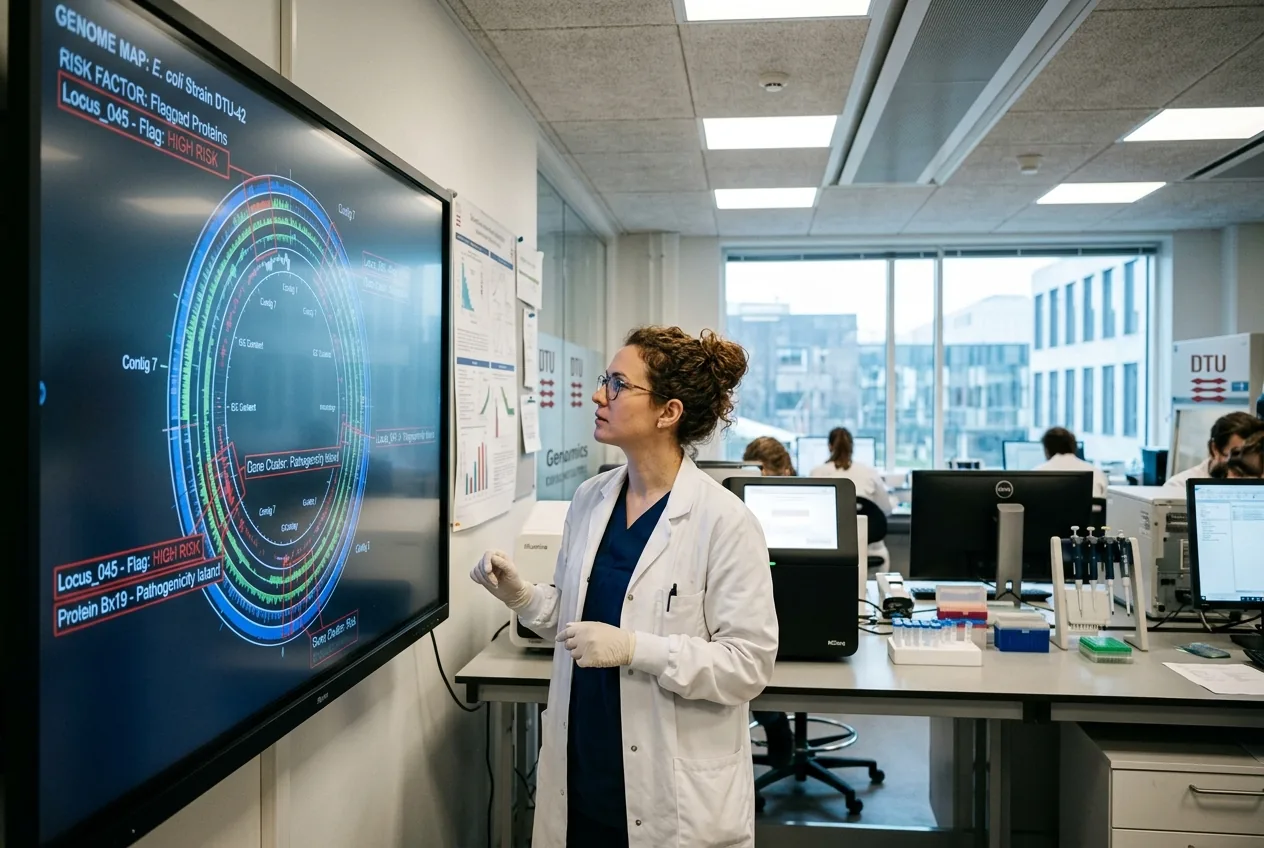
DTU's new model arrives with a vivid promise—and a practical tension
On 27 March 2026 researchers at the Technical University of Denmark (DTU) pushed a new AI service live: PathogenFinder2, a free module in the Global Pathogen Analysis Platform (GPAP) that claims to let users test whole bacterial genomes and have the tool assesses the potential threat those genomes pose. In a crisp summary accompanying the Bioinformatics paper, the team led by Alfred Ferrer Florensa says the model can highlight proteins and genetic signals linked to virulence even when the organism has no close known relatives. The result is a fast, interpretable flagging system for sewage surveys, wild‑microbe discovery and microbiome scanning that—on paper—moves assessment from “we don’t know” toward “this one looks worrying.”
That capability matters now because genomic sequencing—of wastewater, food, animal reservoirs and human samples—has exploded. Groups are discovering bacterial species with no clinical history; public health agencies cannot wait weeks for culture work and lengthy phenotyping at every minor alarm. PathogenFinder2 promises to triage those discoveries, offering which genomes deserve urgent wet‑lab follow‑up and which can be filed as background noise. But the technology also brings the familiar trade‑offs: faster triage, more false alarms; model interpretability, but also training‑set bias; and public‑health value, but significant governance gaps in who acts on the warnings.
How the tool assesses the potential threat: protein language models and 21,000 genomes
The team trained and validated the system on what they describe as the largest labeled dataset to date: more than 21,000 genomes annotated as disease‑associated or non‑pathogenic drawn from clinical isolates, microbiome surveys, probiotic strains and even extremophiles. Critically, the model also returns an explanation: it highlights the specific proteins or regions that most strongly influence a high‑risk score—classical virulence factors such as toxins or adhesins, but also previously uncharacterized proteins that warrant lab study. That interpretability is deliberate: DTU frames PathogenFinder2 as an evidence‑prioritization tool rather than a final arbiter of pathogenicity.
When the tool assesses the potential threat — strengths, blind spots and comparison with lab tests
But computational prediction is not a substitute for phenotype. Classic microbiology—growth curves, host‑cell interaction assays, animal models and clinical correlation—remain the gold standard for proving a bacterium causes disease. AI scores are probabilistic and prone to two practical errors: false negatives (novel mechanisms the model hasn’t learned) and false positives (biochemical signatures correlated with virulence in some contexts but innocuous in another). Also, sequencing platforms differ—Illumina and Nanopore have different error profiles—and those technical differences can change which proteins are reliably called. The result: PathogenFinder2 is best viewed as a decision‑support filter that prioritises specimens for targeted lab validation, not as a public‑health verdict machine.
Where PathogenFinder2 fits into surveillance and how it could change public‑health decisions
Applied sensibly, a genomic triage tool shortens the lag between discovery and action. DTU and its partners point to uses that are already familiar to public‑health teams: sewage surveillance for early outbreak signals, screening environmental samples from food chains, and mining healthy‑person microbiomes to identify strains that carry risky features. If a genome from a wastewater pipeline lights up with multiple high‑influence proteins, labs could allocate culture and infectivity assays to that specimen first, and regulators could stand up targeted contact tracing or sampling.
Yet the influence of such tools on policy depends on several operational realities. First, laboratory and clinical capacity varies wildly between regions: many public‑health systems lack the high‑containment capacity and specialty tests needed to confirm AI flags. Second, agencies need confidence in the tool’s operating characteristics in their local setting—sensitivity, positive predictive value and patterns of false positives—and that requires independent validation datasets, not only the training set assembled by DTU. Third, policy makers must weigh the cost of acting on AI leads against the social and economic consequences of premature alarms. The tool shortens one timeline (genomic triage) but it does not, on its own, close the loop from genomic signal to effective intervention.
Power, privacy and dual‑use: what deploying a model that assesses the potential threat reveals about governance
PathogenFinder2 sits at the messy intersection of capability and responsibility. There are three governance risks that deserve attention. One is privacy and data‑sharing law: genomic data—especially when linked to human or agricultural metadata—are subject to strict rules in many jurisdictions (for example, GDPR in Europe). Cross‑border data flows, needed for robust training and evaluation, are often constrained by policy. Second is equity: wealthy labs will validate AI flags fast; under‑resourced regions may see predictive tools amplify their inability to act, widening surveillance gaps.
The third risk is dual‑use. Commentators have pointed out that AI methods can be repurposed to design or tune biological agents. The PathogenFinder2 team emphasises interpretability and public‑good use, but open, powerful models inevitably raise a trade‑off between transparency and potential misuse. The field must pair capability with layered safeguards: access controls on raw sequence searches, staged disclosure of model internals, and strong oversight from international bodies that already handle pathogen surveillance and food safety. Absent those measures, a tool intended to reduce surprise could become a vector of new risks.
Data gaps and the next evidence the tool needs
The genome is precise; the decisions built around it are not. PathogenFinder2 reads proteins; whether institutions read the warnings correctly will decide if the tool prevents the next outbreak or simply adds another dashboard to an already crowded public‑health cockpit.
Sources
- Bioinformatics (journal) — Florensa A. F. et al., whole‑genome prediction of bacterial pathogenic capacity using protein language models (PathogenFinder2).
- Technical University of Denmark (DTU) — DTU National Food Institute press materials and research group for Genomic Epidemiology.
- npj Science of Food (Nature) — review: Advancing microbial risk assessment and detection technologies.
- World Health Organization (WHO) — guidance documents referenced for international risk assessment frameworks and data sharing.




Comments
No comments yet. Be the first!