CERN's most delicate road begins with a crane and a crate
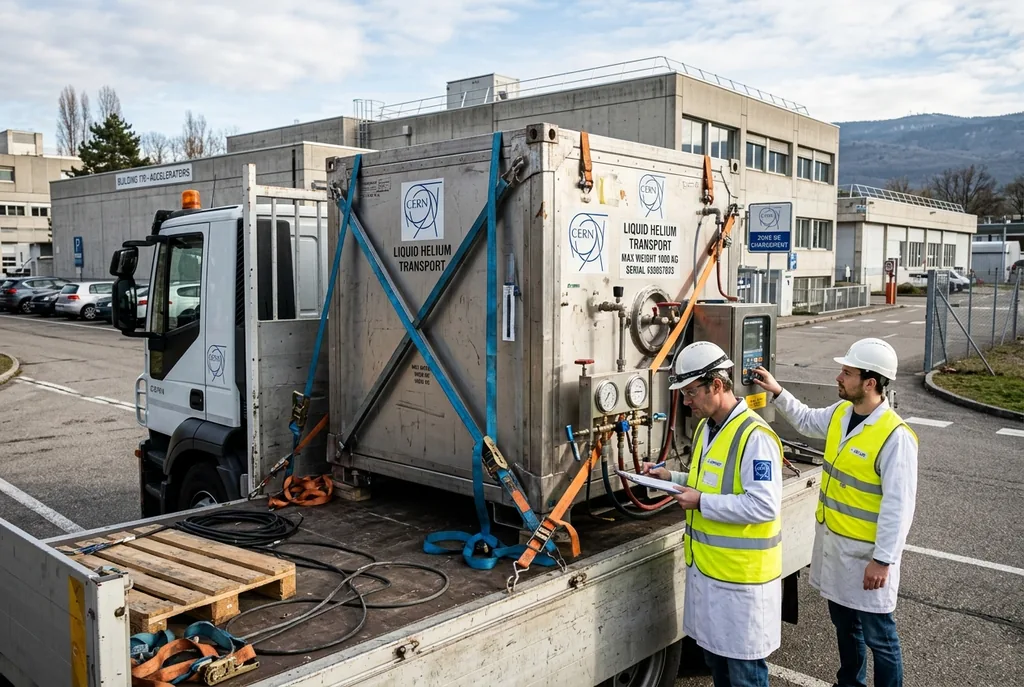
On a grey morning at CERN’s Meyrin campus researchers hoisted a one-tonne cryogenic box, eased it into a flatbed lorry and drove it across the site for roughly thirty minutes — carrying with it fewer than a hundred antiprotons trapped inside a magnetic vacuum. The scene had all the theatre of a museum transfer rather than a particle‑physics milestone: the crate was moved inch‑by‑inch, engineers checked superconducting magnets and colleagues applauded when the particles arrived safe and unchanged. This was cern's most delicate road in literal form: the first time a bank of trapped antimatter has left a fixed laboratory under powered transport.
Why this short truck ride matters
The gesture looks small — a few laps around a research campus — but it is a practical unlocking of new experimental possibilities. For decades, antimatter experiments were tightly co‑located with production facilities because antiprotons are created in accelerators and then slowed, cooled and trapped. Moving the trap to other labs, or moving particles between experiments, lets teams use quieter measurement environments and specialist instruments that are not available next to the Antiproton Decelerator. That improves spectral resolution and the chance to spot minute differences between matter and antimatter that could hint at missing physics. The move also tests the hardware and procedures needed for longer, cross‑border shipments that CERN has signposted as a goal.
cern's most delicate road: the trap, the truck and the physics
The workhorse in the operation is a transportable Penning‑trap system developed over several years under efforts like BASE‑STEP. The device combines ultrahigh vacuum, cryogenic cooling and superconducting magnets to levitate charged antiparticles without any contact with matter. Mechanically it looks like a heavy, insulated safe; conceptually it is a fragile electromagnetic bottle whose fields must be stable against vibrations, shocks and thermal changes during loading, transit and unloading. On this test day, teams reported no measurable particle loss after the short drive, a primary objective of the trial.
How antimatter survives the trip — and why it usually doesn't
Antimatter is the mirror counterpart to everyday particles: an antiproton has the same mass as a proton but an opposite charge. If an antiparticle touches normal matter the two annihilate, converting their mass into energy. That binary physical fact is why handling antimatter has felt like handling a ghost: any stray atom, a speck of dust, or a leak in the vacuum could destroy the sample instantly. To prevent that, traps never touch the particles — they hold them in emptiness using magnetic and electric fields inside an ultraclean vacuum and at cryogenic temperatures. During transport, engineers must preserve vacuum integrity, magnetic field stability and cooling power while isolating the system from jolts. This test was designed to validate that the trap and lorry can satisfy those constraints on the move.
Logistics, safety and the inevitable alarmism
Transporting antimatter sounds like the setup to a science‑fiction thriller, but the reality is prosaic and reassuring: the absolute amount of antimatter involved is vanishingly small. To create a weapon‑scale explosion with antimatter you would need on the order of tenths of a gram — many orders of magnitude more than the tens or hundreds of antiparticles used in precision experiments. The device itself weighs about a tonne because of the magnets and cryogenics, not because of exotic payload. CERN and participating teams emphasise multiple redundant safety systems and stress that the trial posed no public hazard. Still, logistics are complex: planning the crane lifts, vibration damping, thermal management and regulatory paperwork for moving a cryogenic scientific container even across a campus.
What the experiment actually transported and how many particles were involved
The test moved antiprotons — the negatively charged constituents of antimatter that experiments use either directly or to assemble antihydrogen when paired with positrons. Contemporary press accounts of the trial report on the order of a few dozen to a few hundred trapped antiprotons during the drive; the publicised number in several briefings was 92 antiprotons held stably in the portable trap. The immediate goal was not to haul large numbers but to demonstrate lossless, disturbance‑tolerant transport of a trapped cloud. Past research had already shown lossless transport for ordinary protons using the same kind of trap; those earlier demonstrations paved the way for this step with antiparticles.
What experiments stand to gain
Precision antimatter spectroscopy is a direct test of CPT symmetry — the expectation that the laws of physics treat matter and antimatter identically when charges, parity and time are inverted. Smaller systematic errors and quieter electromagnetic environments translate into tighter limits, or the first real discrepancies, which would be a profound discovery. Teams like ALPHA, BASE and others aim to compare masses, magnetic moments and spectral lines of protons and antiprotons or hydrogen and antihydrogen with ever finer precision. Transportable traps let specialists build dedicated infrastructure — for example advanced Penning‑trap clocks or high‑resolution spectrometers — in labs that previously could not access antiprotons.
European science politics: moving particles, moving policy
The step from on‑site shuttles to international road shipments will be as much political and regulatory as technical. CERN has flagged plans to transport antiparticles to partner laboratories — Germany is explicitly mentioned in planning documents — which will trigger permit processes, cross‑border transport rules for cryogenic equipment, and harmonisation of radiological or hazardous‑goods paperwork even if the payload itself is tiny. For Brussels and Berlin the move intersects with broader goals around European research infrastructure: enabling centres of excellence to share scarce resources without duplicating large accelerators could be framed as efficient and sovereign science policy. But the paperwork will be nontrivial and will require careful public communication to avoid misunderstanding.
What still needs proving
The trial answered the narrow technical question of whether a trapped cloud survives a measured, controlled drive across a campus. It did not yet test long‑distance highway conditions, repeated load cycles, or international customs and safety inspections. Engineering teams will need to demonstrate long‑duration stability of the traps (weeks, not hours), robust vibration isolation for real roads, and the ability to re‑integrate the transported particles into different apparatus without introducing measurement biases. Each of those steps is tractable, but none are trivial — so expect a sequence of incremental tests rather than a single triumphant trans‑European convoy.
A slightly wry note on ambition versus bureaucracy
There is something characteristically CERNian about moving a suitcase of antimatter the length of a campus and calling it revolutionary: the physics is audacious, the execution hyper‑methodical, and the PR photo looks like a cross between a museum move and a spy movie. If Europe’s research ecosystem can sync magnet technology, customs forms and local transport authorities, the next phase will be less about the novelty of a truck and more about the quiet, cumulative gains in measurement precision. Until then, the crate remains a heavy bit of hardware and a light bundle of particles with a disproportionate capacity to capture imaginations — and to test forms.
Sources
- CERN (press materials and program documentation on transportable antimatter experiments)
- Nature (paper on transport of charged particles and development of transportable Penning traps)
- arXiv preprints and technical reports on the AD/ELENA antimatter programme
- Heinrich Heine University Düsseldorf / BASE collaboration materials




Comments
No comments yet. Be the first!