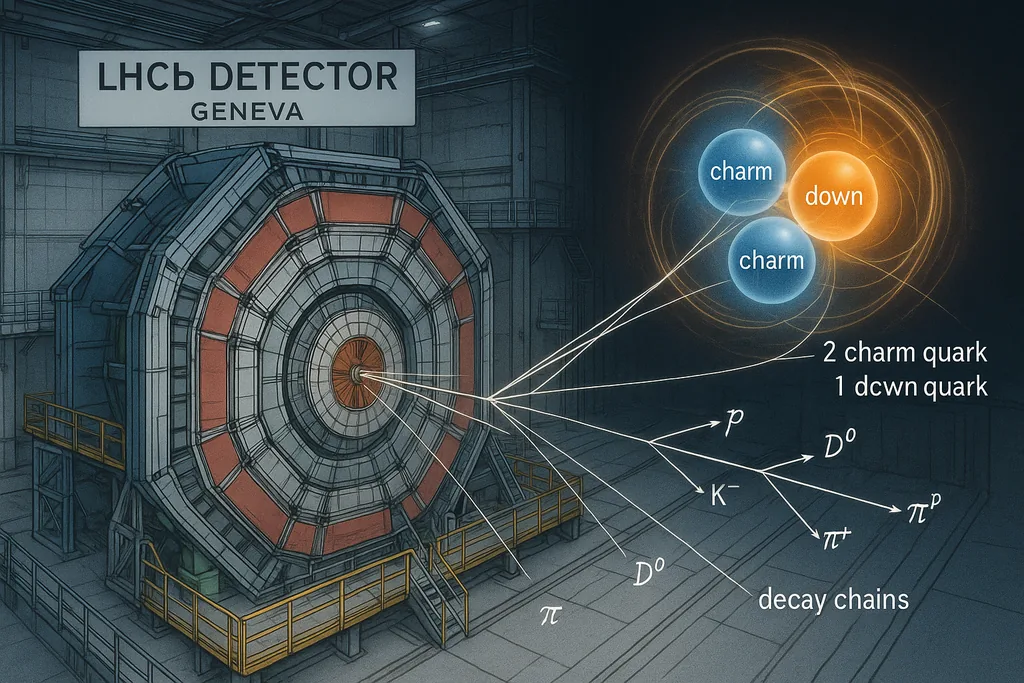
This week, physicists at the European Organization for Nuclear Research announced a clear detection from the LHCb experiment that cern discovers particle that contains two charm quarks and a lighter down quark — a heavy baryon called Xicc+. The result, presented in Geneva and released by collaboration teams on 18–19 March 2026, carries a statistical significance above 7 sigma and is the product of Run 3 data and recent detector upgrades. The discovery is concrete: the new baryon is not a new fundamental force-carrier but an exotic combination of known quarks whose behaviour provides a sharp probe of the strong interaction that holds ordinary matter together.
cern discovers particle that: the particle itself and why it matters
Why does this matter? Baryons like the proton and neutron are stable building blocks of ordinary matter because of how the strong force binds quarks. Heavy, short‑lived baryons act like controlled stress tests for quantum chromodynamics (QCD), the theory describing that binding. Measuring Xicc+’s mass, decay modes and lifetime gives theorists concrete numbers to compare with QCD calculations and lattice simulations; discrepancies flag places where our models need improvement or where unexpected dynamics appear.
The LHCb team reports that the new state appears related to a double‑charm baryon first seen in 2017 — the same quark content but with an up quark instead of a down quark. Even this small change matters: preliminary analyses indicate Xicc+ decays significantly faster than its earlier sibling, a difference that carries information about how quark flavours and internal motion affect decay processes.
cern discovers particle that: how the LHCb detector found and confirmed it
Detecting Xicc+ is a detective story of indirect evidence. The baryon exists for a tiny fraction of a second — less than a trillionth of a second — and never reaches a detector directly. Instead, LHCb recorded the spray of charged and neutral particles produced when the ephemeral baryon decayed. By reconstructing those decay chains, measuring invariant masses and testing alternative hypotheses, analysts isolated a peak in the data consistent with a new resonance.
The claim is robust because it rests on several reinforcing elements: high‑statistics Run 3 collision datasets, improved tracking and readout after an LHCb upgrade completed in 2023, and careful statistical analysis. The team quotes a 7σ significance, comfortably above the 5σ standard most particle physicists require for a discovery. Spokespeople for LHCb have emphasised how the upgraded detector’s timing, vertexing and data throughput made the search feasible for a state that decays faster and is therefore harder to reconstruct than similar particles.
Validation also comes from internal cross‑checks: multiple decay channels, control samples to understand backgrounds, and consistency with theoretical expectations for masses and widths. While a formal peer‑reviewed paper typically follows internal announcement, the combination of experimental care and the magnitude of the signal gives the community high confidence in the finding.
How experiments like this test the strong force and QCD
Quantum chromodynamics is a well‑tested part of the Standard Model, but it becomes numerically messy when quarks are tightly bound inside hadrons. Heavy‑quark systems — those containing charm or bottom quarks — are especially useful because the heavy masses introduce simplifications, yet the bound state still reflects non‑perturbative QCD effects. Double‑charm baryons like Xicc+ sit at a boundary where heavy‑quark approximations meet the dynamics of a light spectator quark.
Measuring properties such as the baryon’s mass splitting relative to its double‑charm partner, its decay branching fractions, and its lifetime provides direct inputs for lattice QCD calculations and phenomenological models. These comparisons help pin down how the strong force arranges energy and angular momentum inside hadrons, refine parameters used across nuclear and particle physics, and improve predictions for rarer exotic configurations such as tetraquarks and pentaquarks.
In practical terms, every well‑measured heavy hadron reduces theoretical uncertainty. That matters beyond pure particle physics: better QCD models feed into nuclear astrophysics, cosmic‑ray modeling and searches for subtle signals in experiments that look for physics beyond the Standard Model.
Matter formation, fragile nuclei and broader connections
The new baryon discovery sits alongside recent LHC results that probe how matter forms in the aftermath of high‑energy collisions. ALICE and associated groups have reported that fragile light nuclei — for example deuterons and antideuterons — are predominantly produced not during the hottest initial blast, but later from decay products of ultra‑short‑lived resonances. That mechanism explains how delicate bound states can appear in an environment briefly hotter than the Sun’s core and implies that the road from quarks and gluons to composite nuclei is more staged than previously thought.
Although Xicc+ is not itself a nucleus or a dark‑matter particle, understanding how QCD binds quarks into hadrons and how resonances feed into later coalescence steps informs a larger narrative about matter formation. Improved knowledge about resonance production and decay affects models used to interpret cosmic‑ray antinuclei searches — searches that can be misread as dark‑matter signals unless the conventional production rates are known precisely.
Space and accelerator experiments are complementary: precision spectroscopy of exotic baryons constrains the microscopic rules and decay rates that feed into macroscopic formation models, while heavy‑ion collision studies show how those decay products recombine in a cooling environment.
Implications for the Standard Model, antimatter and what comes next
For the Standard Model, Xicc+ is another confirmation that the quark picture and QCD remain reliable frameworks, while exposing places where calculations must tighten. The discovery does not overthrow the Standard Model nor point directly to the Higgs mechanism or dark matter. However, by improving the empirical map of hadron spectra and decay dynamics, it sharpens the constraints any new theory must satisfy and reduces room for unexpected anomalies to hide inside hadronic uncertainties.
Some commentators have asked whether results like this can shed light on the universe’s matter‑antimatter imbalance. The short answer is indirect: heavy hadrons and precision measurements of their decays can constrain sources of CP violation and other effects relevant to baryogenesis, but explaining the cosmic asymmetry remains a larger question that likely involves dynamics beyond a single resonance. In short, Xicc+ tightens the experimental scaffolding researchers use to test hypotheses about matter’s dominance, but it is not a direct solution by itself.
Looking ahead, LHCb and other experiments will push for detailed follow‑up: more precise mass and lifetime values, measurement of decay modes and branching ratios, and comparisons with lattice QCD predictions. Each incremental result will narrow theoretical uncertainties and, together with ALICE’s studies of late‑stage formation, will continue to build a more complete picture of how microscopic quark dynamics produce the complex forms of matter we observe.
Sources
- CERN — LHCb Collaboration (experimental discovery and collaboration materials)
- Large Hadron Collider (LHC) — Run 3 datasets and detector upgrade documentation
- ALICE Collaboration / Nature (Observation of deuteron and antideuteron formation from resonance‑decay nucleons)
- Technical University of Munich (TUM) — research reporting linked to ALICE results




Comments
No comments yet. Be the first!