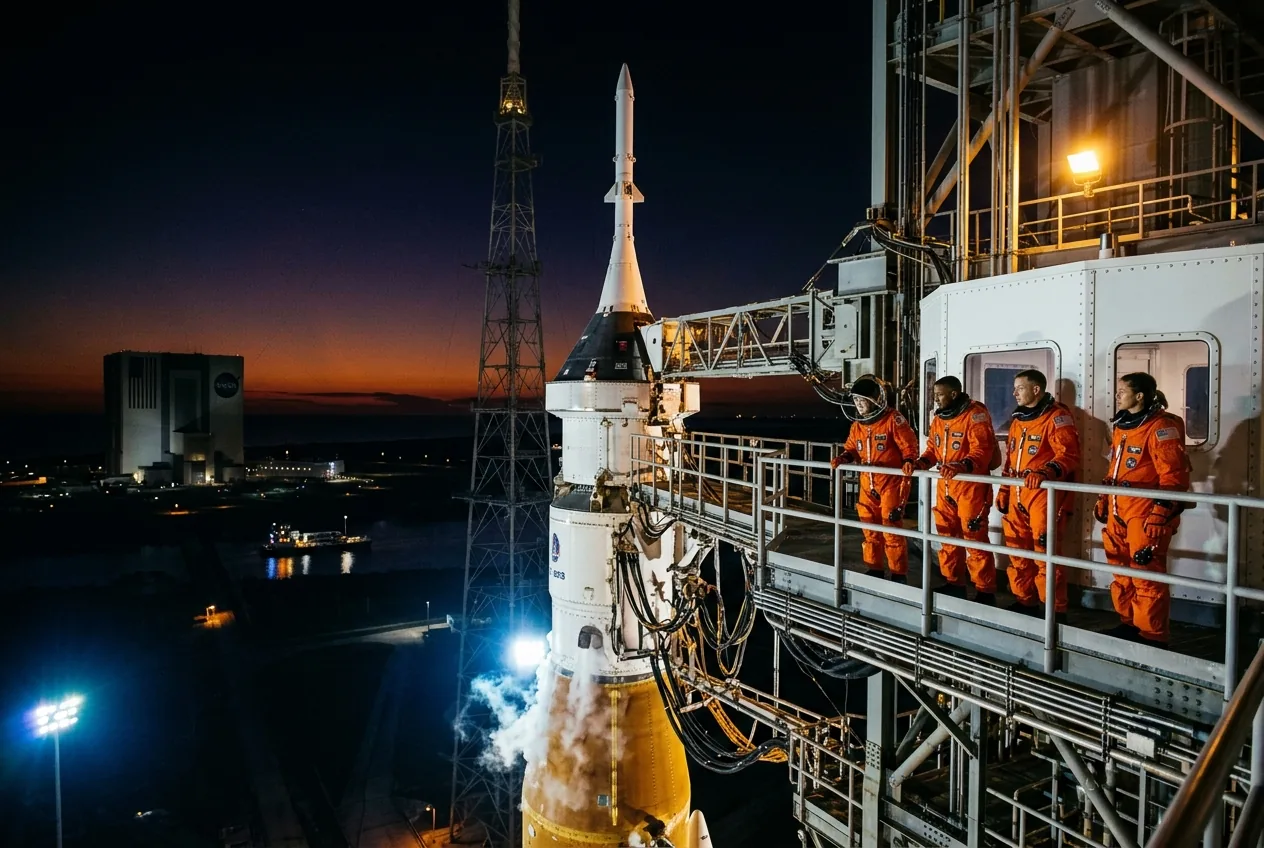
Three T‑38 jets skimmed the runway at Kennedy Space Center and spat the Artemis II crew onto Florida soil; cameras flashed and a plush toy named "Rise" — the mission's zero‑g indicator — bobbed under an astronaut's arm. "Hey! Let's go to the moon!" Reid Wiseman shouted to waiting reporters, a moment that felt celebratory and precarious at once. In those small, noisy minutes the reality of artemis ii: humans fly was clear: four people were about to leave low‑Earth orbit for the first time since 1972, aboard hardware that has been delayed, redesigned and debated for more than a decade.
Why this matters now is simple and immediate. If Artemis II succeeds it will validate Orion and the Space Launch System for crewed deep‑space flight and hand NASA momentum for later lunar landings. If it fails, the program faces not just technical embarrassment but fresh political and budgetary scrutiny — with contractors, commercial partners and international agencies watching. The tension is between an audacious human milestone and a history of cost overruns, leaks and schedule slips that critics say still shape the mission's odds.
artemis ii: humans fly — crew, countdown and the mission profile
The flight manifest is compact and unmistakable: four astronauts — commander Reid Wiseman, pilot Victor Glover, mission specialist Christina Koch and Canadian Space Agency astronaut Jeremy Hansen — will ride NASA's Orion capsule atop the SLS rocket from Launch Pad 39B at Kennedy Space Center. The mission is not a landing; it is a crewed test flight. Launch windows are clustered in early April (official dates being 1–6 and a late‑month option), and the plan calls for roughly a ten‑day mission that takes the crew on a figure‑eight trajectory around the Moon and back.
This is the first time people will travel beyond low‑Earth orbit in more than half a century. Artemis II differs from Artemis I because the earlier flight was uncrewed: Artemis I validated the basic integration of SLS and Orion. Artemis II will place humans inside Orion to exercise life‑support, navigation and manual piloting, and to collect human physiology and radiation data while swinging several thousand kilometres beyond the Moon's far side. In practical terms, the crew will be at the controls for parts of the flight and will test how Orion behaves when astronauts have to steer it themselves — a rehearsal intended to reduce risk for the landing‑era missions that follow.
artemis ii: humans fly and the risky hardware decisions behind SLS and Orion
The other, louder part of the story is hardware history. The core architecture for SLS and many elements of Orion trace back to shuttle‑era decisions and congressional mandates made to preserve an industrial base. That political lineage buys jobs and contracts; it also left NASA with a vehicle that critics say is expensive and hard to iterate. Development costs for SLS and Orion have climbed into the tens of billions — widely reported figures put combined development north of $40 billion — and the rocket first intended to fly crewed missions many years ago only reached pad readiness after repeated delays.
A test flight, not a landing — what Artemis II will actually try to do
Artemis II's objectives are narrow and technical, but their implications are wide. The crew will verify Orion's life‑support systems while living in microgravity, manually pilot the capsule to characterise handling qualities, and operate navigation and communications modes at distances where Earth‑based controllers must cope with longer signal delays. Medical and radiation studies will run throughout, sending back data to refine the models that will underpin future long‑duration missions.
Scientifically the mission offers limited but valuable returns: imaging and targeted observations of portions of the lunar far side and poles that humans have never seen directly, and experiments designed to probe how human bodies react to deep‑space radiation and isolation compared with the ISS environment. Artemis II is explicitly a stepping stone: it does not land, but it is meant to clear the operational and safety hurdles before Orion carries astronauts to rendezvous points for a crewed surface mission planned in the Artemis IV timeframe.
Politics, budgets and a fragile schedule after artemis ii: humans fly
The mission does more than test hardware — it tests policy. NASA's Artemis program has been restructured amid leadership changes and congressional pressures to deliver results faster and cheaper. Agency planners talk openly about using Artemis missions to catalyse a lunar economy and, eventually, a base at the lunar south pole. But the critics' counterpoint is pragmatic: a shuttle‑derived rocket and complex procurement choices mean launches will be infrequent unless costs come down and manufacturing scales up.
That argument is not hypothetical. Independent audits and watchdog reports have flagged unsustainable per‑launch costs and schedule risk, while commercial partners such as SpaceX and Blue Origin face their own development bottlenecks. The result is a fragile choreography: a successful Artemis II gives NASA credibility to accelerate cadence and secure further appropriations; a failure would hand critics concrete ammunition and likely slow the program down again. For now, the political bet is that demonstrating people can travel safely beyond Earth orbit will quiet doubts and attract the partnerships NASA needs.
Observed details, contradictions and the human texture of this mission
There are telling, human details around the countdown: the Rise plush toy carrying a microSD card of public names, the T‑38 arrival that was greeted like a homecoming, and astronauts repeatedly saying the same thing — they are excited, cautious, and prepared. Those moments give texture to a programme often described in spreadsheets and audits. Yet there are also contradictions: NASA wants more frequent missions to learn quickly, but its current rocket design and production tempo make rapid cadence costly and complex. Saying the programme is both historic and expensive is not an either/or — it's the practical problem the agency must manage.
Another concrete tension is cost versus capability. Spending heavily to preserve a legacy industrial base bought political stability; it also generated technical choices, like the use of liquid hydrogen, that complicate operations. The mission's success will not only be measured in photographs of Earthrise but in whether those trade‑offs can be resolved, and whether the agency can deliver repeatable, safe crewed flights on a schedule that sustains scientific, commercial and geopolitical goals.
Artemis II is precisely the sort of hinge moment that looks simple on the press schedule — a launch, ten days, a splashdown — but carries policy, engineering and human consequences that could shape NASA's next decade of deep‑space exploration. When the four astronauts strap in and the countdown reaches zero, the launch will be a test of decades of choices, not just of rocket engines and heat shields. The quiet, stubborn fact is this: if they come home as planned, NASA will have bought itself time and credibility; if not, the questions the programme faces will only grow louder.
Sources
- NASA (Artemis II press kit and mission materials)
- NASA Goddard Space Flight Center, Scientific Visualization Studio (Artemis II media and briefings)
- Canadian Space Agency (crew participation and mission coordination)
- European Space Agency (international contributions and partnerships)
- NASA Office of Inspector General (technical and programmatic audit reports)




Comments
No comments yet. Be the first!