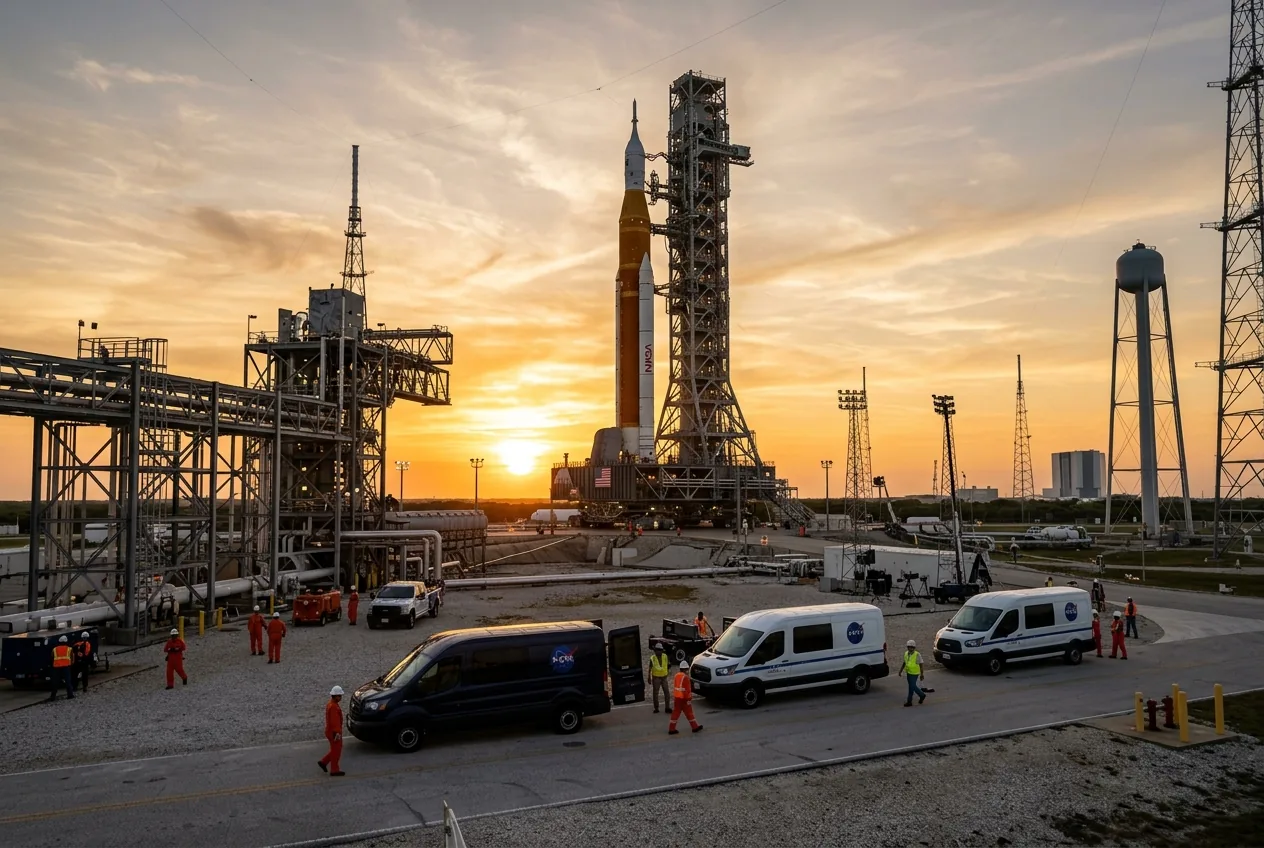
A line of blue vans rolls away from the Neil Armstrong building and the countdown clock is already ticking: artemis astronauts are launching to the Moon on April 1.
The scene at Kennedy Space Center felt quietly familiar — technicians in orange vests, a handful of cameras trained on Launch Pad 39B, and a crew in quarantine preparing to board Orion — yet the stakes were different. This isn’t a publicity rehearsal; it’s a crewed checkout of systems that have only flown uncrewed before. The timeline NASA published pins liftoff no earlier than 6:24 p.m. EDT on Wednesday, 1 April, and it sets in motion roughly ten days of live coverage, mission briefings and a lunar flyby that will test Orion, the Space Launch System and the teams that support them.
Why this matters: four astronauts — NASA’s Reid Wiseman (commander), Victor Glover (pilot), Christina Koch (mission specialist) and Jeremy Hansen (mission specialist, Canadian Space Agency) — will travel around the Moon and back, exercising life‑support and navigation systems with people aboard for the first time in the Artemis program. The tension is practical and political: the rocket and capsule have required repairs and schedule shuffles this spring, and the agency must balance the public appetite for constant live imagery against real mission constraints such as limited bandwidth during a lunar eclipse and temporary communications blackout when Orion flies behind the Moon.
How artemis astronauts are launching — the schedule and where to watch
NASA’s official schedule lists the primary launch target as April 1 at 6:24 p.m. EDT (2224 GMT), with a two‑hour launch window; additional launch opportunities run through April 6 (and April 2 was added after further trajectory analysis). Coverage begins on NASA platforms earlier in the day: tanking operations (propellant loading) will be shown starting at 7:45 a.m. EDT on launch day, with continuous NASA+ and YouTube streams carrying launch, translunar injection and the mission’s periodic downlinks.
If you want to watch live, bookmark NASA’s YouTube channel and the NASA+ streaming service; the agency has also arranged distribution through Amazon Prime and other partners. NASA will provide a separate Orion exterior‑camera feed when bandwidth allows, and it will host daily mission status briefings from Johnson Space Center beginning 2 April. For those who prefer audio only, NASA supplies an audio dial‑in for tanking and launch commentary; local radio frequency feeds may be used at the Space Coast as well.
Practical note for viewers: the exact timings of daily downlinks and press conferences depend on the launch time and how quickly mission phases occur. NASA’s live blog and the Artemis II mission page will post times as the flight progresses.
The crew and the mission plan
Artemis II carries four crew members: Reid Wiseman (commander), Victor Glover (pilot), Christina Koch (mission specialist) and Jeremy Hansen (mission specialist, Canadian Space Agency). The mission will not attempt a landing; instead it will loop around the Moon and return to Earth in about ten days. That roughly ten‑day duration gives the team time to exercise Orion’s life‑support, propulsion, power and navigation systems under crewed conditions far beyond low Earth orbit.
Operational objectives include manual and automated maneuvers in Earth orbit, a translunar injection burn roughly 24 hours after launch, and a close pass beyond the Moon that will send Orion farther from Earth than humans have been since Apollo — the flight is expected to eclipse the Apollo 13 record distance of 248,655 miles for some launch profiles. The crew will also act as human subjects for biomedical experiments designed to measure how bodies respond to microgravity and the higher radiation environment encountered in deep space compared with the International Space Station.
The mission closes with a Pacific Ocean splashdown; NASA currently lists splashdown coverage beginning on 10 April, with a targeted recovery time around 8:06 p.m. EDT, though those times remain subject to change pending launch timing and on‑orbit operations.
Why artemis astronauts are launching now: a patchwork of fixes, windows and trade-offs
That April 1 target is the product of a short but crowded spring of troubleshooting. A wet dress rehearsal in February revealed a hydrogen leak and engineers subsequently found a helium‑flow interruption to the SLS upper stage that required rollout to the Vehicle Assembly Building and repairs. Program managers have been candid about the trade‑offs: frequent tankings for dress rehearsals stress cryogenic systems, so teams try to avoid additional full tankings unless necessary. As Lori Glaze put it in recent briefings, "It’s a test flight, and it is not without risk, but our team and our hardware are ready." Shawn Quinn, manager of Exploration Ground Systems, described how engineers traced a seal issue that was inhibiting helium flow and adjusted its design.
Those fixes earned the mission an April window, and NASA added April 2 when trajectory analysis allowed. But the schedule still sits on narrow orbital geometry: launch windows line up with the Moon’s position, creating roughly one‑week opportunities at the start of some months and longer gaps in between. That said, NASA officials have declined to pin later months to the plan — the focus remains on April and the work needed to roll the vehicle back to the pad and keep tanks healthy before liftoff.
The material trade‑off here is simple and often overlooked: each added rehearsal consumes tank life and raises the chance of introducing fresh anomalies. The program has chosen to accept some operational uncertainty in order to preserve the vehicle for a true launch attempt.
Communications, live video and the limits of being ‘always on’
One of the public’s expectations for Artemis II is near‑continuous live imagery; NASA has promised exterior Orion camera feeds when bandwidth allows. But the mission will face pragmatic limits. During the lunar flyby the spacecraft will pass through an eclipse and then behind the Moon’s far side, producing a predictable loss of communications and a period when video and telemetry are minimal or absent. NASA has warned viewers that imagery quality may degrade with distance and data traffic, and that real‑time feeds may be limited during critical mission phases.
That tension — a promise of 24/7 views in publicity materials, versus periods when physics and bandwidth intervene — is one of the quieter contradictions of modern spaceflight. It matters not only for viewers but for mission planners who must decide when to allocate precious telemetry bandwidth to human downlinks, science data, or the live camera stream that keeps the public glued to a feed.
For reporters and the public the practical takeaway is clear: watch the NASA streams for official video and the daily briefings for context, and expect gaps — especially when Orion is out of line of sight or conserving power during an eclipse.
What could still go wrong — and what would it mean
Artemis II is a test flight with humans aboard, and the program’s public documents and briefings carry reminders that delays and anomalies are possible. Remaining tasks before rollout include final platform removals and a set of checkout procedures in the VAB; engineers also monitor cryogenic plumbing and seals that have previously required hands‑on repairs. If another hardware issue emerges, NASA has contingency months available, but moving the vehicle in and out of the pad and VAB is time‑consuming and expensive.
There’s another, subtler cost: public trust and international expectations. Artemis II will be a highly visible demonstration of whether the Artemis architecture — SLS, Orion and the ground systems — can reliably ferry humans beyond Earth orbit. A successful flight strengthens NASA’s hand in future partnerships and budgets; a high‑profile scrub or abort still matters less for safety than for political momentum and the program’s schedule toward Artemis III and surface landings planned later in the decade.
Program officials are emphatic that the decision to launch will balance technical readiness and safety. For anyone watching, the launch window timetable and NASA’s live coverage plan are the best real‑time indicators of how that balance is playing out.
Sources
- NASA (Artemis II mission briefings and coverage page)
- Canadian Space Agency (crew and mission participation)
- NASA Kennedy Space Center / Exploration Ground Systems (Vehicle Assembly Building operations and pad management)
- 45th Weather Squadron, Cape Canaveral Space Force Station (launch weather support)
- NASA Johnson Space Center (mission operations briefings)




Comments
No comments yet. Be the first!