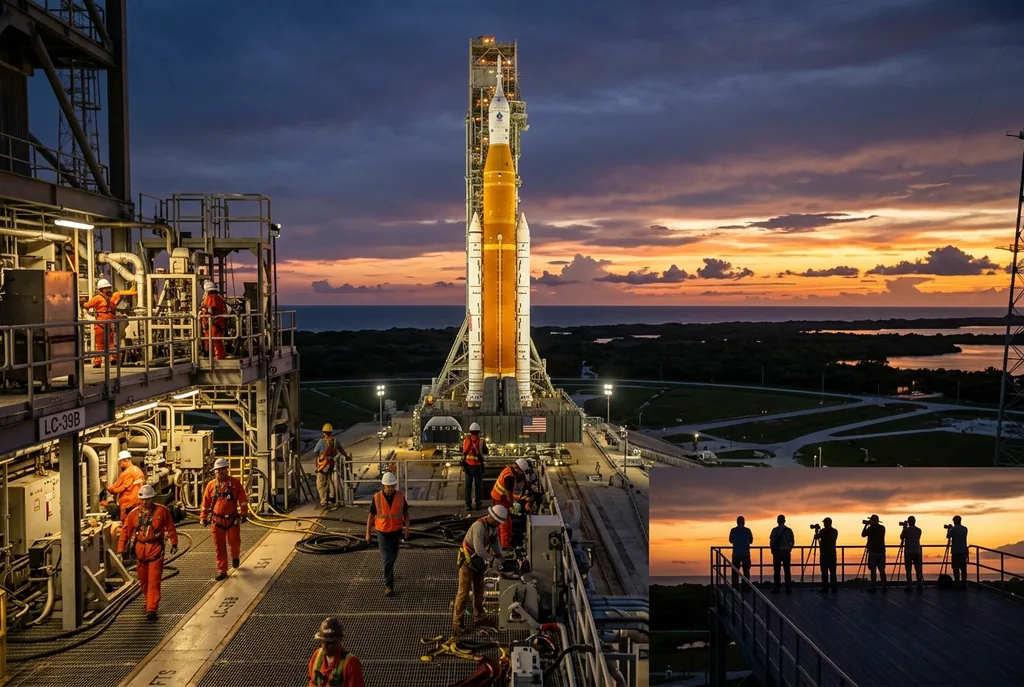
Technicians rolled the SLS back to the pad; four astronauts sat in quarantine — and the clock began to matter.
At Kennedy Space Center the 322-foot Space Launch System and its Orion atop the mobile launcher are back on Launch Complex 39B, technicians still poring over seals and valves after a brief return to the Vehicle Assembly Building. Inside Johnson Space Center the Artemis II crew — Reid Wiseman, Victor Glover, Christina Koch and Canadian Jeremy Hansen — began a two-week quarantine three days ago. As nasa gears artemis launch, those two images — the hardware on the pad and the crew sealed off from the outside world — capture the contradictory pressure NASA faces: the mission is ready enough to set a date, but fragile enough that one anomaly or the Florida weather can change the plan.
That tension is the story for the week ahead. NASA has a targeted liftoff of 6:24 p.m. ET on Wednesday, April 1, with contingency windows through April 6 and another opportunity at the end of the month. The mission will carry astronauts farther from Earth than anyone since Apollo, test crewed operations in deep space, and return Orion to a Pacific splashdown roughly nine days later — all while managers juggle final system checks, a proving ground Wet Dress Rehearsal, and competing launch schedules that touch down on logistics and national-capability trade-offs.
nasa gears artemis launch: the wet dress rehearsal that will decide the get‑go
Back in February, NASA delayed a key fueling rehearsal to avoid running tests in unusually cold conditions; the agency has repeatedly said it prefers the Wet Dress Rehearsal — the full, fueled countdown practice — to be done in conditions resembling a real launch. That rehearsal is the single most consequential event before the official launch call. The test includes loading roughly 700,000 gallons of cryogenic propellant, staging a full-day countdown with the pause where astronauts would board, and running an intentional abort and recovery sequence to exercise how the team handles last‑minute issues.
Launch director Charlie Blackwell‑Thompson has described the wet dress as “the best risk reduction test” available. If the fueling goes smoothly and seals behave under the pressure and temperatures of flow‑up, the path to the April 1 target tightens; if not, NASA shifts to the next available alignment of Earth and Moon — which is not trivial because Artemis II must launch into a specific set of windows tied to orbital mechanics.
Ars Technica reporting laid out another wrinkle: the earlier Artemis I campaign required multiple fueling attempts and root‑cause fixes for hydrogen leaks. Engineers say they’ve adopted a gentler ramping procedure and believe the lessons are in the logbooks, but the agency is rightly cautious. A successful wet dress will be treated as more than a systems check — it will determine whether Artemis II can keep the April cadence or fall into the longer program schedule that affects later lunar landings.
nasa gears artemis launch: crew, cockpit upgrades and real‑time feedback from astronauts
This flight is, at its heart, a test of people working with hardware. The crew of three Americans and one Canadian will not attempt to orbit or land on the Moon; instead, they will use a free‑return trajectory to swing past the Moon and head back to Earth. That profile is intentionally conservative: it exposes Orion and its life‑support systems to the deep‑space environment while preserving a built‑in path home if propulsion issues arise.
One underreported piece of the mission is cockpit software. A Florida company, ENSCO, has its IData display suite installed in Orion’s glass cockpit, allowing mission designers to push new layouts and data elements into mission files rather than rewrite core code. ENSCO’s engineers argue that this reduces the need for costly recertification when the crew requests adjustments — a practical advantage when feedback from astronauts on Artemis II will shape the human‑machine interface for Artemis III and beyond.
That human feedback loop is exactly the point: the astronauts will be the first to tell engineers whether displays and flows work in the cramped, high‑tempo environment of a real deep‑space sortie. The flight is nominally a systems check, but the crew’s impressions will ripple through future cockpit design, timelines for software updates, and the certification regime that governs spacecraft changes.
Schedule friction: why a SpaceX launch matters to Artemis II’s timing
That means a failed or delayed wet dress doesn’t just push Artemis II; it reshuffles other agency flights and commercial cadence too. NASA managers have publicly said they would not like to have a Crew Dragon launch while Orion is in transit because of overlap in recovery and tracking resources. That puts an additional, operationally grounded constraint on the agency’s decision‑making about go/no‑go calls after the rehearsals conclude.
What the mission will — and won’t — do on its lunar swing
Artemis II’s objectives are tightly scoped: demonstrate Orion’s life‑support systems with humans aboard, validate deep‑space communications and navigation with a crew, and exercise operational procedures for multi‑day crewed missions beyond low Earth orbit. The mission will test crew interfaces and will collect data the program needs before more complex flights that include lunar orbit insertion or surface landings.
What it will not do is attempt a landing, or, for the most part, test the lunar Gateway. Artemis II is a shakedown and a human systems experiment — closer in spirit to an extended dress rehearsal than a destination sortie. Even so, the political and programmatic expectations attached to the first crewed lunar flight in more than half a century make each check and each data point consequential.
How to watch and practical lift‑off details
NASA has published a slate of press events and live coverage surrounding the final days and the launch attempt. The official targeted liftoff is 6:24 p.m. ET on April 1, with tanking coverage beginning earlier in the day; the agency has reserved additional windows April 1–6 and a backup on April 30. If you want to follow live, NASA begins coverage hours ahead of launch and will host post‑launch briefings shortly after ascent.
Remember: the launch can be scrubbed for weather or technical reasons. That is not a rhetorical caveat — it’s a standing operational reality that has shaped Artemis II’s timeline since the SLS/Orion stack first rolled to the pad. If you’re lining up viewing plans, expect a day of buildup, a tight launch window, and a post‑splashdown debrief roughly nine to ten days later when Orion returns to the Pacific.
For mission control, engineers, and the four astronauts in quarantine, this week is about proving that the procedural fixes, software tweaks and rehearsals add up to a reliable sequence. For watchers and policymakers, it’s a test of whether NASA can translate the technical promise of Artemis into a cadence of flights that supports a longer program to return humans to the lunar surface.
Sources
- NASA (mission availability chart and press materials for Artemis II)
- Ars Technica (coverage of Wet Dress Rehearsal and SLS fueling operations)
- ENSCO / Lockheed Martin Space (technical briefings on IData integration for Orion)
- Canadian Space Agency (crew assignment and participation details)




Comments
No comments yet. Be the first!