Contract architecture after army awards anduril $20 enterprise contract
The formal agreement is structured as a 10‑year ordering vehicle with a five‑year base period and a five‑year optional extension, and the Army Contracting Command at Aberdeen Proving Ground will administer individual orders under the contract. Officials have described the $20 billion figure as an upper bound or ceiling for the vehicle; the military will buy capabilities against that contract via specific orders, meaning the full amount is not an immediate cash transfer but a total potential value over the decade. The vehicle was framed as a firm‑fixed‑price enterprise contract, a procurement model that centralises multiple programs and gives the Army a streamlined path to place task orders for software, hardware, sustainment and services as needs emerge.
Practically, the contract consolidates more than 120 prior procurement actions that purchased components of Anduril’s commercial solutions. That consolidation aims to remove repeated administrative steps—separate solicitations, multiple award processes and bespoke integration projects—so the Army can deliver software updates and new functionality more quickly. At the same time, the ordering structure preserves per‑order oversight: each delivery, deployment and expenditure will still be authorised through individual task orders issued under the enterprise vehicle.
Operational uses after army awards anduril $20 enterprise contract
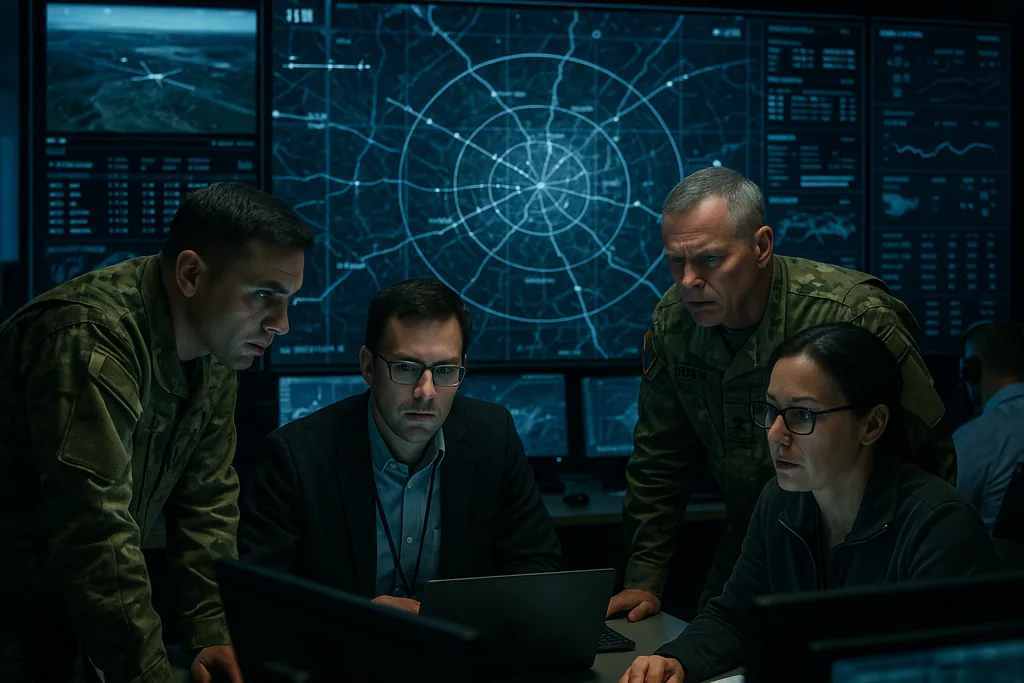
The centrepiece of the agreement is Anduril’s Lattice suite: an open‑architecture, AI‑enabled command‑and‑control platform that fuses sensor feeds, applies machine‑vision and machine‑learning models, and presents a common operating picture to commanders. The Army and the Joint Interagency Task Force 401 emphasised counter‑unmanned aerial systems (C‑UAS) as an immediate priority: Lattice can ingest data from radars, electro‑optical sensors, persistent towers and aerial platforms, run automated detection and tracking, and push prioritised alerts to units and federal partners.
In operational terms, the contract is meant to make identification and attribution timelines shorter—turning a scatter of disconnected sensors into a multilayered, interoperable network where threats can be detected, tracked and routed to a response chain in seconds rather than minutes. Army officials have framed the arrangement as enabling “common air domain awareness” so that warfighters, federal agents and other partners can share validated tracks and coordinate counter‑drone responses without custom point‑to‑point integrations for every sensor type.
Procurement consolidation and the industry shift
Few previous awards have bundled such a broad set of commercial software, sensors and services under one startup. The decision reflects a larger Pentagon trend: treating software platforms as infrastructure rather than purchasing individual capabilities as one‑off systems. Supporters say this model better matches how modern software is developed and updated—continuously, with short release cycles—versus the multi‑year hardware procurement cadence traditional prime contractors use.
For Anduril, a vertically integrated company that designs hardware and writes the software that runs it, the contract legitimises a model where a single supplier provides end‑to‑end solutions. That gives the Army predictable access to upgrades and simplifies interoperability work. For incumbent primes, the award represents competitive pressure to adapt: enterprise platforms and rapid update cycles favour firms that natively operate like software companies.
Who is Anduril and why the Army awarded the contract
Anduril was founded to build autonomous systems, sensor networks and the software that connects them; its Lattice platform grew out of that mission. Army officials and acquisition documents say the company’s product suite—software, Sentry‑style towers, unmanned aircraft and other integrated hardware—fits the immediate operational requirement to heighten air‑domain awareness and counter improvised and massed unmanned aerial threats. The Army’s rationale, in short, was speed and interoperability: a single enterprise vehicle removes friction and lets the service place orders for proven commercial capabilities when and where they are needed.
That rationale also reflects a political and operational context where rapid, software‑driven upgrades can deliver tangible battlefield effects—particularly in counter‑drone environments where a new detection algorithm or command‑and‑control workflow can materially change performance. The award therefore recognises both the technical architecture Anduril has built and the service’s determination to prioritise faster delivery of software‑defined capabilities.
Risks, oversight and governance
The scale and structure of the deal raise predictable governance questions. Concentrating capabilities with a single private supplier can improve integration but also concentrates risk: software errors, supplier financial problems, or misconfigurations could cascade across many units and agencies. Firm‑fixed‑price ordering and per‑order oversight mitigate some of that risk, but they do not remove the need for robust independent testing, red‑team evaluation of algorithms, and continuous security audits of supply chains and cloud infrastructure.
There are also policy questions about algorithmic transparency and operational rules: automated classification and prioritisation systems must be auditable and tuneable to avoid misidentifying civilian traffic or making bad tactical judgements. Interagency data sharing—one of the contract’s stated goals—will need clear legal, privacy and security safeguards so that sensor fusion does not create unintended exposures of sensitive information or give adversaries new signals to exploit.
What this means for military AI and future buying models
If the enterprise vehicle succeeds, the Army’s approach could become a template across the Department of Defense: centralised enterprise contracts for platform‑level software with a roster of ordering authorities and pre‑qualified tasking. That would accelerate the adoption of AI‑enabled capabilities and change industrial practices, drawing more commercial capital and talent toward defence software startups and increasing the pace of innovation inside the Pentagon. It could also change how operational requirements are written and how lifecycle sustainment is budgeted, emphasising frequent updates over long‑lead hardware refreshes.
But the long arc will depend on how well the Army balances speed with scrutiny. Effective checkpoints—independent testing, incremental operational acceptance, and open interfaces that permit competition at the module level—will determine whether a single enterprise vehicle yields faster, safer capability delivery or creates new single‑point failures in national defence procurement. For now, the army awards anduril $20 headline is a statement of intent: the service has chosen a software‑first path and a single platform provider to start walking it.
For soldiers and policymakers alike, the question is no longer whether the military should use AI and autonomous systems; it is how to buy, govern and oversee them at the speed the technology enables while managing the new forms of concentration and risk that approach brings.
Sources
- U.S. Army
- U.S. Department of Defense (Office of the Chief Information Officer statements)
- Joint Interagency Task Force 401 (counter‑UAS tasking and acquisition statements)
- Army Contracting Command, Aberdeen Proving Ground (contract vehicle administration)
- Anduril Industries (company product and press materials)




Comments
No comments yet. Be the first!