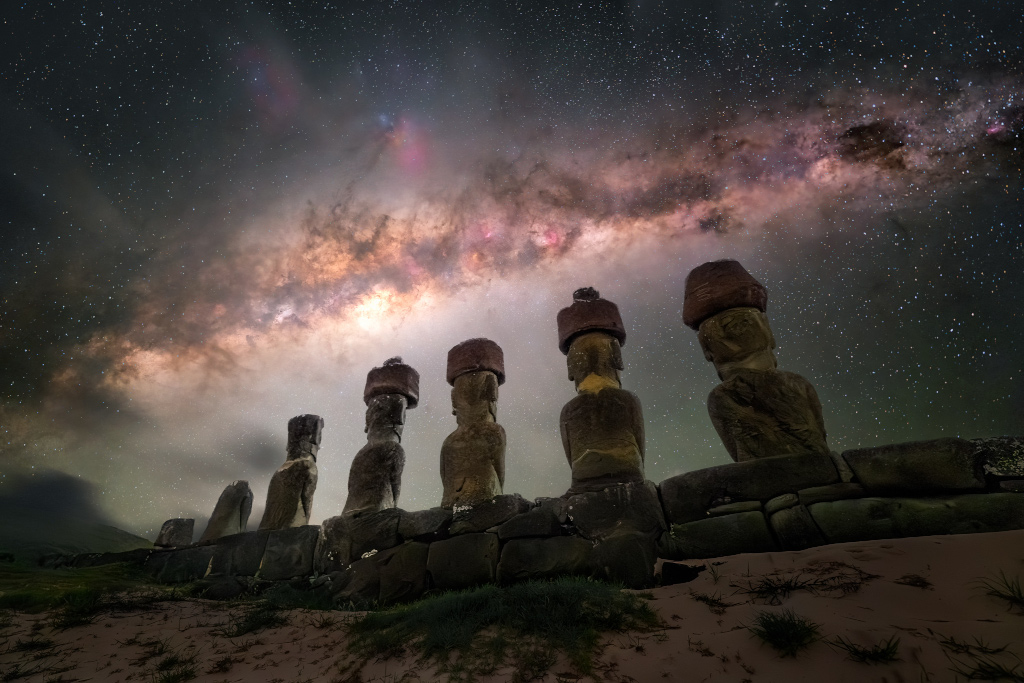
Ahu Tongariki is the largest ceremonial platform on Rapa Nui, featuring 15 restored mo'ai statues that represent the most significant megalithic monument in all of Polynesia. This site served as the sociopolitical and religious epicenter for the Hotu Iti clan, with historical occupation dating back to approximately 900 AD. The statues stand as silent guardians over the island’s heritage, having survived civil unrest and a devastating 1960 tsunami before being meticulously restored in the 1990s.
The Sentinel Statues of Ahu Tongariki
The physical significance of the 15 mo'ai at Ahu Tongariki lies in their scale and the engineering prowess required to transport them across volcanic terrain. These larger-than-life figures were carved from tuff, a compressed volcanic ash, and the largest among them weighs a staggering 86 tons. Their presence at the edge of the Pacific Ocean serves as a testament to the complex social hierarchy and ancestral reverence that defined the culture of Rapa Nui for centuries.
Historical narratives of Rapa Nui are etched into the very placement of these stone sentinels along the coastline. While the island was annexed by Chile in 1888, the indigenous history of the site remains its most compelling feature. The statues were originally toppled during internal tribal conflicts and later scattered by a massive tsunami in 1960. It was not until a collaborative international effort in the 1990s—notably involving Japanese crane manufacturers and archaeologists—that the mo'ai were returned to their upright positions on the platform (ahu), restoring the site's spiritual and visual gravity.
The remote Pacific location of Rapa Nui provides a unique atmospheric canvas that makes it a world-class site for astrophotography. Because the island is situated thousands of kilometers from the South American coast, it is shielded from the "sky glow" of major metropolitan areas. This lack of light pollution allows the Milky Way to appear with startling vividness. Photographers, such as Rositsa Dimitrova, whose work was recently featured by NASA, capture the statues with their backs to the dark ocean, gazing toward a sky thick with interstellar dust and distant starlight.
How did ancient Polynesians use the stars for navigation?
Ancient Polynesians utilized a sophisticated system of celestial wayfinding, tracking "star paths" or specific rising and setting points of constellations to maintain headings across open water. By memorizing the positions of the stars relative to the horizon, navigators could guide their voyaging canoes across the Pacific with mathematical precision. This non-instrument navigation relied on a deep, generational knowledge of the celestial sphere and its seasonal shifts.
Stellar navigation was not merely a survival skill but a rigorous scientific discipline integrated into the fabric of Rapa Nui society. Navigators identified "zenith stars" that passed directly over specific islands, allowing them to pinpoint their latitude without the need for modern tools. This archaeoastronomy provided the foundation for the expansion of Polynesian culture across the "Polynesian Triangle," enabling travel between distant landmasses like Hawaii, New Zealand, and Rapa Nui through the careful observation of the Milky Way and other prominent constellations.
The cultural role of astronomical alignment extended beyond travel to the calibration of the annual calendar and ceremonial timing. Evidence suggests that many ahu sites were constructed with specific celestial orientations in mind, such as the rising of the Pleiades or the solstices. These alignments signaled the beginning of new seasons, the timing of agricultural cycles, and the commencement of sacred festivals. The statues of Ahu Tongariki, while primarily facing inland to watch over the community, exist within a landscape that was essentially a giant, outdoor observatory used for the maintenance of civil and religious life.
Why is Rapa Nui considered a prime location for dark sky observation?
Rapa Nui is considered a prime location for dark sky observation due to its extreme geographical isolation, which creates some of the lowest levels of light pollution on Earth. Its position in the middle of the Pacific Ocean ensures that the atmosphere is exceptionally clear and stable. This provides astronomers and photographers with an unobstructed view of the Milky Way and other deep-space phenomena that are often invisible from continental locations.
Dark sky preservation on Rapa Nui is increasingly recognized as a vital effort to protect both scientific clarity and indigenous cultural history. Modern photography, such as the images highlighted by NASA, serves as a digital record of this pristine environment. As astrophotographer Rositsa Dimitrova observed, these "silent sentinels" have watched the heavens for generations, and maintaining the darkness of those skies is essential for future generations to connect with the same celestial landscape that guided their ancestors. Protection of the night sky prevents the erasure of the visual heritage that inspired the island's unique mo'ai craftsmanship.
The future of Rapa Nui involves a delicate balance between welcoming global tourism and preserving its archaeological integrity. Researchers continue to study the chemical composition of the volcanic stone and the environmental factors that threaten the statues' longevity. By integrating modern dark sky preservation techniques with traditional land management, the island serves as a global model for heritage conservation. These efforts ensure that the mo'ai will continue to stand under a vibrant Milky Way, serving as a bridge between the ancient Polynesian past and a future dedicated to scientific and cultural discovery.
Key Metrics and Observations:
- Site Importance: Ahu Tongariki contains 15 mo'ai, the largest number on a single platform.
- Weight Record: The heaviest statue at the site weighs approximately 86 tons.
- Scientific Recognition: Featured by NASA as an Astronomy Picture of the Day (APOD) for its unique intersection of archaeology and astronomy.
- Geographic Isolation: Located approximately 3,700 kilometers off the coast of Chile.




Comments
No comments yet. Be the first!