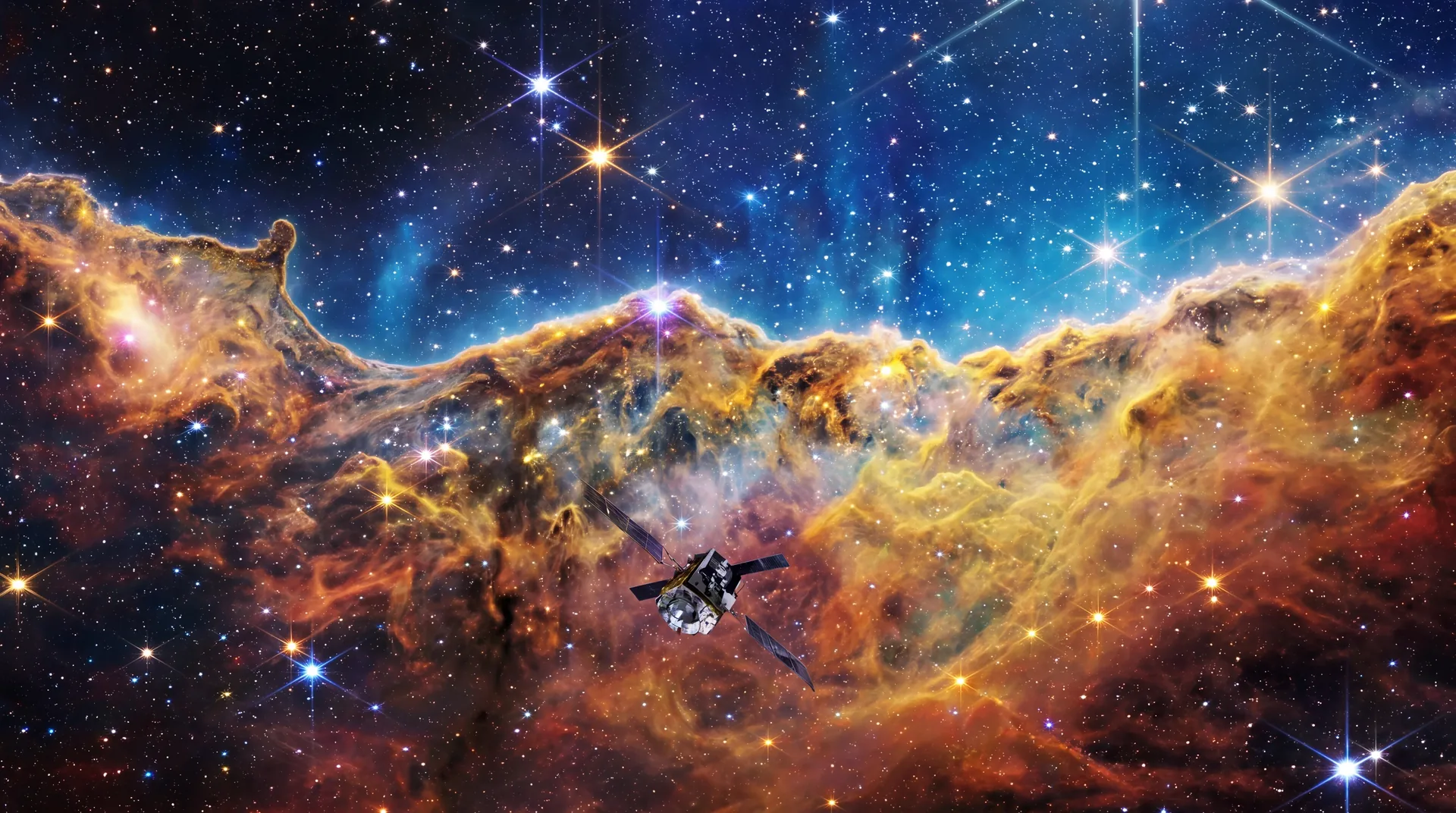

Astrophysicists have a massive problem on their hands: the cosmos is expanding at the wrong speed. When scientists measure the expansion rate of the early universe, the numbers simply do not line up with what they observe in the modern era.
Either our maths is fundamentally flawed, or there is an unseen, dynamic force actively stretching the fabric of space-time out of shape. To figure out which it is, NASA is sending a massive optical instrument to a parking spot one million miles from Earth.
Slated to launch on a SpaceX Falcon Heavy rocket by April 2026, the Nancy Grace Roman Space Telescope is built to map the positions of hundreds of millions of galaxies. If it finds what mission scientists suspect it might, we are looking at a mandatory rewrite of the laws of physics.
A crisis in the cosmic expansion rate
The core tension lies in a metric called the Hubble constant. It is supposed to tell us exactly how fast the universe is pushing itself apart, but the existing data refuses to cooperate.
Julie McEnery, Roman’s Senior Project Scientist at NASA, points out that the telescope is specifically designed to investigate this glaring mismatch. By mapping the cosmic web over billions of years, Roman will track whether dark energy is a static background force or a dynamic field that shifts over time.
To pull this off, the observatory relies on a 2.4-meter primary mirror. That is exactly the same size as the one inside the venerable Hubble telescope. However, Roman is equipped with a Wide Field Instrument that captures a view 100 times larger than Hubble’s infrared camera in a single shot.
Instead of staring at a tiny patch of black, Roman will conduct a massive galactic census. It will track the subtle stretching of space-time by cataloguing the movements of billions of stars and monitoring Type Ia supernovae.
The sniper and the surveyor
NASA already has a massive infrared telescope sitting at the Sun-Earth L2 Lagrange point: the James Webb Space Telescope. But the two machines are built for entirely different jobs.
Agency officials describe Webb as a sniper and Roman as a surveyor. Webb peers back to the first light of the universe to capture minute details in an incredibly narrow field. Roman will cast a massive net, finding the rare objects and primordial galaxies that Webb can then examine up close.
Because it covers so much sky so quickly, Roman will generate an immense volume of data. Jamie Dunn, the project manager at NASA’s Goddard Space Flight Center, notes the telescope will essentially beam back a continuous, high-definition movie of the deep universe.
Blocking a billion-to-one glare
Beyond mapping dark energy, Roman is designed to hunt for rocky, Earth-mass worlds. It will achieve this using gravitational microlensing, a quirk of physics where the gravity of a foreground star acts as a massive magnifying glass for the light of a star far behind it.
If a planet happens to be orbiting that foreground star, it creates a tiny, characteristic blip in the light. This lets astronomers spot planets orbiting at distances similar to our own solar system—a massive blind spot in current exoplanet catalogues.
The telescope is also carrying a highly experimental coronagraph. The instrument is engineered to physically block out the glare of a host star by a factor of one billion, exposing the incredibly faint reflected light of orbiting gas giants.
If the coronagraph works, it will serve as the vital proof-of-concept for the upcoming Habitable Worlds Observatory, a future mission tasked with finding chemical signs of life on distant exoplanets.
Beating the flagship curse
Large-scale space observatories are notoriously plagued by decades of delays and billions in cost overruns. Yet, Roman is currently on track to hit its launch window ahead of schedule.
Nicky Fox, head of NASA's Science Mission Directorate, credits a strict design-to-cost approach and consistent funding for avoiding the usual developmental nightmares that plague flagship builds.
The mission owes its name to Nancy Grace Roman, NASA’s first Chief of Astronomy. Widely known as the "Mother of Hubble," she spent the 1960s and 70s fighting to get the first large telescopes off the ground. Fifty years later, a telescope bearing her name might just figure out what the universe is actually made of.
Sources
- NASA Goddard Space Flight Center
- NASA Science Mission Directorate





Comments
No comments yet. Be the first!