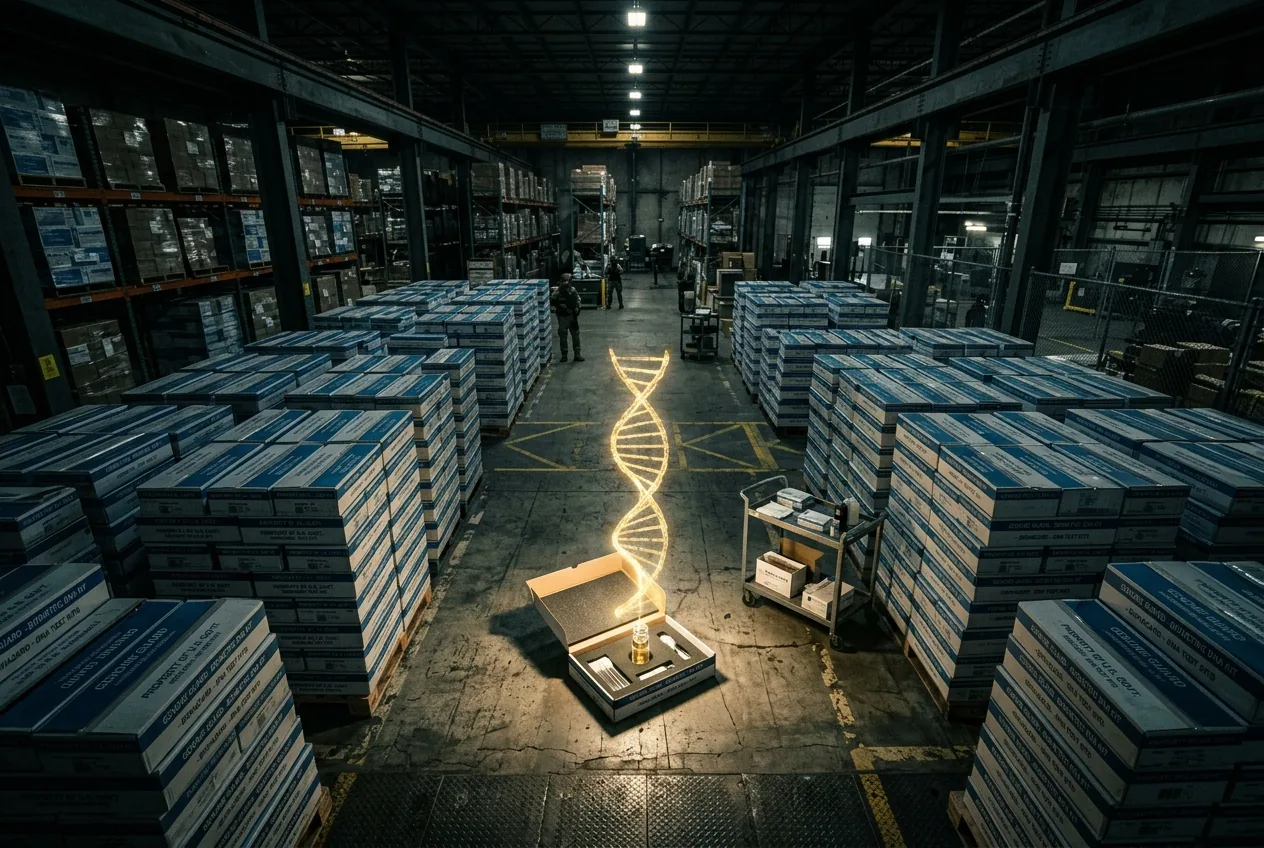
In the refrigerated archives of consumer genomics firms like 23andMe and , the biological blueprints of over 40 million people are stored as digital code. For most contributors, these sequences represent a search for a lost great-grandfather or a predisposition to late-onset Alzheimer’s. But according to a series of extraordinary claims surfacing from the fringes of the intelligence community, the Central Intelligence Agency viewed these databases not as genealogical tools, but as a planetary-scale dragnet for what they termed “genetic variances” linked to non-human origins.
The allegation, which first gained traction through testimony from Dr. Jason Reza Jorjani on the American Alchemy podcast, posits that the CIA sought and obtained backdoor access to these private repositories. The objective was allegedly to identify a specific subset of the population: individuals carrying markers of the so-called "Nordics," a hypothesized race of extraterrestrials that—according to long-standing but unverified lore—have integrated into human societies, particularly in remote areas like the Colorado Rockies. While the premise sounds like a discarded script from the mid-nineties, the structural vulnerabilities of DNA databases and the agency's historical interest in unconventional biology lend the story a disturbing, if speculative, weight.
This development comes at a moment of extreme fragility for the consumer genomics industry. With 23andMe facing a collapsing stock price and the potential sale of its massive data library, the question of who might eventually hold the keys to this information has shifted from a theoretical privacy concern to an urgent matter of national security and bioethics. If an intelligence agency can indeed bypass the legal firewalls of a private corporation to screen for "alien" markers, it suggests a precedent where any genetic signature—be it for dissent, susceptibility to pathogens, or perceived "otherness"—is fair game for state surveillance.
The Kit Green Paradox and the Timeline of Surveillance
Central to the whistleblower claims is the figure of Christopher “Kit” Green, a former CIA analyst with a storied, often controversial history in the agency’s Life Sciences division and its Remote Viewing Program during the 1970s and 80s. The narrative provided by Jorjani—citing information from Army veteran Lyn Buchanan—suggests that Green developed the methodology for screening these databases for specific extraterrestrial signatures. However, the timeline presents a significant analytical hurdle: Green left the CIA years before 23andMe or Ancestry were even founded, let alone before they reached the scale required for a meaningful population-wide search.
From a reporting perspective, this contradiction suggests one of two things: either the program is a legacy initiative passed down to a new generation of analysts using Green’s theoretical framework, or the story is a conflation of the agency’s very real interest in "anomalous health incidents" with the speculative world of exobiology. Green has, in more recent years, published papers on the clinical effects of UAP (Unidentified Anomalous Phenomena) encounters on human tissue, particularly brain scans of pilots. Moving from scanning the brains of military personnel to scanning the saliva of millions of civilians is a massive escalation in scope, one that would require a level of computational access that DNA companies vehemently deny exists.
The institutional friction here is palpable. While the CIA has historically operated with a "collect it all" mandate regarding signals intelligence (SIGINT), biological intelligence (BIOINT) is a far messier field. To search for a "genetic variance" that identifies a non-human hybrid, one would first need a reference genome—a baseline of what “alien DNA” actually looks like. In the absence of a publicly acknowledged extraterrestrial specimen, the agency would essentially be searching for “genetic noise” or orphans in the code that don't match known human haplogroups, a process that would yield thousands of false positives among Earth’s own highly diverse and under-sequenced populations.
The Myth of the Nordic Marker and the Colorado Cluster
The specific mention of the "Nordic" phenotype—tall, blonde, blue-eyed individuals allegedly residing in the Colorado Rockies—introduces a troubling element of genetic determinism into the conversation. In the realm of professional genetics, the idea that a specific set of visible traits (phenotypes) could reliably mask an extraterrestrial genotype is a biological non-starter. Human variation is vast; the genes responsible for light pigmentation and height are well-mapped and firmly rooted in terrestrial evolutionary history, specifically in the selective pressures of Northern Europe during the Holocene.
Why, then, would an intelligence agency focus on such a specific, almost folkloric group? If we look past the sci-fi window dressing, the "Colorado Rockies" detail points to a more grounded reality of surveillance. The region is home to a high concentration of aerospace contractors, military installations (including NORAD and Cheyenne Mountain), and a culture of deep-state skepticism. If the CIA were monitoring DNA in this region, it might have less to do with hunting aliens and more to do with the genetic surveillance of a specific workforce or a population exposed to experimental technologies. In this light, the "Nordic" claim acts as a high-strangeness cover for more traditional, if equally invasive, counterintelligence efforts.
The trade-off between privacy and perceived security is nowhere more lopsided than in the realm of genomics. When a user signs a consent form for a DNA kit, they are agreeing to let a company hold their most intimate data. They are not, however, agreeing to have that data cross-referenced against an agency’s classified list of "biological anomalies." The lack of transparency regarding how the CIA or the FBI interacts with these databases creates a vacuum where even the most outlandish claims can take root, simply because there is no mechanism to independently verify that a backdoor doesn't exist.
Regulatory Blind Spots in the Genomic Marketplace
The institutional response to these allegations has been a predictable mixture of silence and boilerplate denials. The FDA and the FTC, which oversee the accuracy and marketing of DNA tests, have little to no oversight over how the resulting data is handled once it enters the sphere of national security. Current US law, specifically the Genetic Information Nondiscrimination Act (GINA), protects citizens from being penalized by employers or insurers based on their DNA, but it offers no protection against the government using that data for “investigatory” purposes.
Comparing the US approach to the EU’s GDPR reveals a stark contrast. In Europe, genetic data is classified as a "special category" of personal information with much higher barriers to state access. In the US, it is treated more like a digital asset, subject to the whims of the market and the broad reach of the Patriot Act. If the CIA wanted to screen 23andMe’s database, they might not even need a secret backdoor; a National Security Letter (NSL) could theoretically suffice, accompanied by a gag order that would prevent the company from ever disclosing the intrusion.
The High Cost of Biological Uncertainty
The CIA’s alleged hunt for Nordics in the Rockies might be a fever dream of the contemporary UFO movement, or it might be a distorted echo of a very real, very classified interest in the limits of human biology. What is certain is that the tools for such a search are now widely available, and the legal safeguards to prevent them are remarkably thin. In the end, the most unsettling part of the whistleblower’s story isn’t the idea that aliens are living among us, but the realization that our most private biological information is now just another dataset to be mined, modeled, and potentially weaponized by those we never authorized to see it.
The genome is precise; the world it lives in is anything but. We are rapidly approaching a future where your ancestry report might tell you where you came from, but only the agency in the basement knows exactly what they think you are.




Comments
No comments yet. Be the first!