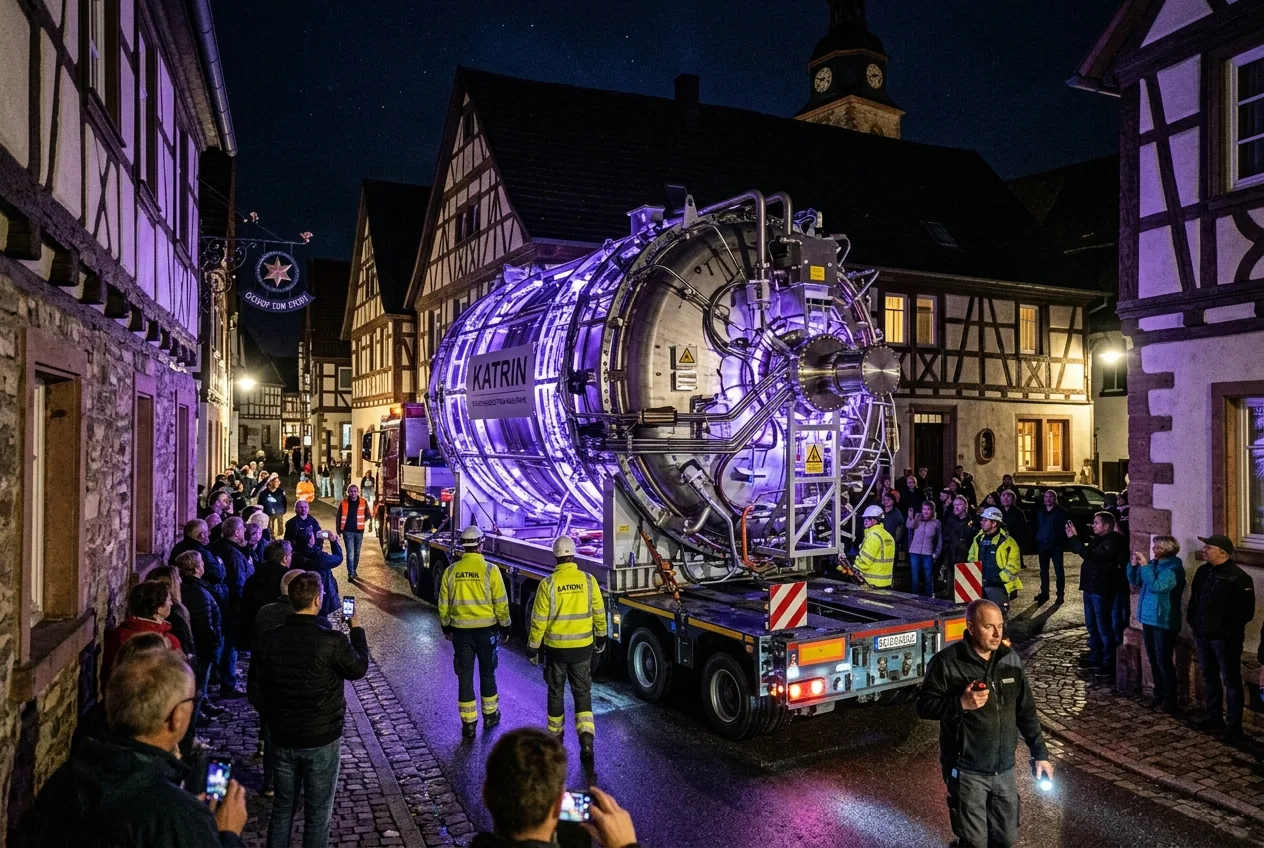
In 2008, a 200-tonne steel cylinder roughly the size of a blue whale was squeezed through the narrow, timber-framed streets of Leopoldshafen, Germany. The main spectrometer for the Karlsruhe Tritium Neutrino (KATRIN) experiment had only five centimeters of clearance from the village’s houses. It was a masterpiece of logistics for a machine designed to measure something that might not even have a mass: the neutrino. Nearly two decades later, that same hardware is being leveraged to hunt for something even more elusive than a "ghost particle." It is looking for a door to a fifth dimension.
The motivation for this search is not a sudden interest in science fiction, but a looming crisis in the Standard Model of physics. We live in a four-dimensional world—three of space, one of time—yet the math governing our universe refuses to stay within those bounds. From the labs in Baden-Württemberg to the theoretical halls of Istanbul University, a consensus is forming: if we want to understand why gravity is so weak or where dark matter is hiding, we have to accept that our four-dimensional reality is merely a thin membrane stretched over a much deeper, more complex bulk.
The Ricci Scalar and the Geometry of Collapse
When spacetime is crushed to the densities found in the earliest microseconds of the Big Bang, or within the heart of a neutron star, the traditional four-dimensional geometry of Albert Einstein begins to stutter. A recent framework proposed by Lina Yıldız, Deha Kaykı, and Ertan Güdekli at Istanbul University suggests that dimensionality itself isn't a fixed constant, but a dynamic property that responds to curvature. They utilize the Ricci scalar—a mathematical tool that measures how much a specific region of spacetime differs from a flat plane—to show that in high-curvature environments, the universe effectively "unfolds" into higher dimensions.
This isn't just a mathematical trick to balance an equation. It represents a fundamental shift in how we view the vacuum. In the Istanbul model, the extra dimensions are "effective," meaning they manifest as a result of the extreme energy densities. For an engineer, this is an exercise in scale: at the macro level, a garden hose looks like a one-dimensional line; zoom in, and you realize it is a three-dimensional cylinder. The Turkish team suggests the universe does the same thing, but instead of physical zooming, it is the intensity of gravity that reveals the hidden structure. Their model fits within the broader "scalar-tensor" theory, which is a favorite among European researchers looking to extend General Relativity without resorting to the more exotic, and often untestable, versions of String Theory.
The trade-off here is one of simplicity versus utility. Adding a fifth dimension solves the "hierarchy problem"—the confusing fact that a tiny refrigerator magnet can overcome the gravitational pull of the entire Earth. If gravity is leaking into a fifth dimension, its weakness in our four-dimensional world finally makes sense. However, every dimension added increases the complexity of the math exponentially. Brussels and the various national funding bodies, like the German Research Foundation (DFG), have historically been cautious about funding purely theoretical "dimension-hunting" unless it can be tied to experimental reality. That is where the hardware in Karlsruhe comes in.
Why Karlsruhe Is Looking for Right-Handed Neutrinos
The KATRIN experiment is currently the world’s most sensitive scale for weighing neutrinos. These particles are so light that for decades we thought they were massless. We now know they have a tiny amount of mass, but we don't know why. One leading theory suggests the existence of "right-handed" neutrinos—partners to the particles we already know, but which don't interact with the weak nuclear force. These hypothetical particles are the perfect candidates for a "dark dimension."
If these right-handed neutrinos exist, they could be storing their mass in a hidden spatial dimension that is roughly one micron in size. In the context of subatomic physics, a micron is cavernous. If the KATRIN data shows a specific anomaly in the energy spectrum of tritium decay, it would be the first empirical evidence that particles are "leaking" into a space we cannot see. This would turn the Karlsruhe spectrometer from a simple weighing machine into a probe for the structure of the cosmos itself. The engineering challenge is immense: keeping the entire 70-meter-long apparatus at temperatures near absolute zero while maintaining a vacuum as pristine as the space between stars.
There is an industrial-policy irony here. While the European Space Agency (ESA) and the EU’s Chips Act focus on the tangible—satellites and silicon—the fundamental physics that could rewrite our understanding of energy and matter often survives on the margins of large-scale infrastructure projects. KATRIN was built to measure neutrino mass, but its most profound legacy might be proving that the ground we stand on has more than three directions. If the "dark dimension" theory holds, dark matter isn't a particle we haven't found yet; it's just regular gravity from a higher dimension felt through the veil of our limited perception.
The Portal in the Fermion
Another compelling piece of the puzzle comes from a joint Spanish-German study that posits a "portal" particle. This theory suggests that a new type of fermion—a category of particles that includes electrons and quarks—could act as a bridge between the Standard Model and the fifth dimension. Unlike the Istanbul model, which treats dimensions as a result of curvature, this approach treats the fifth dimension as a persistent feature of the universe, hidden by a warp in spacetime.
The researchers argue that this portal particle would explain the abundance of dark matter without requiring the complex "WIMP" (Weakly Interacting Massive Particle) models that have failed to turn up in detectors like the Large Hadron Collider (LHC). From a procurement perspective, this is a significant pivot. For twenty years, the physics community has bet heavily on finding new particles within the four dimensions we know. The failure to find them has left a multi-billion-euro hole in our understanding of the universe. Investing in five-dimensional models is, in many ways, a strategic hedge against the limitations of current collider technology.
The European approach to this has been characteristically methodical. While US-based theorists often chase "multiverse" narratives that make for good television, the collaboration between institutions in Granada and Mainz has stayed focused on the "hierarchy problem." They are asking why the Higgs boson—the particle that gives everything else mass—is so light. Their answer is that the fifth dimension acts as a sort of gravitational stabilizer. It’s an elegant solution, but it requires a level of mathematical precision that pushes the limits of modern supercomputing. This is where Germany’s investment in quantum computing and high-performance clusters (like the Juwels system in Jülich) becomes relevant. You can't simulate a five-dimensional portal on a standard workstation.
The Bureaucracy of the Infinite
What makes the current hunt for extra dimensions different from the string theory hype of the 1990s is the emergence of "testable" math. We are no longer talking about dimensions so small they can never be seen. The "Dark Dimension" model, which has gained traction in both European and American circles, suggests that at least one extra dimension must be relatively large—somewhere between one and ten microns. This puts it within the reach of next-generation gravity experiments.
In laboratories across the EU, researchers are now building tabletop experiments to measure the "Inverse Square Law" of gravity at micrometer scales. If gravity starts to behave strangely at those distances, it’s a smoking gun. However, this type of research often falls through the cracks of EU funding structures. It’s not quite "applied science," so it misses the industrial grants, and it’s too "fringe" for some of the more conservative fundamental physics buckets. The result is a fragmented landscape where the best work is often done by small, cross-border teams operating on shoe-string budgets compared to the behemoth projects like the LHC.
There is also the matter of international competition. While the US has traditionally dominated theoretical physics, the move toward experimental verification of higher dimensions is a field where Europe’s strength in precision engineering and long-term infrastructure (like the KATRIN experiment) gives it an edge. The question is whether the administrative burden of European research—the endless reporting cycles and the requirement for "societal impact"—will stifle the kind of blue-sky thinking required to conceptualize a five-dimensional universe.
The reality is that the fifth dimension is likely there, whether we can afford to prove it or not. The math of the early universe doesn't work without it, and the mystery of dark matter is reaching a breaking point. We are currently in a state of "mathematical necessity," where we are forced to invent new dimensions just to keep our existing laws of physics from collapsing under the weight of their own contradictions. It is a classic engineering workaround: when the system is too crowded, you build upward.
Europe has the sensors and the theorists to find the door. Now it just needs to decide if it's willing to pay for the key. For now, the hunt continues in the quiet labs of Karlsruhe and the chalk-dusty offices of Istanbul. We are looking for a hole in the world, a gap in the four-dimensional fence that lets us see the rest of the yard. It is progress, of the kind that doesn't fit on a slide deck but might just explain why the universe exists at all. Brussels will eventually provide the funding, provided the researchers can prove the fifth dimension complies with the GDPR.




Comments
No comments yet. Be the first!