X‑ray map reveals interstellar 'tunnel' in our neighborhood
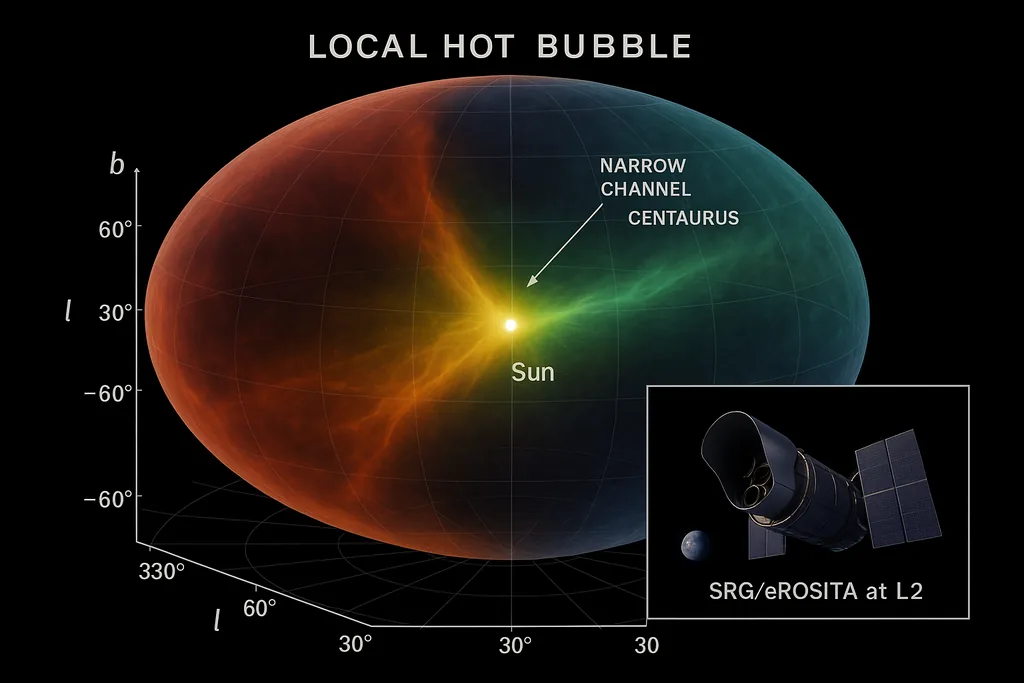
On 29 October 2024 a team led from the Max‑Planck Institute for Extraterrestrial Physics published a detailed X‑ray study that redraws the immediate galactic environment around the Sun. Using the first all‑sky pass of the SRG/eROSITA telescope, the authors produced a three‑dimensional model of the Local Hot Bubble (LHB) and identified narrow, low‑density corridors of million‑degree plasma — described in the paper as "tunnels" — including a prominent channel pointing toward the constellation Centaurus. The result is not a sci‑fi shortcut but a clearer, higher‑resolution view of how supernovae and stellar winds have scoured cavities and linked them across hundreds of light‑years.
Mapping the Local Hot Bubble
The Local Hot Bubble is the region of tenuous, X‑ray emitting gas that surrounds the Solar System. It was proposed in the 1970s to explain a soft X‑ray glow detected across the sky: the idea is that ancient supernova explosions and powerful stellar winds evacuated and heated the nearby interstellar medium, creating a cavity tens to a few hundred parsecs across. The new study leverages eROSITA’s soft X‑ray sensitivity and the mission’s vantage point at Sun–Earth L2 to assemble a spatially resolved map of the bubble’s emission measure and temperature. That dataset lets the team separate the hot plasma signal from foreground contaminants and build a 3D model of the bubble’s shape and internal structure.
Crucially, eROSITA observes the sky from outside the Earth’s exosphere and completed its first full sky survey close to solar minimum — conditions that reduce contamination from solar wind charge exchange and make the soft X‑ray background easier to interpret. That cleaner view is what allowed the authors to identify fine structure within the LHB that previous surveys could only hint at.
When the paper refers to an "interstellar tunnel" it does not mean a physical passage that could carry spacecraft or signals beyond the speed of light. Instead, the term describes a narrow region where cooler, denser interstellar material is missing and replaced by hotter, lower‑density plasma. In the X‑ray maps these regions appear as coherent channels of enhanced emission measure and higher temperature. One such feature aligns with coordinates roughly (l, b) ≈ (315°, 25°) on the sky and points toward Centaurus; another lines up with the previously known β Canis Majoris tunnel. These channels are best interpreted as the fingerprints of past energetic events — supernovae, collective winds from stellar clusters, or blow‑outs from neighbouring superbubbles — that punched holes in the colder phases of the interstellar medium.
How these structures form and evolve
Stellar feedback sculpts the interstellar medium. When massive stars reach the end of their lives they explode as supernovae, releasing vast kinetic energy that sweeps up surrounding gas into expanding shells and evacuates hot interiors. If several explosions occur in a region or if winds from young, massive clusters act together, the evacuated volumes can grow into superbubbles hundreds of light‑years across. Over time, overlapping bubbles, asymmetric explosions, and density gradients in the surrounding medium produce channels and blow‑outs where hot gas finds pathways to escape. The eROSITA map adds a new observational layer by showing that some of these pathways are relatively narrow, coherent, and long‑ranging.
Because the mapped tunnels are filled with plasma at temperatures of order 10^6 K, they are bright in soft X‑rays but nearly invisible at optical wavelengths; conversely, dust and cold gas maps, plus absorption line datasets, are critical to pin down where the hot gas has displaced colder components. The paper’s authors combined their eROSITA X‑ray analysis with existing 3D dust maps and catalogues of supernova remnants and superbubbles to place the features in a broader structural context.
Why this matters for astronomy and the Solar System
First, the map refines our picture of the immediate galactic neighbourhood. Knowing the geometry and pressure of the LHB affects models of cosmic‑ray transport, the penetration of interstellar gas into the heliosphere, and the interpretation of diffuse X‑ray and ultraviolet backgrounds. Second, the discovery of connecting channels supports an older theoretical picture in which the interstellar medium is not a homogeneous fog but a foamy network of bubbles linked by tunnels and chimneys that ferry hot gas between scales. The eROSITA results give this picture empirical weight by resolving previously blended structures and quantifying temperature variations across the bubble.
Finally, a clearer map helps plan follow‑up observations. Targeted distance measurements — for example from absorption lines against background stars or from parallax‑calibrated dust maps — will determine whether a given X‑ray feature lies a few tens of parsecs away or is part of a more distant superbubble. That is essential to decide whether a channel is a local corridor or a chance alignment of unrelated distant structures. The authors themselves flag the Centaurus region as one that needs dedicated spectral and distance analyses to disentangle overlapping emission.
Separating headlines from physics
Popular coverage of the paper sometimes used vivid metaphors — "tunnel" or even "interstellar highway" — and that invited speculative leaps about interstellar travel or wormholes. Those ideas are not supported by the observations. Traversable wormholes remain speculative theoretical constructs that require exotic physics not evidenced by X‑ray maps; the eROSITA tunnels are macroscopic, thermal features of the interstellar medium created by ordinary astrophysical processes. Responsible reporting therefore needs to keep the metaphorical language and the physics distinct.
What comes next
Sources
- Astronomy & Astrophysics (Yeung et al., "The SRG/eROSITA diffuse soft X‑ray background — I. The local hot bubble in the western Galactic hemisphere").
- Max‑Planck‑Institute for Extraterrestrial Physics (MPE) press materials on the eROSITA LHB study.
- SRG/eROSITA mission documentation and instrument papers.




Comments
No comments yet. Be the first!