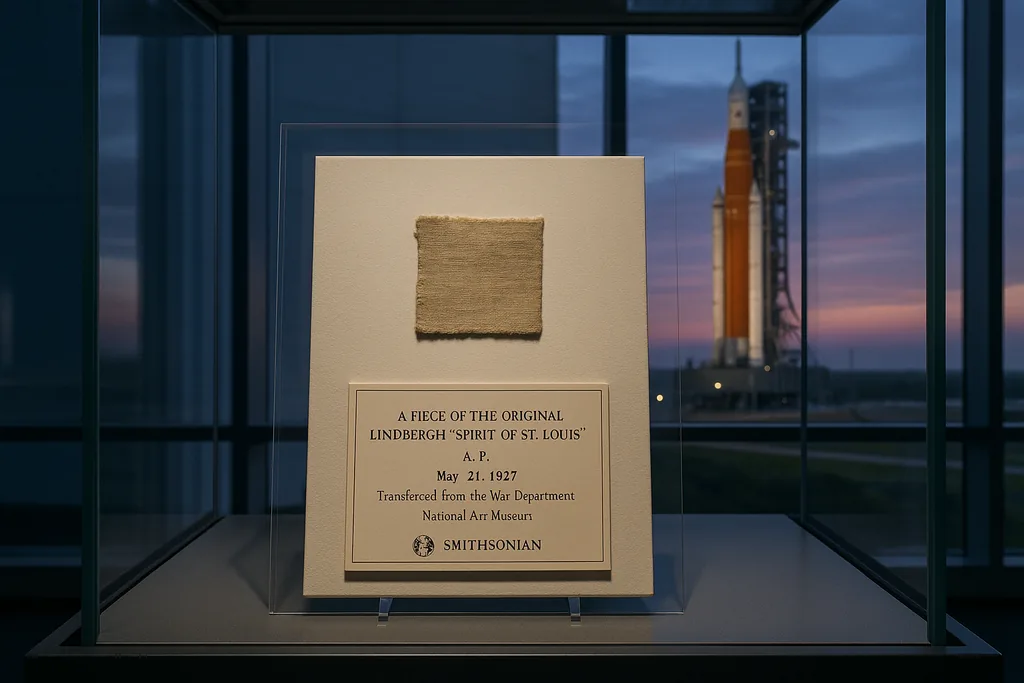
One tiny square, a century of flight
Why a swatch matters
The fabric is small enough to weigh almost nothing, yet NASA and its partners have long used symbolic objects like this to tie modern missions to the longer arc of aerospace history. For Artemis II the gesture is deliberate: the mission's Official Flight Kit (OFK) combines historic relics, program emblems and practical experiment samples to represent both the cultural lineage and technical goals of returning humans to lunar space.
Contents of the Official Flight Kit
NASA's manifest for the OFK reads like a compact museum and a lab combined. Alongside the Wright Flyer fabric are items that span the spectrum of U.S. aviation and spaceflight: a U.S. flag originally prepared for the canceled Apollo 18 mission, a banner that previously flew on STS-1 and STS-135 and then rode on a commercial Crew Dragon flight, and a copy of a 4-by-5-inch negative from Ranger 7 — the 1964 robotic mission that first returned thousands of lunar images to Earth.
Not everything is simply ceremonial. The OFK contains biological materials and engineering samples intended to gather data or mark long-running experiments: small bags of soil from trees grown from seeds that previously flew around the Moon, seed packets (zinnia and chile pepper among them) for biology exposure studies, and an entry-descent-landing material swatch intended to inform future spacecraft design. The kit also includes an SD card containing millions of names submitted through NASA's "Send Your Name to Space" campaign, hundreds of patches and pins representing partner organisations, and even metal shavings taken from construction of the SLS core stage.
Personal keepsakes and crew pouches
In addition to the OFK, each Artemis II astronaut carries a Personal Preference Kit (PPK) of their own. Public descriptions of those small pouches show the personal side of deep-space missions: commander Reid Wiseman has said he will carry a notecard to capture thoughts during flight; pilot Victor Glover is flying a bible and family mementos; mission specialist Christina Koch will take handwritten notes from loved ones; and Canadian Space Agency astronaut Jeremy Hansen will carry small moon pendants for his family. The PPKs are tactile reminders that, even on a technically demanding test flight, the human element remains central.
A chain of flights: from Kitty Hawk to Mars
Taking a fragment of the Wright Flyer to lunar space is part of an established NASA practice of letting history hitch a ride on milestone flights. Portions of the Flyer have flown before: a smaller square was aboard a 1985 Space Shuttle mission, and other historical swatches have made symbolic journeys on robotic and crewed missions. In 2021, for example, the Mars Helicopter Ingenuity carried a small historic textile as part of its payload.
That continuity is the point. The same breath that traces Wilbur and Orville Wright's first powered, controlled hops across sand now traces four astronauts as they fly beyond low Earth orbit. In public remarks accompanying the OFK release, NASA quoted Jared Isaacman as saying the assortment of keepsakes "reflect the long arc of American exploration and the generations of innovators who made this moment possible." Whether noted as heritage or morale, the artifacts are intended to connect the past to the technical steps needed for a sustained return to the Moon.
Technical context and timeline
Artemis II is the first crewed test flight of the SLS rocket and the Orion spacecraft. The stacked vehicle rolled to the Kennedy Space Center launchpad in mid January as teams moved into final launch preparations. NASA has described a wet dress rehearsal — a full rocket fueling test — scheduled in early February; the agency has said the mission could launch in the first available window that follows those tests, with mission planners eyeing opportunities in February.
Although Artemis II is often described as a test flight, its orbit and objectives make it historically significant: the crew will fly a lunar flyby that sends them farther from Earth than any human has travelled in more than five decades. The OFK and crew PPKs will be stowed in Orion for the 10-day mission and will remain out of the way during active mission operations.
What the artifacts do — beyond symbolism
It is easy to read the OFK as pure pageantry, but several items serve scientific or programmatic purposes. The moon-tree soil samples and seed packets will continue a long-running set of biological exposures in space and may provide data — albeit in a small sample set — about how plant-associated soils and seeds respond to deep-space environments. The entry-descent-landing material swatch could provide useful comparative data about wear, contamination or radiation effects when analysed after return. Even flags and program patches have a role: they embody partnerships and personnel recognition across NASA centres and international collaborators such as the European Space Agency and the Canadian Space Agency.
Conservation and curation
Historic objects destined for space require careful handling. The Wright Flyer swatch is loaned from the Smithsonian's National Air and Space Museum, one of a handful of institutions that manages objects with both archival value and flight history. After Artemis II returns, the swatch will be repatriated to the museum and catalogued alongside other flight-flown textiles. Museums and NASA coordinate on conservation protocols to ensure that both the historic integrity of the item and the safety of mission hardware are protected.
What to watch next
In the coming days NASA will complete pad operations and the wet dress rehearsal that helps determine the launch window for Artemis II. Observers watching the countdown will see the technical choreography of a test mission: fueling, communications checks and systems rehearsals. For those tracking the human side of the story, the OFK offers a compact, museum-like narrative that will return to Earth with the crew — a physical reminder that each step away from our planet builds on earlier, smaller leaps in flight.
Whether the Wright Flyer swatch is viewed as a sentimental token or a connective artifact, its passage aboard Orion will be a vivid public link between 1903 Kitty Hawk and 21st-century lunar exploration. The tiny square of fabric will not be the mission's headline, but as it circles the Moon and returns, it will remind future historians that aerospace progress is cumulative: fragile experiments and modest materials can, over time, become the foundation for ventures that take humanity beyond its home world.
Sources
- NASA (mission materials and official flight kit documentation)
- Smithsonian National Air and Space Museum (Wright Flyer collection)
- Jet Propulsion Laboratory (Ranger 7 mission archival materials)
- European Space Agency (Artemis international partnership)
- Canadian Space Agency (crew participation and mission items)




Comments
No comments yet. Be the first!