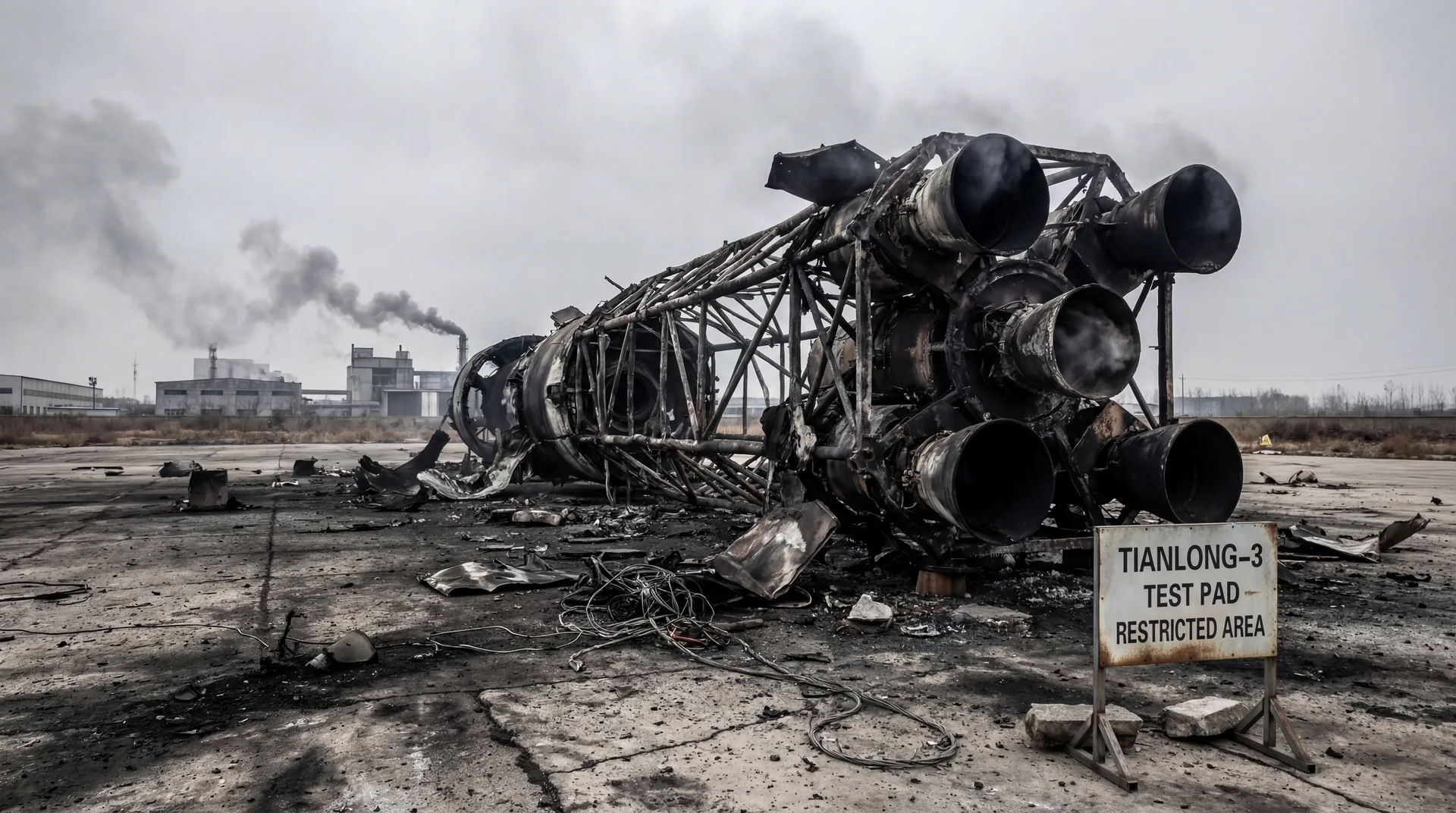

On April 3, 2026, the Tianlong-3 rocket from the Chinese commercial firm Space Pioneer suffered a critical failure during its debut launch, marking a significant setback for the nation's private aerospace ambitions. The 72-meter-long vehicle experienced an anomaly during its ascent phase shortly after lifting off at 12:17 a.m. Eastern from the Jiuquan Satellite Launch Center. This event occurred as the company attempted to demonstrate the capabilities of its multi-stage, kerosene-liquid oxygen propellant system, which was designed to compete directly with global leaders like SpaceX. The failure was confirmed by state media outlet Xinhua, indicating that while the nine Tianhuo-12 engines performed initially, the mission ultimately failed to reach orbit.
The Space Pioneer mission was highly anticipated within the industry as it represented one of the most ambitious commercial launch attempts in China to date. The Tianlong-3 is a two-stage launch vehicle with a 3.8-meter diameter, engineered for partial reusability and a payload capacity of up to 22,000 kilograms to low Earth orbit. This launch was intended to validate the redesigned first stage and the structural integrity of the vehicle following a high-profile ground accident nearly two years prior. Despite the failure, the company has expressed its commitment to analyzing the data and refining its flight systems for future attempts.
What caused the structural failure in the Tianlong-3 tail section?
The structural failure in the Tianlong-3 tail section occurred at the connection between the rocket body and the test platform, causing the first-stage rocket to detach during a static-fire test. The nine engines ignited normally, but this failure led to an unexpected liftoff and subsequent crash into nearby mountains. Space Pioneer confirmed this as the cause in their official statement regarding the earlier 2024 incident.
Engineering investigations into the earlier Gongyi anomaly revealed that the force generated by the nine Tianhuo-12 engines exceeded the load-bearing capacity of the ground-anchored clamps. During that static-fire procedure, the rocket unintentionally transitioned into an uncontained flight, traveling a short distance before crashing and exploding on a hillside. This specific engineering failure forced a comprehensive redesign of the vehicle’s tail section and a rigorous review of safety protocols for all subsequent ground tests and launch attempts from the Dongfeng Commercial Aerospace Innovation Test Zone.
The 2026 launch failure, however, appears to be a separate issue involving the ascent phase rather than the ground-anchoring systems. While the 2024 incident was a failure of the test stand interface, the most recent mishap occurred while the vehicle was in flight, suggesting possible issues with stage separation, guidance systems, or engine performance under flight loads. According to reports from Andrew Jones of SpaceNews, amateur footage showed apparent instability before the mission was declared a loss, highlighting the extreme difficulty of transitioning from ground testing to orbital flight.
Are there safety concerns for China's commercial space sector after this mishap?
The incident highlights risks in China's rapidly growing commercial space sector, as falling debris and unplanned flights from test sites underscore safety challenges in private rocket development. However, no casualties occurred due to prior evacuations and the remote location of test sites. It does not indicate systemic safety failures but emphasizes the need for robust testing protocols.
Safety regulations for the commercial aerospace sector in China have faced increased scrutiny following these high-visibility failures. The 2024 Gongyi incident was particularly alarming because it occurred near populated areas, prompting the China National Space Administration (CNSA) to implement stricter guidelines for private launch providers. These regulations focus on the structural connection points of test stands and the mandatory evacuation zones surrounding commercial innovation zones. The fact that the 2026 launch occurred at the Jiuquan Satellite Launch Center suggests a shift toward more controlled, military-grade environments for debut flights.
Despite the inherent dangers of rocket development, the industry remains resilient. The Space Pioneer failure was the third major launch anomaly for China in 2026, a year in which the nation targets approximately 140 total launches. Other firms, such as CAS Space, have seen success with vehicles like the Kinetica-2, demonstrating that the sector is maturing even as individual companies face technical hurdles. The focus on safety is now a primary driver for the engineering teams, as they must balance rapid innovation with the public and environmental safety required for long-term commercial viability.
How does the Tianlong-3 failure impact Space Pioneer's future launch schedule?
The failure will likely delay Space Pioneer's future launch schedule as the company investigates the cause and conducts rectification work with experts. This follows a previous pattern where the 2024 static fire accident led to a significant delay in the Tianlong-3 maiden flight. Future satellite constellation deliveries will remain on hold until the company resolves these technical anomalies.
Managing the timeline for a reusable rocket program is a complex task that requires total mission success before moving to commercial operations. Space Pioneer had previously secured roughly $350 million in funding in late 2025 to support the development of next-generation engines and the Tianlong-3 platform. These funds were intended to fast-track a high launch cadence; however, investors and partners may now demand more rigorous "iron bird" ground testing and software simulations before the next flight attempt is authorized.
The road ahead for Tianlong-3 involves a meticulous "rectification" phase, as noted by company officials. This will likely involve a deep dive into the telemetry data from the April 3 flight to determine if the anomaly was a software glitch or a hardware malfunction. Given the goal of competing with the Falcon 9, the company must master the transition between first-stage burn and second-stage ignition, which is often where new rockets face their greatest challenges. The broader challenge of scaling reusable rocket technology remains the ultimate hurdle for the company as it seeks to maintain its credibility in the global space market.
- Launch Date: April 3, 2026 (0417 UTC)
- Vehicle Dimensions: 72 meters long, 3.8 meters diameter
- Engine Configuration: 9 Tianhuo-12 variable thrust engines (First Stage)
- Propellant: Kerosene-liquid oxygen (Kerolox)
- Site: Dongfeng Commercial Aerospace Innovation Test Zone, Jiuquan
The implications for the field are significant, as Space Pioneer was seen as a frontrunner in the race for Chinese orbital reusability. While the failure is a blow to the immediate schedule, the history of aerospace engineering—from SpaceX to the CNSA—is defined by learning from such high-energy anomalies. As the company works toward its next mission, the global space community will be watching to see if the Tianlong-3 can overcome its "growing pains" to become a reliable workhorse for China’s burgeoning satellite constellations.





Comments
No comments yet. Be the first!