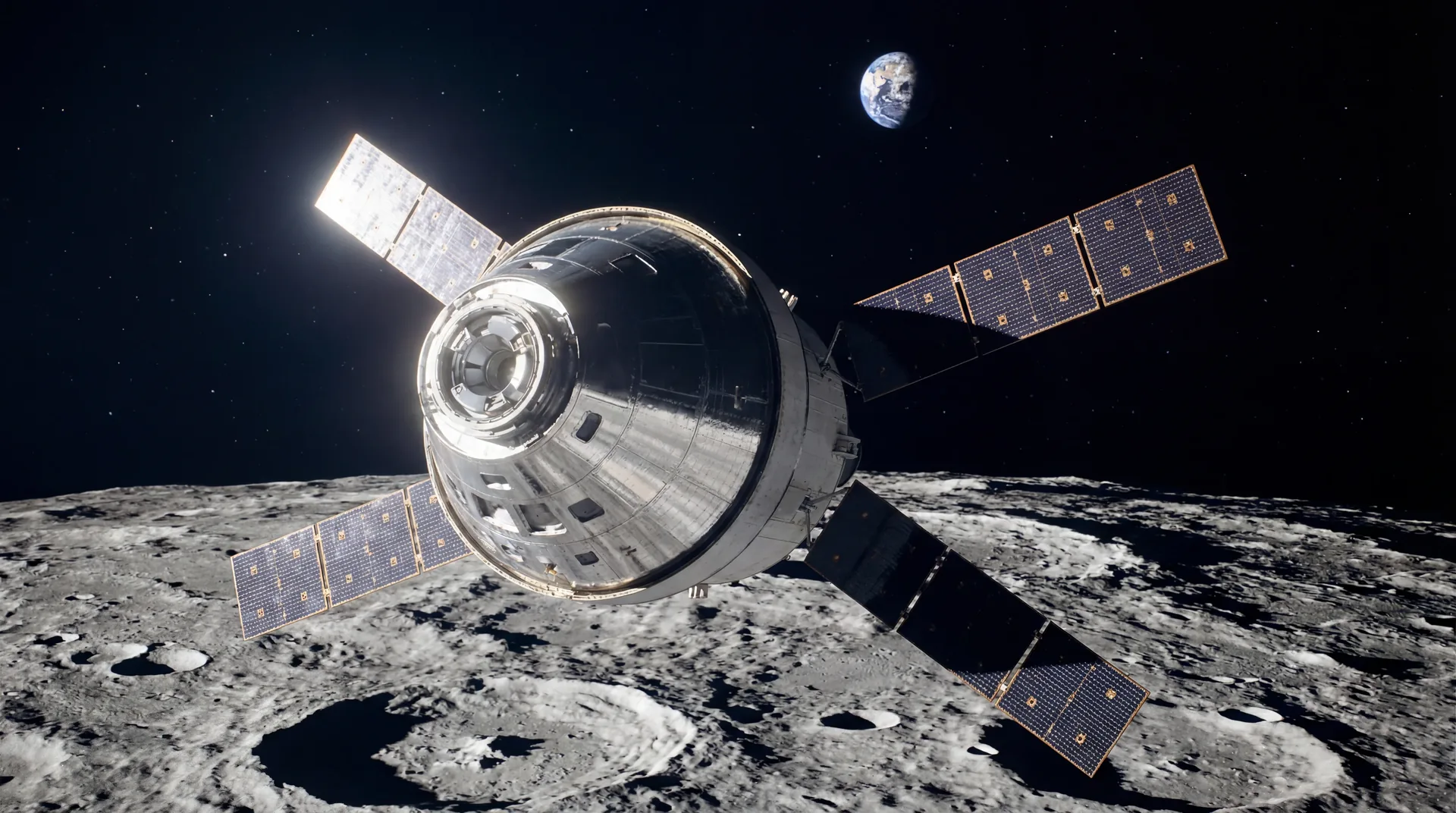

The Orion spacecraft is currently navigating a precise perilune pass as part of the Artemis II mission, reaching a distance from the Moon’s surface that will provide the crew with unprecedented views of the lunar terrain and critical navigation data. This historic flyby serves as a foundational test for NASA’s deep-space capabilities, marking the first time a crewed vehicle has visited the lunar vicinity since the Apollo era. By utilizing a high-altitude trajectory, the mission showcases advanced optical navigation systems and sets the stage for future landing attempts.
NASA’s return to deep space represents a significant pivot in human spaceflight, moving beyond Low Earth Orbit (LEO) to establish a sustainable presence around the Moon. The Artemis II mission was designed to validate the performance of the Space Launch System (SLS) and the Orion spacecraft in a high-radiation environment. Researchers and engineers at institutions like the Johnson Space Center have emphasized that this flight is not merely a "lap around the Moon" but a rigorous evaluation of the technologies required to keep humans alive during the multi-year transit to Mars. The mission’s success hinges on proving that the life support systems can sustain four astronauts for the duration of the journey while maintaining structural integrity against micrometeoroids and solar radiation.
The journey to the Moon began with a flawless launch from Kennedy Space Center, where the SLS rocket successfully executed its primary ascent and the critical Trans-Lunar Injection (TLI) burn. This maneuver propelled the Orion Spacecraft out of Earth’s orbit and onto a path toward the lunar sphere of influence. During the initial days of the flight, the crew performed a series of proximity operations and system checks to ensure the European Service Module (ESM) was providing the necessary power and propulsion. These early milestones confirmed that the most powerful rocket ever built could reliably deliver a crewed payload into deep space, a prerequisite for all subsequent missions in the Artemis architecture.
How does the free-return trajectory ensure crew safety?
The free-return trajectory for Artemis II uses the Moon's gravity to naturally sling the Orion spacecraft back toward Earth after the flyby, minimizing the need for propulsion and ensuring a safe return even if systems fail. This passive path enhances crew safety by reducing reliance on onboard fuel and engines for the homeward journey, effectively acting as a celestial "u-turn."
By placing the spacecraft on this specific orbital path, NASA engineers have built a fail-safe into the mission’s physics. If the Orion Spacecraft were to experience a total propulsion system failure after its initial TLI burn, the laws of orbital mechanics would still dictate a return to Earth’s atmosphere. This strategy was famously employed during the Apollo 13 mission to save the crew after an oxygen tank explosion. For Artemis II, this trajectory allows mission controllers to monitor the spacecraft’s performance with the peace of mind that the crew is on a predetermined path home, regardless of minor mechanical anomalies. This "safety first" approach is critical when testing new deep-space hardware for the first time with human occupants.
What happens to the crew during the lunar far-side flyby?
During the lunar far-side flyby, the crew will be out of direct communication with Earth due to the Moon blocking radio signals, relying on Orion's autonomous systems for navigation and operations. They will continue monitoring spacecraft status and performing science tasks, with the flyby providing unique views of the Moon's far side that are impossible to capture from Earth.
The period of radio silence, often referred to as the "loss of signal" (LOS), is one of the most psychologically and technically demanding phases of the Artemis II mission. As the spacecraft passes behind the lunar limb, the massive bulk of the Moon acts as a physical shield, severing all data and voice links with Mission Control in Houston. During these critical minutes, the Orion Spacecraft must function with total autonomy. The crew—consisting of Commander Reid Wiseman, Pilot Victor Glover, and Mission Specialists Christina Koch and Jeremy Hansen—is trained to handle any contingencies without ground support. This period also allows the crew to focus on high-resolution photography and sensor data collection of the lunar highlands, providing new insights into the Moon's geological history.
Why this matters for Mars
Testing deep-space life support and radiation shielding during the Artemis II mission is the ultimate stress test for future crewed voyages to the Red Planet. Unlike missions to the International Space Station, which benefit from the protection of Earth’s magnetic field, Artemis II exposes the crew to the harsh environment of interplanetary space. The data gathered during this flight will directly inform the design of the Mars-bound transport vehicles, specifically regarding how to mitigate the effects of long-duration cosmic radiation on human tissue.
- Radiation Shielding: Orion is equipped with advanced shielding and a "storm shelter" area to protect the crew from Solar Particle Events (SPEs).
- Human Physiology: Researchers are monitoring the crew’s bone density and cardiovascular health to predict how the human body will react to a three-year Mars mission.
- Life Support Redundancy: The mission tests the durability of the Carbon Dioxide Removal System (CDRS) and water recovery systems in a high-stakes environment.
- Autonomous Navigation: Testing "optical navigation" techniques where the spacecraft uses star tracking and lunar landmarks to find its way without GPS.
Success for Artemis II is defined by more than just a safe splashdown; it is measured by the volume of telemetry data returned to NASA's engineers. Every liter of oxygen consumed and every watt of power generated by the solar arrays is being scrutinized to refine the "lunar architecture" that will eventually support the Artemis III landing. By identifying any minor "bugs" in the Orion system now, NASA can ensure that the next mission, which aims to land the first woman and first person of color on the lunar surface, is as safe as possible. The mission essentially serves as a high-fidelity simulation for the challenges of long-distance space travel, where help from Earth is millions of miles—or several light-minutes—away.
Looking ahead, once the Artemis II crew completes their lunar flyby, they will begin a multi-day journey back to Earth, culminating in a high-speed atmospheric reentry. The spacecraft will hit the atmosphere at speeds exceeding 25,000 miles per hour, testing the world’s largest ablative heat shield. A successful splashdown in the Pacific Ocean will signal that the Orion and SLS systems are "human-rated" and ready for the complex orbital maneuvers required for the Gateway station and future Mars transit vehicles. The mission is a bold reminder that before we can walk on another planet, we must first master the art of navigating our own celestial backyard.





Comments
No comments yet. Be the first!