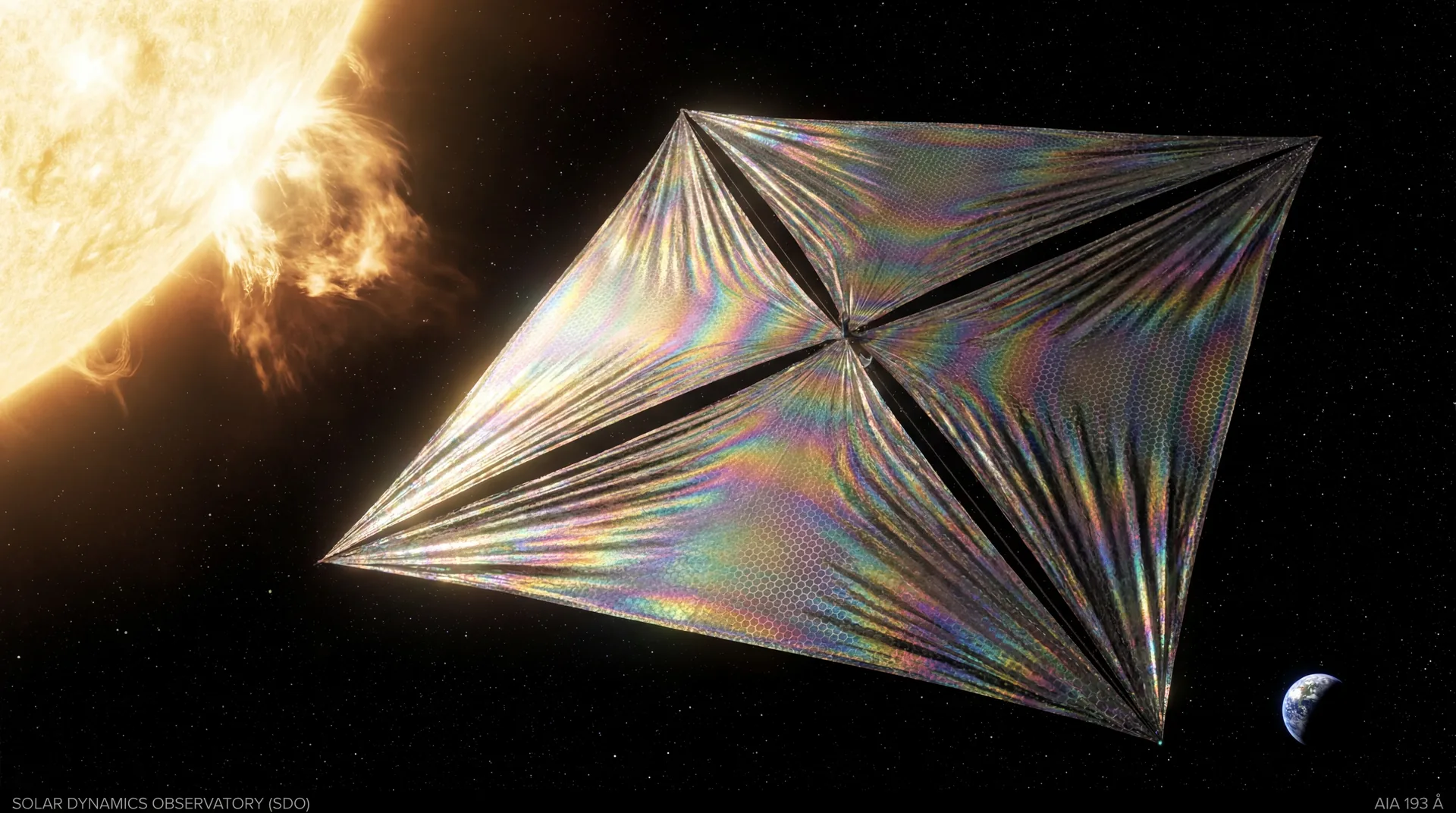

For decades, the concept of laser-pushed space travel remained confined to the realm of theoretical physics, but a recent breakthrough using graphene has brought this science-fiction dream closer to reality. An international research team, collaborating with the European Space Agency (ESA), has successfully demonstrated how graphene aerogels can be propelled by light in microgravity conditions. This discovery suggests that future spacecraft could bypass traditional chemical engines entirely, instead using high-powered lasers to push ultra-lightweight sails across the cosmos at unprecedented speeds.
Why is graphene the ideal material for solar sails?
Graphene is considered the ideal material for solar sails because its extreme structural strength and nearly negligible mass allow it to harness radiation pressure with maximum efficiency. Unlike traditional materials, graphene aerogels are highly porous and ultralight, providing a vast surface area to capture photons while remaining durable enough to withstand the rigors of deep space travel and high-energy laser beams.
The pursuit of propellant-free travel is driven by the inherent limitations of modern rocketry. Traditional chemical propellants are heavy, expensive, and finite, often making up the majority of a spacecraft's initial launch weight. To reach interstellar distances, such as our neighboring star system Alpha Centauri, a craft must be light enough to be accelerated to a significant fraction of the speed of light. Graphene, a single layer of carbon atoms arranged in a hexagonal lattice, offers a unique solution. When formed into an aerogel structure, it maintains its exceptional electrical conductivity and mechanical performance while possessing a density low enough to respond to the infinitesimal pressure exerted by light particles, or photons.
According to Ugo Lafont, ESA’s materials’ physics and chemistry engineer, these materials represent a paradigm shift in aerospace engineering. The research highlights how graphene aerogels can convert light into motion, effectively saving critical fuel and hardware space for scientific instrumentation. By eliminating the need for heavy combustion systems, engineers can design smaller, more agile probes capable of reaching the outer edges of the solar system in a fraction of the time required by current technology.
How does a gravity rollercoaster test deep space tech?
A gravity rollercoaster, such as ESA’s 86th parabolic flight campaign, tests deep space technology by creating a microgravity environment through repeated free-fall maneuvers. These flights allow researchers to observe how graphene samples react to laser pulses without the interference of Earth’s gravitational pull, simulating the weightless conditions found in the vacuum of outer space.
During the experiments conducted in May 2025, researchers from the Université Libre de Bruxelles (ULB) and Khalifa University placed graphene aerogel cubes inside a vacuum chamber. As the aircraft performed its parabolic arc, plunging into a state of weightlessness, a continuous laser was beamed onto the samples. Under normal Earth gravity, these materials showed virtually no movement; however, once the microgravity phase began, the graphene responded with startling speed. High-speed cameras captured the cubes shooting forward almost instantly upon contact with the light beam.
The speed of the reaction was a primary takeaway for the scientific team. Marco Braibanti, ESA’s project scientist for the experiment, noted that the acceleration was "fast and furious," with the entire event occurring in just 30 milliseconds. This rapid response confirms that the momentum transfer from the laser to the graphene is not only viable but highly efficient. The results of this study, published in the journal Advanced Science, provide the empirical evidence needed to move from fundamental laboratory science to practical aerospace applications.
Can laser-steered satellites replace traditional propellant?
Laser-steered satellites can potentially replace traditional propellants by using graphene-based surfaces to perform orbital adjustments and attitude control. By tuning the intensity and direction of a ground-based or space-based laser, operators can nudge a satellite into a new position, maintaining its orbit indefinitely without the need for onboard chemical thrusters or propellant refills.
The experiment demonstrated that the propulsion of graphene aerogels is highly controllable. By adjusting the strength of the laser beam, the research team could precisely dictate the level of acceleration the samples experienced. This ability to "tune" the thrust is vital for satellite attitude control—the process of keeping a satellite pointed in the correct direction. Currently, satellites have a limited lifespan determined by how much fuel they can carry for these minor corrections. A graphene-coated satellite powered by remote lasers would theoretically be limited only by its electronic components' durability.
This technological shift would allow for the deployment of "constellations" of small satellites that are lighter and cheaper to launch. Beyond simple maintenance, the implications for interstellar probes are profound. Because a laser can be fired from a stationary source—such as a lunar base or a large orbital array—it can provide a continuous push to a graphene solar sail over vast distances. This allows a probe to accelerate continuously, eventually reaching velocities that would be impossible to achieve with onboard fuel tanks.
The road to the stars: Future directions for graphene
While the microgravity tests are a resounding success, several hurdles remain before graphene sails are deployed on a mission to Proxima Centauri. One of the primary challenges is the large-scale manufacturing of high-quality graphene aerogels that maintain their integrity over kilometers of surface area. To be effective for interstellar travel, a solar sail might need to be hundreds of meters or even kilometers wide, yet remain thin enough to stay ultralight. Researchers are also investigating the long-term effects of cosmic radiation and thermal fluctuations on 2D materials over decades-long missions.
ESA is currently addressing these challenges through its Enable topical team, a specialized working group focused on the benefits of 2D materials for space exploration. This group is looking beyond just propulsion, exploring how graphene can be used for thermal management, radiation shielding, and even advanced sensors within the same sail structure. The goal is to create a multi-functional material that serves as the engine, the shield, and the communication array for future probes. As the Enable team continues its assessment, the transition from parabolic flight experiments to low-Earth orbit (LEO) testing is expected to be the next major milestone.
The findings from this microgravity research represent the first steps toward a propellant-free future. By proving that graphene can translate light directly into motion with high efficiency, scientists have opened a new door for deep-space exploration. Whether it is keeping a communications satellite in orbit for an extra decade or sending the first human-made object to another star system, graphene and lasers are set to redefine our reach into the universe. The "gravity rollercoaster" has shown that the path to the stars may not be paved with fire and fuel, but with light and carbon.





Comments
No comments yet. Be the first!