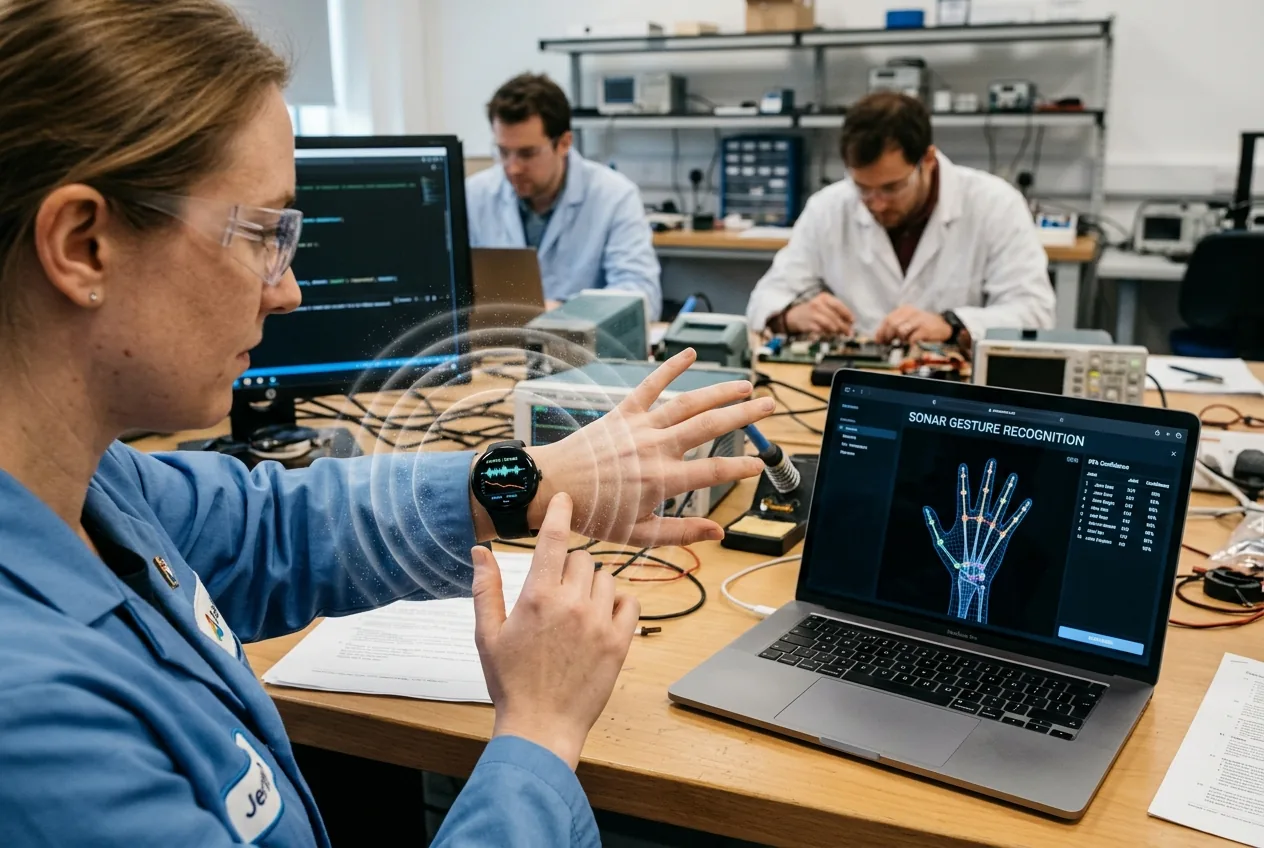
A lab volunteer in Ithaca taps thumb and forefinger twice in the air and a nearby Android watch, worn on the opposite wrist, silently notes the motion and advances a song. The demonstration — part of a research project called WatchHand from Cornell University in collaboration with KAIST — used only the watch’s built-in speaker and microphone, inaudible micro‑sonar pulses and a compact machine‑learning model running on the device itself. The plain fact that this works is the headline: sonar stock smartwatches leads to usable, continuous hand‑tracking without changing hardware or sacrificing local privacy.
The novelty is not that sound can measure distance; it is that the researchers stitched together signal design, acoustic modelling and tight engineering so that off‑the‑shelf devices can reconstruct three‑dimensional finger and wrist poses in real time. The result matters because it moves advanced gesture control out of lab prototypes and into devices millions already wear, promising assistive interfaces, unobtrusive AR controls and a route around cameras that many users — and regulators — distrust.
sonar stock smartwatches leads to a privacy‑first control model
WatchHand’s first selling point is that it sidesteps vision entirely. The system emits short, inaudible sonar chirps from the watch speaker; the microphone captures their echoes and a locally running neural net decodes the echo signatures into joint angles and finger poses. Because all audio sensing and inference happen on the smartwatch, no video is recorded, no cloud roundtrip is required, and sensitive imagery never leaves the device. That’s a genuine privacy advantage compared with camera‑based approaches — and it’s exactly the argument that will appeal to European regulators and privacy‑conscious consumers.
But privacy comes with trade‑offs. Sonar’s spatial resolution is coarser than a high‑end depth camera and prone to acoustic multipath in cluttered rooms; it also depends on the watch being on the correct wrist and reasonably close to the hand. Still, for many tasks — gesture shortcuts, assistive control for users with limited dexterity, or as a low‑energy AR input — the system offers an attractive balance between functionality and privacy.
sonar stock smartwatches leads — how the trick works on off‑the‑shelf hardware
The engineering here is deceptively simple in ingredient list but intricate in execution. WatchHand uses the watch’s existing speaker to emit micro‑sonar pulses at frequencies above human hearing. Those pulses bounce off fingers and the hand and return to the watch microphone with tiny delays and amplitude shifts. The researchers trained a machine‑learning model to map those echo patterns to a three‑dimensional hand pose. Crucially, they optimised the model and the signal protocol to fit within the compute and power budget of contemporary Android smartwatches.
So how does sonar enable hand‑tracking on stock smartwatches? It is a form of active sensing: the watch probes its surroundings rather than passively observing them. Echo time‑of‑flight, phase and frequency shifts carry spatial information; the ML model learns the complex, non‑linear relationship between those acoustic signatures and finger joint angles. What makes the breakthrough possible without new hardware is a combination of compact signal designs, robust preprocessing to remove environmental noise, and neural models small enough for on‑device inference.
That explains the other PAA question: what makes this possible without new hardware is not a miracle in acoustics but practical engineering — careful calibration of speaker/mic pairs, inaudible frequency bands that existing components can reproduce, and tailored ML that squeezes performance into limited memory and CPU cycles.
Performance, limits and real‑world trade‑offs
The team validated WatchHand with about 40 participants and roughly 36 hours of gesture data across multiple watch models, wrist sides and noise environments. The results are impressive for a first consumer‑grade prototype: the system reliably recognised a broad set of finger configurations and wrist rotations in stationary tests and in typical indoor settings. It achieved latencies low enough for fluid interactions and handled moderate background noise without crashing the model.
There are important caveats. Accuracy drops when the wearer is walking or otherwise in motion, because body movement introduces Doppler shifts and changes the echo geometry faster than the model was trained to handle. Continuous, always‑on tracking consumes battery: short‑burst sensing and duty‑cycling mitigate that, but a smartwatch can’t run full‑time high‑fidelity sonar without a measurable hit to battery life. Compared with a camera, sonar typically uses less power than continuous video capture and avoids heavy GPU workloads, but it is not free — designers must choose duty cycles and interaction models carefully to balance responsiveness and battery endurance.
The comparison to camera and depth sensors is worth spelling out. Cameras deliver rich spatial detail and are versatile for many computer‑vision tasks, but they raise privacy concerns, perform poorly in darkness, and often require server processing for high‑quality inference. Depth sensors add accuracy but more hardware cost and energy draw. Sonar on stock smartwatches sits in the middle: modest spatial fidelity, stronger privacy, and lower hardware cost — with a hit to reliability when the user or environment is highly dynamic.
Applications: invisible typing, assistive controls and AR shortcuts
Where WatchHand sings is in short, high‑value gestures rather than full replacement of a keyboard. The team demonstrated commands like thumb‑index taps to control media, nuanced finger poses for menu navigation and wrist rotations for scrolling. For users with motor impairment or speech limitations, these mappings could be translated into assistive communication tools. In AR and VR, a watch‑based sonar controller removes the need to strap on gloves or carry external trackers, offering a low‑friction entry path for immersive interaction.
Developers can also combine sonar with the watch’s inertial sensors to build multimodal classifiers that are more robust on the move. That hybrid approach addresses one of the main limitations flagged during the trials and is likely the practical route product teams will take first: sonar for detail, IMU for gross motion.
European industry and regulatory angles — why Germany should care
For European suppliers and policy makers, WatchHand is interesting for two reasons: it creates a demand for smart software stacks that run on commodity hardware, and it sidesteps thorny camera‑privacy debates that have hampered some consumer features in the EU. German manufacturers — with strengths in low‑power systems, embedded ML and industrial audio components — could shepherd such features into consumer devices under a ‘privacy‑by‑design’ banner.
There are also competition and standards questions. If watchmakers adopt sonar‑based APIs, interoperability and signal standards will matter. The EU’s devices‑and‑trust agenda could be an asset here: insisting on local processing, transparency in data use and auditability would neatly align with WatchHand’s engineering choices. Conversely, fragmentation between Android vendors and closed ecosystems could slow uptake unless a cross‑industry effort defines common interfaces and power profiles.
Where this technology is likely to land next
Expect to see incremental, conservative productisation: short gestures, media controls, and assistive features first; full continuous hand tracking in specialized apps later. WatchHand currently runs on Android smartwatches — expanding to other ecosystems will require access to low‑level audio APIs and careful cooperation from vendors. The practical path will combine silicon vendors optimising audio chains, OEMs exposing safe APIs, and standards bodies sketching guidelines for duty cycles and privacy protections.
There’s a broader lesson for the industry. Sonar on watches is not a silver bullet that makes cameras obsolete — it is a complementary sensing modality that fills real gaps in privacy, low light and cost. For product teams, the real decision is not whether sonar can work, but how to use it where its physics and power profile fit the user need.
In the short term, users can expect experimental apps and research SDKs; in the medium term, manufacturers may bake tuned sonar modes into watch OS releases. If you work in European hardware or standards policy, it’s time to sketch the guardrails: energy limits, data‑localisation guarantees, and an interoperability story that keeps the feature consumer‑friendly and regulator‑safe.
In the irony department: Europe is good at privacy rules, Germany is good at mechanical engineering, and someone — probably outside Europe — will be first to ship a sonar typing overlay that looks cool on stage. Progress, but with paperwork.
Sources
- Cornell University (WatchHand research team and preprint)
- Korea Advanced Institute of Science and Technology (KAIST) collaboration materials
- arXiv preprint (WatchHand: AI‑powered micro sonar hand‑pose tracking on smartwatches)




Comments
No comments yet. Be the first!