
Webb’s Invisible Map: NASA Telescope Reveals the Dark Matter Scaffolding Holding 800,000 Galaxies Together
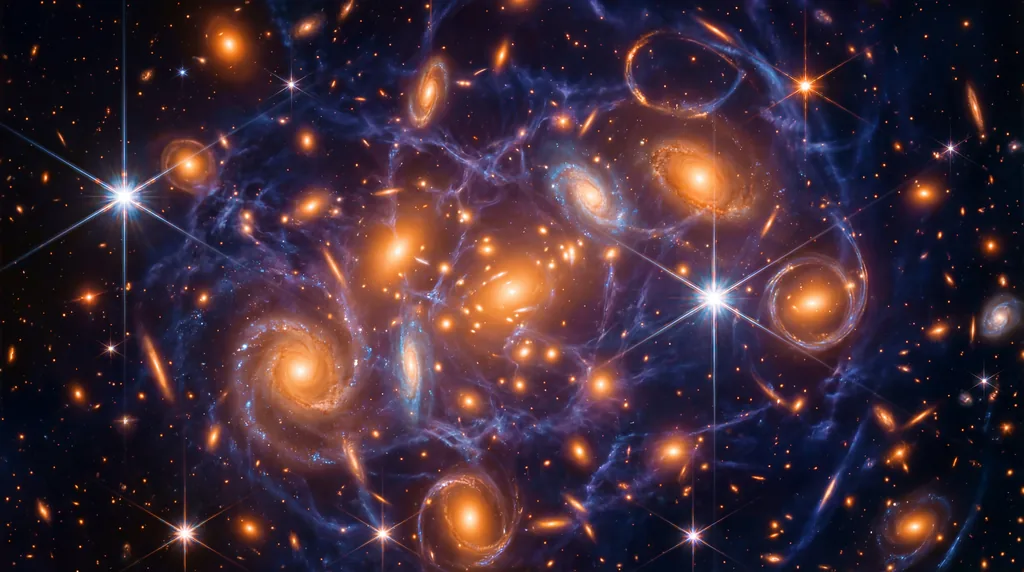
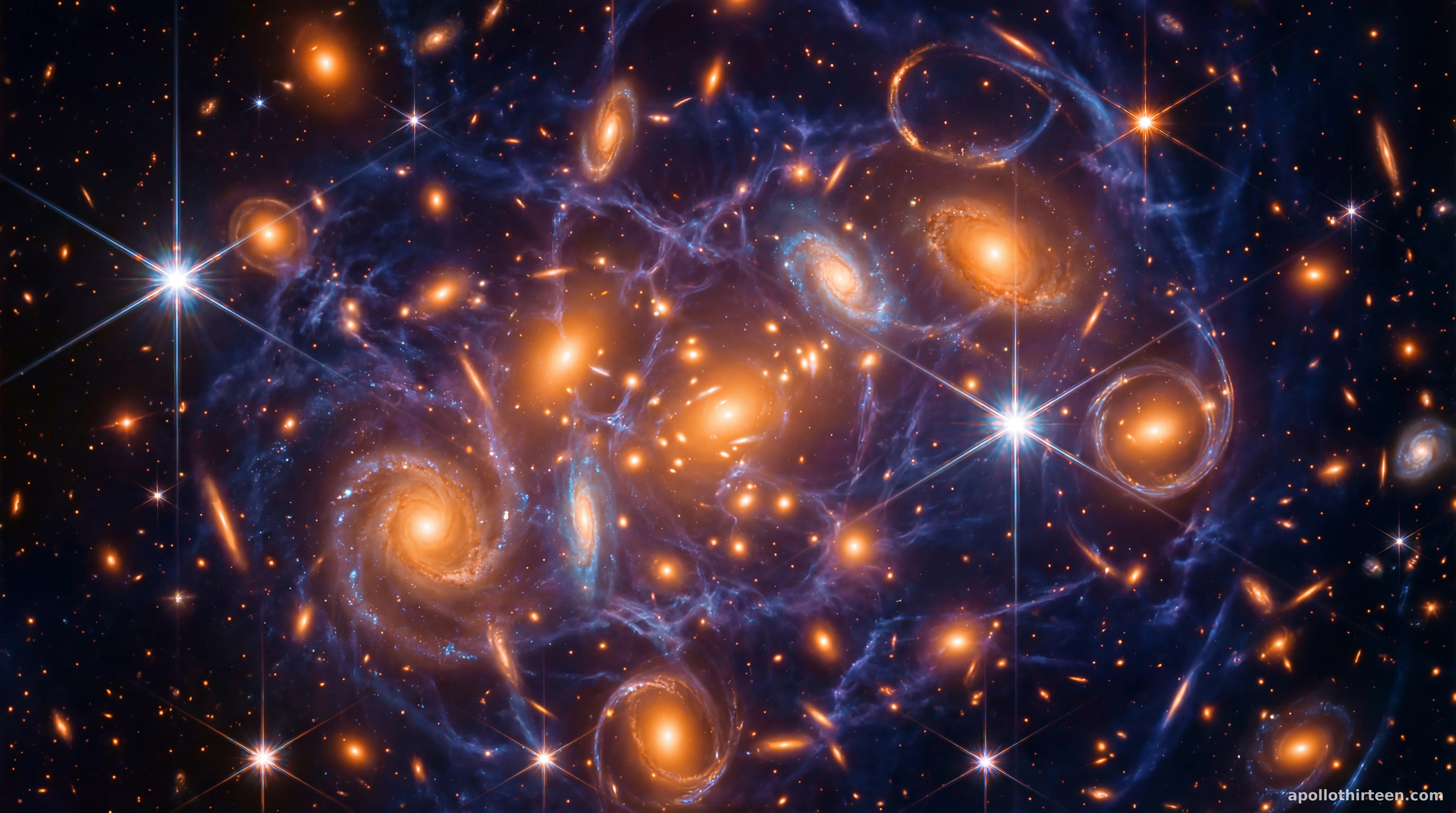
In a profound expansion of our understanding of the cosmic architecture, NASA’s James Webb Space Telescope (JWST) has produced an unprecedented visualization of the universe’s most elusive component: dark matter. By peer-reviewing a dense field of nearly 800,000 galaxies within the constellation Sextans, researchers have successfully mapped the invisible gravitational scaffolding that dictates the distribution of all visible matter. The resulting image, a composite of infrared data and gravitational analysis, reveals a complex network of dark matter density, represented by a deep blue overlay where the brightest hues indicate the highest concentrations of mass. This discovery marks a significant leap in resolving the long-standing mystery of how the universe’s largest structures are anchored and organized across eons of cosmic time.
Dark matter remains one of the most significant enigmas in modern astrophysics. It does not emit, reflect, or absorb light, making it entirely invisible to traditional observational methods. Despite its stealthy nature, dark matter is believed to constitute approximately 85% of the total matter in the universe, exerting a relentless gravitational pull that governs the rotation of galaxies and the formation of massive galaxy clusters. Without the stabilizing presence of dark matter, the 800,000 galaxies captured in Webb’s view would likely drift apart, unable to maintain the structural integrity required to form the stars and planetary systems we observe today. By mapping this "invisible" substance, scientists are effectively looking at the blueprint of the cosmos itself.
The Mechanics of Weak Gravitational Lensing
The methodology behind this discovery relies on a phenomenon predicted by Albert Einstein’s General Theory of Relativity: gravitational lensing. Because mass curves the fabric of spacetime, large concentrations of dark matter act as a cosmic magnifying glass, bending the path of light as it travels from distant background galaxies toward Earth. While "strong lensing" creates obvious, dramatic distortions—visible to the naked eye as arcs or rings of light—the Webb team utilized a more subtle technique known as "weak gravitational lensing."
Weak lensing involves measuring minute, statistically significant distortions in the shapes of thousands of galaxies. To the casual observer, these galaxies might look normal, but by aggregating data from 800,000 distinct sources, researchers can infer the presence of intervening mass. Webb’s Near-Infrared Camera (NIRCam) was instrumental in this process, staring at a 0.54-square-degree patch of sky for approximately 255 hours. This extreme sensitivity allowed the telescope to capture light from galaxies so distant and faint that their subtle distortions provide a high-fidelity "fingerprint" of the dark matter they passed through on their multi-billion-year journey to the telescope's mirrors.
The Cosmic Evolution Survey (COSMOS)
This latest dark matter map is a cornerstone of the Cosmic Evolution Survey (COSMOS), an international project dedicated to understanding how galaxies grow and evolve in tandem with their environments. The COSMOS field covers about two square degrees—roughly ten times the size of the full Moon—and has been probed by over 15 telescopes, including the Hubble Space Telescope. However, the integration of Webb data has revolutionized the project’s depth. The new Webb-based map contains roughly ten times more galaxies than maps generated by ground-based observatories and twice as many as the previous benchmark set by Hubble in 2007.
By comparing the 2007 Hubble data with the current Webb findings, researchers can observe the universe with newfound clarity. Webb’s ability to see in the infrared spectrum allows it to peer through cosmic dust clouds that formerly obscured distant galaxies. This has revealed previously unknown clumps of dark matter and provided a higher-resolution view of the "cosmic web"—the interconnected strands of matter that span the void of space. The collaboration between NASA, the European Space Agency (ESA), and the Canadian Space Agency (CSA) underscores the global effort required to process such a massive data set, which involved sophisticated algorithms to separate the dark matter signal from the luminous regular matter of the galaxies themselves.
Technical Precision: NIRCam and MIRI
The success of the mapping effort was largely dependent on the synergy between Webb’s primary instruments. While NIRCam provided the high-resolution imaging necessary for shape analysis, the Mid-Infrared Instrument (MIRI) played a vital role in refining distance measurements. MIRI, which was developed through a partnership between NASA and ESA and managed by the Jet Propulsion Laboratory (JPL) at Caltech, is uniquely adept at detecting galaxies hidden by thick dust. Accurate distance measurements are essential because the strength of gravitational lensing depends on the relative positions of the background light source, the dark matter "lens," and the observer.
- NIRCam: Captured the shapes of 800,000 galaxies over 255 hours of observation.
- MIRI: Penetrated dust clouds to determine the precise distance of galaxies, ensuring the dark matter map is three-dimensionally accurate.
- Resolution: The map offers a 2x increase in detail over the landmark 2007 Hubble survey.
- Scale: Covers a region 2.5 times the size of the full Moon in the constellation Sextans.
Implications for the Standard Model of Cosmology
The implications of this map extend far beyond a simple visualization. By detailing the distribution of dark matter, scientists can test the "Standard Model" of cosmology, which predicts how matter should clump together under the influence of gravity and the expansion of the universe. If the observed dark matter density aligns with theoretical models, it reinforces our current understanding of physics. However, if discrepancies emerge—such as dark matter clumping more or less than predicted—it could signal the need for "new physics" to explain the behavior of the early universe.
Furthermore, these findings provide critical context for the role of dark matter in galaxy evolution. The map shows a clear correlation between high-density dark matter regions (the "bright blue" areas) and the locations of massive galaxy clusters. This confirms that dark matter acts as the gravitational seed for galaxy formation; galaxies do not form in isolation but are pulled toward the massive "wells" created by dark matter halos. Understanding this relationship is key to explaining why some regions of the universe are densely packed with stars while others remain vast, empty voids.
Future Directions: Dark Energy and Beyond
As the James Webb Space Telescope continues its mission, the COSMOS project will likely expand its reach. The current map represents only a portion of the planned survey area, and future observations will aim to cover the full two-square-degree COSMOS field with Webb’s infrared precision. This will allow researchers to create a more comprehensive "history book" of the universe, tracking how dark matter structures have shifted and grown over billions of years.
Ultimately, the mapping of dark matter is a precursor to investigating an even more mysterious force: dark energy. While dark matter pulls things together, dark energy is responsible for the accelerating expansion of the universe. By precisely measuring the growth of dark matter structures through time, Webb will help cosmologists determine the strength and behavior of dark energy, potentially solving the greatest mystery in the history of science. For now, the 800,000 galaxies in the Sextans constellation serve as a glittering testament to the invisible forces that shape our reality, brought into the light by the most powerful telescope ever built.




Comments
No comments yet. Be the first!