
Webb Telescope Identifies 'Crystal-Spewing' Protostar Solving 4.6 Billion-Year Solar System Mystery
In a landmark observation that bridges modern astrophysics with the primordial origins of our own planetary neighborhood, NASA’s James Webb Space Telescope (JWST) has provided conclusive evidence for a long-standing cosmic paradox. For decades, astronomers have struggled to explain why frozen comets, residing in the ultracold outskirts of our solar system, contain crystalline silicates—minerals that require temperatures exceeding 1,000 degrees Fahrenheit to form. New data released in January 2026 reveals that the protostar EC 53, an actively forming sun-like star in the Serpens Nebula, is currently forging and distributing these same crystals into its outer reaches, effectively acting as a cosmic foundry for the building blocks of future worlds.
The Paradox of the Cold Comet
The mystery centers on the composition of "dirty snowballs"—the comets found in the Oort Cloud and the Kuiper Belt. These regions are the frozen reservoirs of our solar system, where temperatures rarely rise above a few dozen degrees above absolute zero. However, when missions like Stardust returned samples from Comet Wild 2, scientists were shocked to find crystalline silicates, such as olivine and pyroxene. These minerals can only be created when amorphous dust is heated to extreme temperatures, a process known as annealing. This created a fundamental conflict: how could materials forged in the solar furnace end up millions of miles away in the deep freeze of the outer solar system? The discovery of EC 53 provides the first direct visual evidence of the transport mechanism that resolves this 4.6 billion-year-old puzzle.
The NIRCam Discovery in the Serpens Nebula
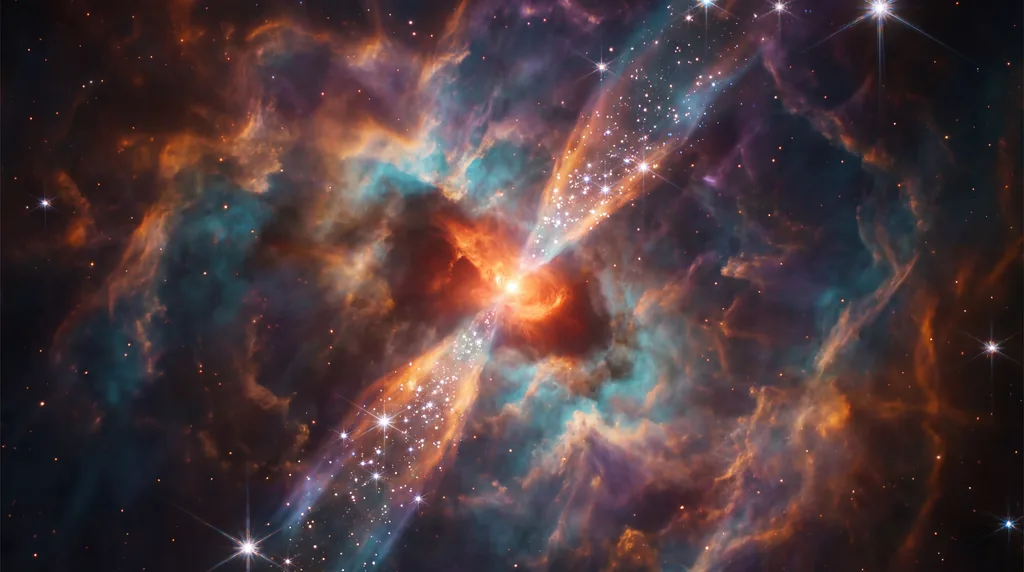
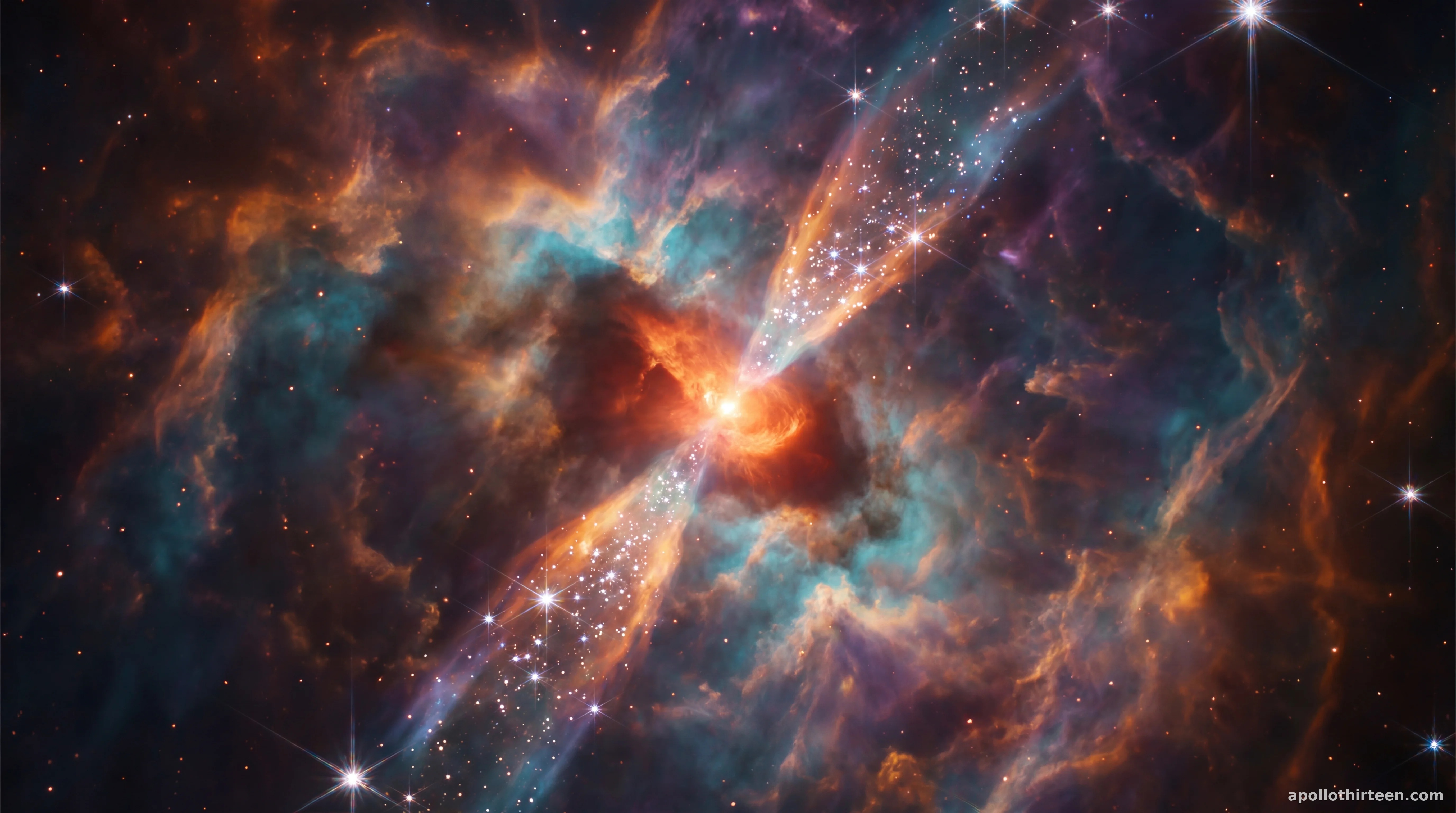
Located approximately 1,300 light-years from Earth, the Serpens Nebula is a dense nursery of star formation. Using the Near-Infrared Camera (NIRCam), the Webb Telescope was able to pierce through the thick, opaque veils of interstellar dust that typically shroud young stellar objects. The image, processed by Alyssa Pagan of the Space Telescope Science Institute (STScI), centers on the protostar EC 53. Unlike previous observatories, Webb’s sensitivity allowed researchers to resolve the delicate structures of the protoplanetary disk—the swirling mass of gas and dust that will eventually coalesce into planets. Within this chaotic environment, the telescope identified the signatures of crystalline silicates being forged in the white-hot inner disk and subsequently ejected outward.
How Stars Create and Distribute Silicates
The process of silicate crystallization is a violent and high-energy affair. According to the research team, which includes Klaus Pontoppidan of NASA’s Jet Propulsion Laboratory (NASA-JPL) and Joel Green of STScI, the intense heat generated by the gravitational collapse of the protostar creates a "thermal zone" very close to the star. In our own solar system, this would be the equivalent of the space between the Sun and Earth. In this region, the ambient heat is sufficient to rearrange the atomic structure of cosmic dust into a crystalline lattice. However, the discovery’s most significant contribution is the observation of a strong stellar outflow—a "spewing" mechanism—that carries these newly minted crystals away from the heat and into the cold, distant regions of the disk before they can be destroyed or pulled into the star itself.
Mechanisms of Radial Transport
The physics of this radial transport are complex and have been the subject of theoretical models for years. The Webb observations of EC 53 confirm that these outflows are not merely gentle drifts but powerful jets and winds capable of lofting minerals across vast astronomical distances. This "mixing" process ensures that the composition of a solar system is not uniform; instead, materials from the hottest regions are integrated into the coldest bodies. This explains why comets, which formed in the Kuiper Belt or Oort Cloud, are not composed solely of pristine interstellar ice but are instead a mosaic of materials from across the entire protoplanetary disk. The observations of EC 53 align remarkably well with these theoretical models of early stellar evolution, providing a real-time laboratory for studying our own history.
Implications for the Early Solar System
By observing EC 53, astronomers are essentially looking into a mirror of our own Sun’s infancy. The "crystal-spewing" behavior observed in the Serpens Nebula is likely the same process that occurred 4.6 billion years ago during the birth of our planets. This discovery validates the theory that the early solar nebula was a highly dynamic environment characterized by large-scale mixing. It suggests that the chemical inventory of the planets—including the distribution of minerals that would eventually form the rocky mantles of Earth, Mars, and Venus—was determined by these powerful outflows early in the star's life. This "conveyor belt" of minerals provided the necessary diversity of materials for the formation of complex planetary systems.
A Multi-Instrumental Approach to Stellar Evolution
While NIRCam provided the high-resolution imagery necessary to locate the protostar and its outflows, the broader scientific impact of this discovery relies on the synergy of Webb’s instruments. The Mid-Infrared Instrument (MIRI) is expected to play a critical role in future studies of EC 53, as it can more precisely identify the specific chemical signatures of different types of crystals. By analyzing the light spectra, astronomers can determine the exact temperature at which these crystals formed and the speed at which they are being ejected. This data will allow for more accurate simulations of how water and organic materials—often found alongside these silicates—are transported through space, potentially seeding distant planets with the ingredients for life.
Future Research and Webb's Ongoing Mission
The discovery of the crystal-spewing protostar marks a significant milestone in the James Webb Space Telescope's mission to "unfold the universe." However, the work is far from over. Future research will focus on whether this phenomenon is universal among all sun-like stars or if it depends on specific environmental factors within a nebula. Astronomers are now planning to survey other young stellar objects in the Serpens and Orion nebulae to determine the frequency of these mineral outflows.
- Investigation of the chemical evolution of disks to track the movement of carbon and oxygen.
- Long-term monitoring of EC 53 to observe changes in outflow intensity.
- Comparing the silicate signatures of EC 53 with samples from the OSIRIS-REx and Hayabusa2 missions.
Conclusion: A New Chapter in Cosmochemistry
The findings regarding EC 53 represent more than just a beautiful image; they represent a fundamental shift in our understanding of how solar systems are built. The ability of the James Webb Space Telescope to link the microscopic structure of minerals to the macroscopic dynamics of star formation is a testament to its unprecedented engineering. As we continue to analyze the data from the Serpens Nebula, we are not just learning about a distant star system 1,300 light-years away—we are uncovering the definitive story of our own origin, proving that even the coldest objects in our sky were once touched by the fire of a young sun.




Comments
No comments yet. Be the first!