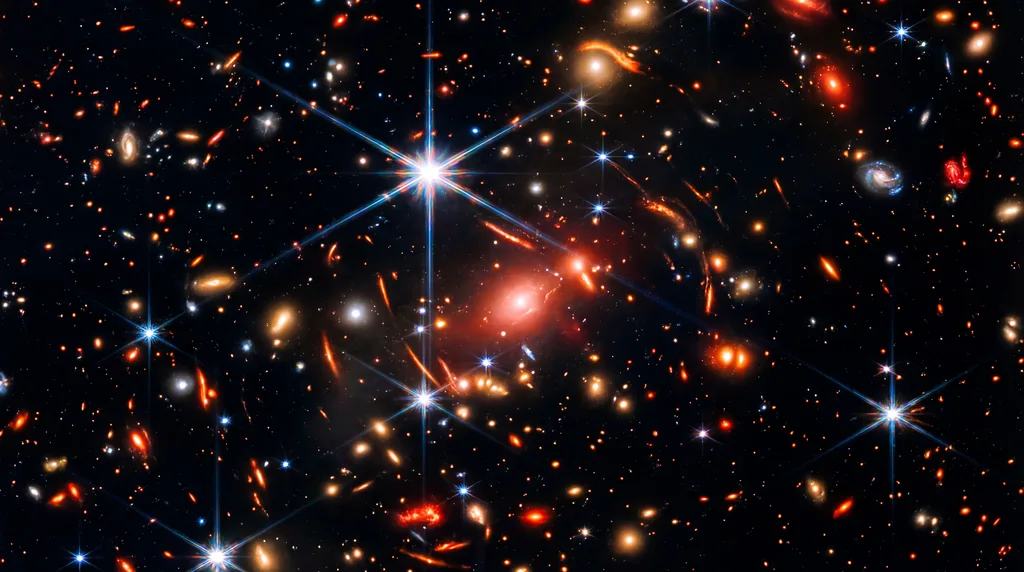

NASA’s James Webb Space Telescope (JWST) has once again redefined the limits of human observation by confirming the existence of a bright, robust galaxy that existed only 280 million years after the Big Bang. This discovery, identified in the research as MoM-z14 (and associated with the JADES-GS-z14-0 discovery suite), represents a monumental leap in our ability to probe the "Cosmic Dawn"—the era when the very first stars and galaxies began to illuminate the primordial darkness of the universe. By capturing light that has traveled for over 13.5 billion years, Webb has provided an unprecedented glimpse into the infancy of cosmic structure, challenging long-held theoretical models regarding how quickly the universe organized itself after its violent birth.
The New Frontier: Identifying MoM-z14
The identification of MoM-z14 was made possible through the JWST Advanced Deep Extragalactic Survey (JADES), an ambitious program designed to map the evolution of the earliest galaxies. While the Hubble Space Telescope previously offered hints of distant stellar populations, its sensitivity was limited by the "redshifting" of light—a process where the expansion of the universe stretches ultraviolet and visible light into the infrared spectrum. Webb, specifically engineered to operate in the near- and mid-infrared, has the unique capability to see through cosmic dust and detect these ancient, highly redshifted signals.
Confirming such a distant object requires more than just a high-resolution image; it demands precise spectroscopic data. Using Webb’s NIRSpec (Near-Infrared Spectrograph), researchers confirmed that MoM-z14 possesses a cosmological redshift of 14.44. This metric provides a definitive timestamp, placing the galaxy within the first 300 million years of the universe’s 13.8-billion-year history. "We can estimate the distance of galaxies from images, but it’s really important to follow up and confirm with more detailed spectroscopy so that we know exactly what we are seeing, and when," noted Pascal Oesch of the University of Geneva, a co-principal investigator on the survey.
A Galaxy That Defies Early Universe Expectations
Perhaps the most startling aspect of MoM-z14 is not its age, but its physical characteristics. According to current astrophysical simulations, galaxies in the very early universe were expected to be small, chaotic, and relatively dim. However, MoM-z14 is remarkably bright—nearly 100 times more luminous than theoretical studies predicted prior to Webb's launch. This luminosity suggests a significant mass of stars already in place, indicating that the processes of star formation and gas cooling occurred with unexpected efficiency in the wake of the Big Bang.
“With Webb, we are able to see farther than humans ever have before, and it looks nothing like what we predicted, which is both challenging and exciting,” said Rohan Naidu of the Massachusetts Institute of Technology’s (MIT) Kavli Institute for Astrophysics and Space Research. Naidu, the lead author of the study published in the Open Journal of Astrophysics, emphasizes that the sheer brightness of this galaxy suggests it is not an outlier, but perhaps representative of a much more active early universe than scientists had dared to imagine.
Pushing the Boundaries of the Observable Universe
The confirmation of MoM-z14 serves as a testament to the technological leap represented by the JWST. To capture these signals, the telescope’s 6.5-meter primary mirror collects faint photons that have been traveling across an expanding void since the universe was only 2% of its current age. This "time machine" effect allows astronomers to bypass the limitations of the local universe and observe the fundamental physics of galactic assembly in real-time. By surpassing the records held by both the Hubble Space Telescope and even earlier Webb observations, this discovery moves the "observable boundary" significantly closer to the Big Bang itself.
The concept of redshift is central to this achievement. As space-time expands, it stretches the light waves passing through it. A redshift of 14.44 indicates that the universe has expanded significantly since the light left MoM-z14. Effectively, Webb is detecting "fossil light" that has been altered by billions of years of cosmic expansion, requiring the telescope's sophisticated NIRCam and NIRSpec instruments to reconstruct the original nature of the galaxy.
Challenging Cosmic Evolution and Galactic Formation
The existence of such a mature-looking galaxy so early in the cosmic timeline presents a significant "tension" in modern cosmology. The standard model of the universe, known as Lambda CDM (Cold Dark Matter), provides a framework for how structure grows over time. However, the presence of MoM-z14 suggests that either the "seeds" of galaxies were planted earlier than thought, or that the rate at which dark matter pulls gas together to form stars is much faster than current equations allow.
Jacob Shen, a postdoctoral researcher at MIT and a member of the research team, noted that this discovery highlights a "growing chasm between theory and observation." To bridge this gap, researchers are looking for chemical clues within the galaxy's light. Interestingly, MoM-z14 shows evidence of unusual nitrogen enrichment. This same chemical signature is found in a small percentage of the oldest stars in our own Milky Way. By comparing these "stellar fossils" in our backyard to the active galaxies seen by Webb, scientists are beginning to piece together the chemical evolution of the entire cosmos.
Key Findings from the MoM-z14 Analysis:
- Redshift: Confirmed at 14.44, indicating a distance of 280 million years post-Big Bang.
- Luminosity: 100 times brighter than pre-launch theoretical models.
- Composition: Evidence of heavy element enrichment, specifically nitrogen, suggesting multiple generations of star birth happened very quickly.
- Implication: Galaxy formation was significantly more rapid in the early universe than previously hypothesized.
The Future of Deep Space Discovery
While MoM-z14 currently holds the record for the most distant confirmed galaxy, the Webb mission team believes this is only the beginning. The telescope's ongoing surveys continue to identify candidate objects that may exist even closer to the 100-million-year mark after the Big Bang. Each new discovery provides more data points to refine our understanding of dark matter's role in the early universe and the transition from the "dark ages" to the first light of the stars.
The implications of this research extend beyond mere record-breaking. They prepare the way for the next generation of observatories and help refine the physics that govern our understanding of gravity, light, and the origins of matter. As Webb continues to push the boundaries of the observable universe, it is not just observing history; it is actively rewriting the textbook on how our universe came to be. For Rohan Naidu and the JADES team, the focus now shifts to finding more of these "bright monsters" to determine if the early universe was truly a crowded, luminous frontier of rapid creation.




Comments
No comments yet. Be the first!