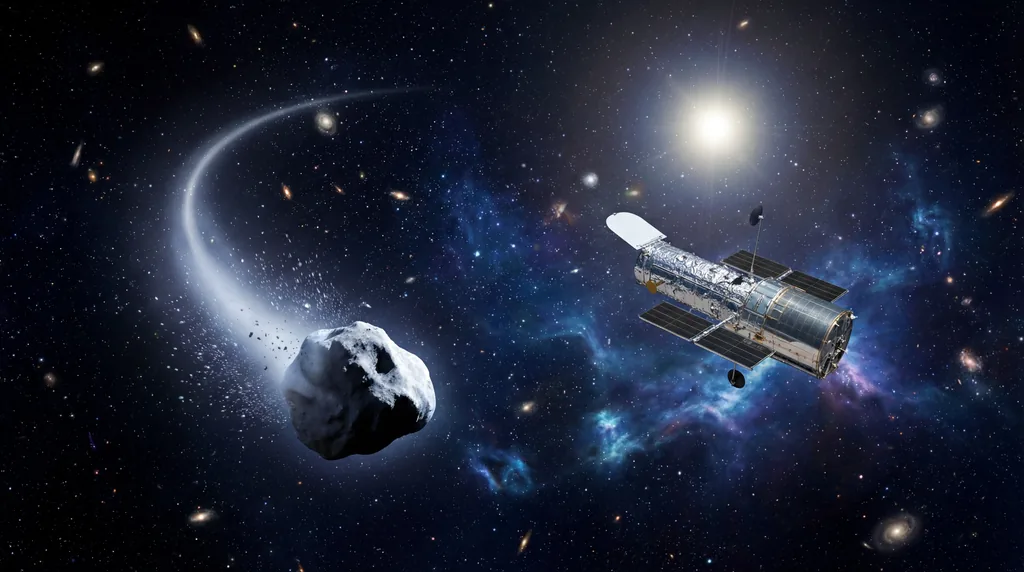

Volatile activity on a comet's nucleus causes anisotropic outgassing, where gas and dust are ejected unevenly due to the sublimation of ice as the comet approaches the Sun. This process produces recoil forces or torques that can dramatically alter a nucleus’s rotation. Recent data from the Hubble Space Telescope confirms that these natural thrusters can slow, stop, and even reverse a comet's spin direction.
Comet 41P/Tuttle-Giacobini-Kresák, a small Jupiter-family comet approximately 0.6 miles (1 kilometer) in diameter, has become the center of a groundbreaking study regarding small-body dynamics. Originally residing in the Kuiper Belt, the comet was redirected into the inner solar system by Jupiter’s gravitational influence and now completes an orbit every 5.4 years. Its small size, roughly three times the height of the Eiffel Tower, makes it particularly susceptible to rotational changes driven by surface activity.
The research, published in The Astronomical Journal on March 26, 2026, utilized a multi-observatory approach to track the comet's erratic behavior. Initial observations by the Discovery Channel Telescope at Lowell Observatory in March 2017 were compared with May 2017 data from NASA’s Neil Gehrels Swift Observatory, which revealed the comet’s rotation had slowed from 20 hours to nearly 60 hours. Follow-up imaging from the Hubble Space Telescope in December 2017 ultimately confirmed the rotation had reversed and accelerated to a 14-hour period.
What is the significance of this discovery for solar system evolution?
This discovery highlights how outgassing torques on small cometary nuclei can drive rapid spin changes, potentially leading to rotational instability, breakup, or fragmentation. By observing these shifts in Comet 41P, astronomers can better model the dynamical lifetimes of Jupiter-family comets and understand how surface activity exposes fresh ice through landslides and rapid physical evolution.
The rapid evolution of Comet 41P suggests that small comets may be far more temperamental than previously assumed. Researchers noted that the comet’s overall gas production has declined by an order of magnitude since its 2001 perihelion passage. This suggests that the comet’s surface is depleting its volatile materials at an accelerated rate, which could eventually lead to the object becoming an inert, asteroid-like body or disintegrating entirely under the stress of its own shifting rotation.
How the Hubble Space Telescope tracked the mechanics of outgassing
The Hubble Space Telescope identified that as Comet 41P approached the Sun, frozen gases sublimated to create high-pressure surface jets that acted as natural thrusters. These unevenly distributed jets applied a rotational torque to the small 1-kilometer nucleus, successfully slowing its initial spin to a standstill before forcing it to rotate in the opposite direction at a much higher velocity.
“Jets of gas streaming off the surface can act like small thrusters,” explained David Jewitt, a researcher at the University of California at Los Angeles (UCLA) and lead author of the study. Jewitt compared the phenomenon to a merry-go-round: if you push against the direction of motion, you can eventually stop it and force it to turn the other way. Because 41P is so small, the force required to "torque" or twist the nucleus is significantly lower than that required for larger comets, making this spin reversal a visible reality.
Is the spin reversal of this tiny comet a first for the Hubble Space Telescope?
While changes in cometary spin have been documented in larger bodies, this is the first time researchers have observed definitive evidence of a comet completely reversing its rotation. The Hubble Space Telescope captured Comet 41P transitioning from a slowed state to a reversed high-speed spin, marking a milestone in the study of how volatiles dictate the physical fate of small bodies.
The study provides a rare look at the rotational dynamics of a nucleus in real-time. Previous observations of other comets have shown minor increases or decreases in spin, but the 180-degree change in direction observed in Comet 41P is unprecedented. This dramatic shift is attributed to the specific distribution of active vents on the comet's surface, which happened to align in a way that opposed the original angular momentum of the body during its 2017 transit.
Future Directions in Cometary Research
Looking ahead, the discovery of 41P's spin reversal will necessitate more frequent monitoring of small-body rotation during perihelion passages. Understanding the structural integrity of these bodies is critical for future deep-space mission planning, as a rapidly spinning or unstable nucleus poses significant challenges for landing or proximity operations. Future missions may target these "temperamental" comets to study how the internal composition shifts as the outer crust is reshaped by rotational stress.
Astronomers now aim to use the Hubble Space Telescope and upcoming observatories to determine if other Jupiter-family comets exhibit similar "braking" behaviors. By cataloging the rotational history of these objects, the scientific community can build a more comprehensive map of Solar System evolution, tracing how the smallest inhabitants of our neighborhood survive the intense heat and pressure of repeated solar encounters.





Comments
No comments yet. Be the first!