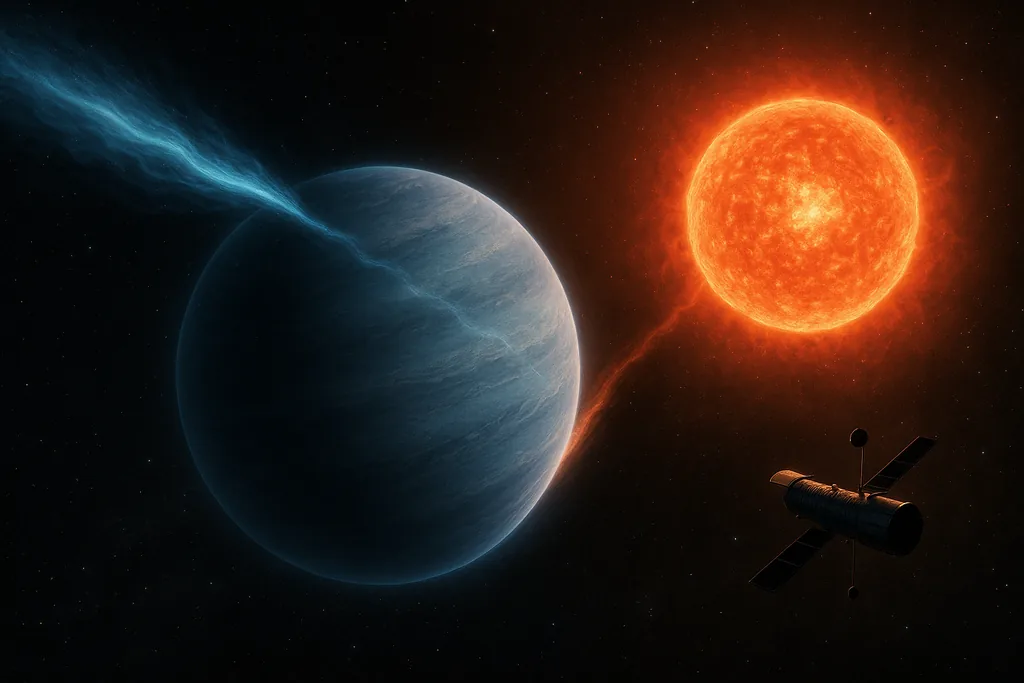
A vanishing world seen in ultraviolet
For astronomers peering in ultraviolet light, a Neptune-sized world some 96 light-years away looks less like a planet and more like a comet. Hubble Space Telescope spectra reveal a vast cloud of neutral hydrogen surrounding GJ 3470b, blown off the planet and streaming into space; the signal is strong enough that researchers estimate the planet has already lost a sizable fraction of its original mass and is evaporating faster than any comparable world yet studied.
How the signal was found
The detection comes from repeated observations of GJ 3470b’s transit across its red-dwarf host star, taken in the Lyman-α line of hydrogen as part of the Panchromatic Comparative Exoplanet Treasury (PanCET) program. The Hubble data show deep, repeatable absorption during transit: roughly 35% in the blue wing of the line and 23% in the red wing, signatures that point to a large, structured envelope of neutral hydrogen reaching well beyond the planet’s Roche lobe. These measurements allowed the team to model escaping material and infer a contemporary neutral-hydrogen loss rate on the order of 10^10 grams per second.
Physics of escape: heating, radiation pressure and Roche limits
Close-in planets are bathed in their star’s X-ray and extreme-ultraviolet radiation (XUV). That energy heats the upper atmosphere, driving it into hydrodynamic flow: the gas expands until individual particles escape the planet’s gravity. For GJ 3470b this process is amplified because the world is relatively low density and orbits a young, active M-dwarf, so the star’s radiation pressure and high-energy flux push neutral hydrogen away at high speeds. Numerical simulations that combine observed stellar irradiation with particle dynamics reproduce the Hubble absorption signatures and imply the planet is losing material far faster than previously measured warm Neptunes.
Exosphere shape gives a clue to the dynamics
GJ 3470b’s absorption is asymmetric in velocity, with both blue- and redshifted components. That pattern—an extended blue wing indicating atoms being accelerated away from the star and a red wing consistent with dense, slow-moving gas—suggests multiple regions in the escaping flow. The analysis favors an ellipsoidal, elongated thermosphere that can extend tens of planetary radii ahead of and behind the planet, and it may include a shocked layer where outflowing planetary gas collides with the stellar wind. These geometric details are what let astronomers move from a mere detection of a cloud to an estimate of the mass-loss history.
How much has already gone, and what the future may hold
Projecting the inferred escape rate backward under reasonable assumptions about the star’s past activity, the team estimates that GJ 3470b may already have lost between roughly 4% and 35% of its current total mass over its roughly two‑billion‑year lifetime—and that fraction could be larger if the star was dramatically brighter in XUV when young. Continued escape at comparable average rates could strip the planet of most of its hydrogen envelope in a few billion years, leaving behind a much smaller, rocky core—one evolutionary path that may help explain why so few Neptune‑sized planets are observed very close to their stars. The calculations carry substantial uncertainties, however: mass‑loss rates depend on the uncertain history of stellar activity, the composition and thermal structure of the atmosphere, and interactions with the stellar wind.
Context: the evaporation desert and population evolution
Exoplanet surveys have long noted a relative dearth of intermediate-sized planets at short orbital distances—a feature sometimes called the "evaporation desert." One explanation is that many warm Neptunes formed with thick hydrogen/helium envelopes but were whittled down to super‑Earths and mini‑Neptunes by sustained atmospheric escape. GJ 3470b sits close to that desert’s edge, and its vivid ongoing loss provides a direct, observable example of the erosion mechanism in action. Comparing GJ 3470b to the better-known evaporating Neptune GJ 436b shows that escape behaviour can vary widely between similar planets because of differences in density and host‑star activity.
Observational challenges and why ultraviolet is critical
Studying hydrogen escape relies on ultraviolet spectroscopy, and that presents a major observational limitation: the interstellar medium scatters and absorbs Lyman-α, so only relatively nearby systems—within roughly 150 light‑years and with favourable lines of sight—are accessible. Hubble’s ultraviolet capability has therefore been essential, and the PanCET program’s multi-epoch approach made it possible to separate planetary signals from stellar variability and instrumental effects. Complementary tracers, like helium seen in the infrared, bypass some of the Lyman-α limitations and are accessible to instruments such as the James Webb Space Telescope and ground-based spectrographs tuned to helium lines; those observations are a high priority because they can probe lower-velocity regions of the flow and help close the bookkeeping on total mass loss.
Open questions and next steps
Despite the clarity of the Hubble signal, key uncertainties remain. Translating a measured neutral‑hydrogen loss rate to a total atmospheric-mass loss requires assumptions about the ionization balance and the fraction of heavier species carried away in the outflow. The star’s high-energy history—how luminous it was in XUV when it was young—dominates estimates of integrated mass loss and is only indirectly constrained. Going forward, astronomers plan multi-wavelength follow-up: helium searches in the infrared, additional ultraviolet monitoring to check for long‑term stability or changes linked to stellar activity, and comparative surveys that expand the sample of warm Neptunes observed in Lyman‑α. Together these observations will refine the role of evaporation in sculpting exoplanet populations.
GJ 3470b is therefore both a laboratory and a warning: under the relentless influence of a nearby star, a world can slowly peel itself into something entirely different. That evolution—messy, extended and visible if you know where to look—may be a common chapter in the life stories of many planets orbiting small, active stars.
Sources
- Astronomy & Astrophysics (research paper: "Hubble PanCET: an extended upper atmosphere of neutral hydrogen around the warm Neptune GJ 3470b").
- Johns Hopkins University / PanCET press materials on Hubble observations of GJ 3470b.
- Space Telescope Science Institute (Hubble mission support and PanCET program documentation).




Comments
No comments yet. Be the first!