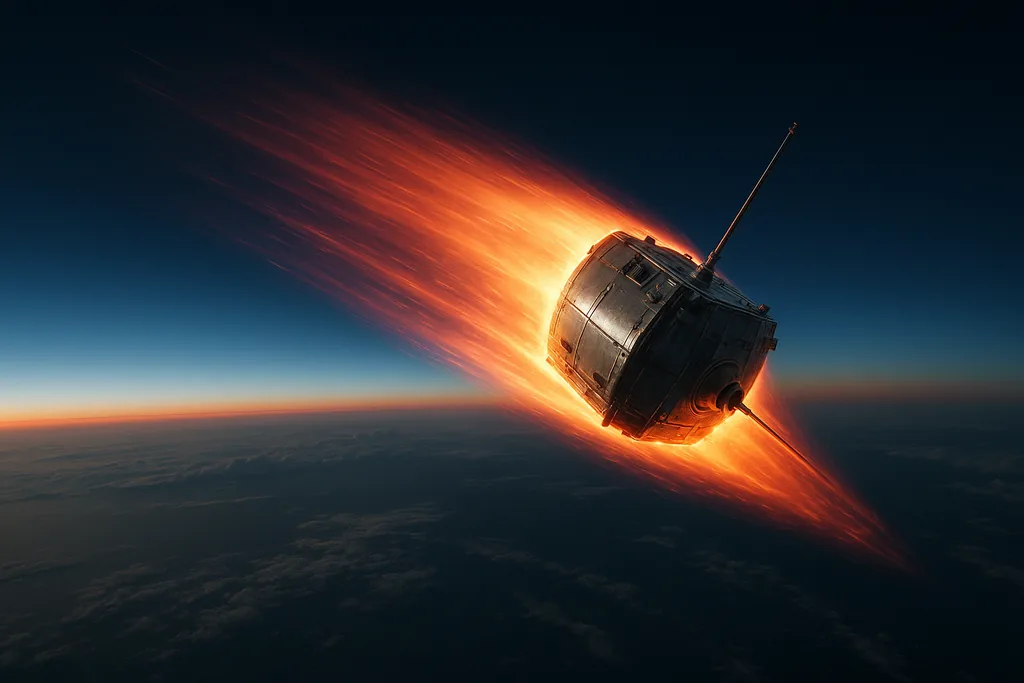
Early on Wednesday, March 11, 2026, a now-defunct NASA craft made headlines when the spacecraft makes uncontrolled plunge back to Earth, streaking through the equatorial Pacific. The craft was Van Allen Probe A — a 1,323-pound scientific satellite launched in 2012 to study Earth's radiation belts — and US Space Force tracking data cited by astronomers and NASA placed its fiery descent south of Mexico and west of Ecuador. NASA and military trackers said most of the vehicle was expected to burn up, though a few dense components could have survived; they placed the statistical risk that debris might harm a person at roughly 1 in 4,200.
Why this spacecraft makes uncontrolled plunge earlier than planned
The Van Allen probes were retired in 2019 when they ran out of fuel; mission planners expected them to remain in orbit for many years, with initial forecasts putting Probe A's re-entry around 2034. Those calculations, however, did not fully anticipate the pace of space-weather-driven changes in the upper atmosphere. The Sun reached a lively solar maximum around 2024 and has remained active, heating and expanding the upper atmosphere and increasing aerodynamic drag on objects in near-Earth space. That extra drag gradually sapped orbital energy from Probe A and pulled it into denser layers of the atmosphere years ahead of schedule.
A second reason is procedural: once spacecraft run out of propellant they cannot perform the controlled deorbit burns that would steer them to a planned, low-risk reentry over unpopulated ocean areas. Without fuel or functioning guidance to execute a precise deorbit, a vehicle is left to decay under gravity and atmospheric drag — the classic scenario for an uncontrolled re-entry. Engineers design many satellites to ‘‘design for demise’’ if possible, but older hardware like Probe A was built to survive harsh conditions to gather science, not necessarily to disintegrate entirely on return.
How agencies predict when a spacecraft makes uncontrolled plunge back to Earth
Predicting the timing and location of an uncontrolled re-entry is a probabilistic exercise, and agencies rely on a network of military and commercial sensors to refine forecasts. The U.S. Space Force operates cataloguing and tracking systems that provide orbital data; research astronomers and private firms such as space-tracking companies ingest those feeds to run re-entry models. Those models simulate the object's current orbit, atmospheric density, the incoming solar flux, and how the vehicle's shape and mass will respond to heating and drag.
Even with sophisticated tools, uncertainty is significant. For Probe A, the Space Force published a prediction window with an uncertainty of roughly +/-24 hours, because small changes in atmospheric density or an unexpected attitude change in the spacecraft can shift where and when decay accelerates. Analysts update forecasts as the object descends and more precise tracking becomes available. In practice, that means agencies can say with growing confidence when a reentry will occur and narrow the longitude band where debris could fall, but they rarely — if ever — can predict an exact impact point for uncontrolled events.
What survives re-entry and how dangerous such events are
Putting that number in context helps. Oceans cover roughly 70% of Earth's surface, so the most likely outcome for surviving fragments is an impact into water. Historical precedent shows both the typical and exceptional outcomes: large objects have returned without causing harm (the uncontrolled re-entry of China's Tiangong-1 space station in 2018 produced no reported injuries), while rarer incidents have scattered debris across land — including a 2024 case where a small piece of space hardware reportedly pierced the roof of a house in Florida. Space-trackers estimate that roughly one object a week of meaningful mass survives to the ground somewhere on Earth, but most are small and fall in uninhabited areas.
Policy choices, safety measures and the growing debris challenge
Space agencies and satellite operators use several strategies to reduce the risk from reentering hardware. The U.S. requires that government-launched vehicles be disposed of or deorbited within 25 years of mission end; mission teams are encouraged to plan end-of-life strategies such as a controlled deorbit, a transfer to a graveyard orbit, or design-for-demise choices that make surviving components unlikely. In practice, trade-offs exist: executing an intentional deorbit consumes fuel that might otherwise be used for science, while leaving an object in a graveyard orbit adds to long-term orbital congestion.
Experts argue the Van Allen Probe A event is a reminder of both the limitations of past design choices and the changing environment in LEO. More frequent launches, larger constellations, and a more energetic Sun have combined to make debris mitigation a central policy and engineering problem. Analysts at institutions such as The Aerospace Corporation and universities have pushed for stricter design standards, better post-mission disposal planning, and investment in active debris-removal technologies to reduce the number of large, trackable objects that can later become uncontrolled risks.
For the public, immediate safety measures are mostly about information and monitoring. Agencies issue reentry predictions and updates to give affected regions and national authorities time to assess risk. For high-risk scenarios — very rare — authorities could issue local warnings; for the routine case, the key protection is that most surviving debris falls into oceans or uninhabited areas and the statistical risk to any individual remains extremely small.
Examples from past uncontrolled re-entries
Recent uncontrolled returns provide useful comparisons. In 2018, China's Tiangong-1 space station reentered over the South Pacific after losing attitude control, drawing attention to the global coordination needed for debris tracking. In 2022 a Chinese rocket booster made an uncontrolled return that prompted scrutiny and diplomatic commentary. Historical Cold War-era objects such as the Soviet Kosmos 482 capsule illustrate how long-lived hardware can remain in orbit and later reenter decades after launch — sometimes with a higher likelihood of surviving reentry because they were built to endure planetary descent environments. These cases reinforce why accurate tracking and transparent updates from agencies are important.
The Van Allen mission itself leaves a positive scientific legacy even as Probe A returned in an uncontrolled way. The twin probes fundamentally improved understanding of the radiation belts, revealing transient structures and dynamics that inform how satellites and future crews will be protected from space weather. The unexpected timing of Probe A's return highlights an operational consequence of those same space-weather dynamics: the environment researchers study also changes the fate of the hardware that studies it.
Sources
- NASA (Van Allen Probes mission materials and reentry statement)
- U.S. Space Force (space object tracking and reentry predictions)
- Johns Hopkins Applied Physics Laboratory (Van Allen Probes development)
- Harvard–Smithsonian Center for Astrophysics (orbital tracking and commentary)
- Delft University of Technology (context on legacy re-entries such as Kosmos 482)
- The Aerospace Corporation (space debris assessment and policy analysis)




Comments
No comments yet. Be the first!