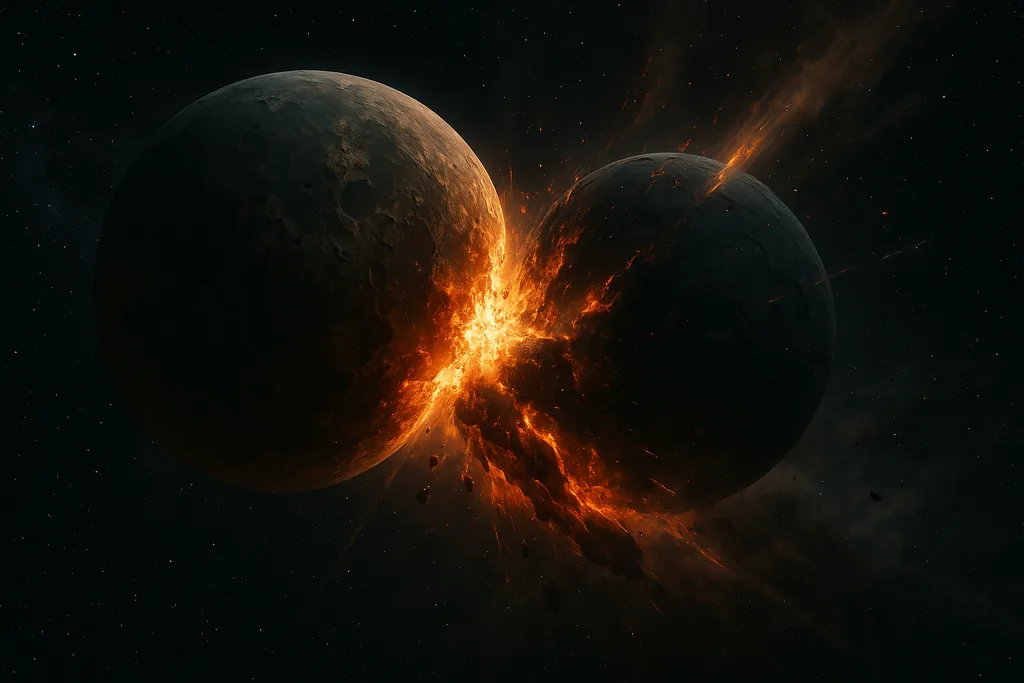
University of Washington astronomers identified evidence of a planetary collision by observing a massive infrared brightness spike followed by a dramatic dimming of visible light around the star Gaia20ehk. This sequence indicates that two massive exoplanets collided, creating a glowing, molten debris cloud that eventually orbited in front of the star, blocking its light from Earth’s perspective. This rare observation provides critical empirical data supporting the Giant Impact Hypothesis.
The discovery, led by University of Washington doctoral candidate Andy Tzanidakis and research professor James Davenport, was published on March 11, 2026, in The Astrophysical Journal Letters. This research marks a significant milestone in exoplanet studies, as witnessing the immediate aftermath of such a cosmic impact is exceptionally rare. By analyzing data from a sun-like star 11,000 light-years away in the constellation Puppis, the team has provided a "real-time" look at the violent processes that likely shaped our own solar system billions of years ago.
What evidence did UW astronomers find of two planets colliding?
Astronomers found evidence of a planetary collision through a combination of infrared brightening followed by visible light dimming over a multi-year period. Roughly 2.5 years before the star Gaia20ehk dimmed in late 2021, it exhibited a significant spike in infrared brightness, signaling a massive heat release of approximately 1,000 Kelvin. This thermal energy, followed by an erratic 500-day dimming event, confirmed the presence of a vast, hot debris cloud resulting from the impact of two massive exoplanets.
The methodology involved combing through archival telescope data to find "extreme variability" in otherwise stable stars. Tzanidakis noted that the star’s light output remained "nice and flat" until 2016, when three preliminary dips in brightness occurred. These initial flickers are theorized to be "grazing impacts" as the two planets spiraled toward their final catastrophic meeting. The subsequent infrared spike captured by thermal-sensing telescopes provided the "smoking gun" that the material blocking the star was not merely cold dust, but superheated wreckage from a planetary smash-up.
Why did the star's brightness go 'bonkers' in 2021?
The star’s brightness fluctuated dramatically—or went "bonkers"—in 2021 because a massive cloud of gas, vaporized rock, and dust from the planetary collision began passing in front of it. As this debris cloud orbited the star at a distance of roughly one astronomical unit, it patchily obscured the light reaching Earth, creating a chaotic flickering pattern that lasted for several hundred days as the material dispersed and settled.
According to Tzanidakis, stars like our sun do not typically exhibit such wild fluctuations, making Gaia20ehk a primary candidate for studying protoplanetary disk evolution. The sheer volume of material required to cause such significant dimming suggests the involvement of two large bodies, likely similar in scale to "ice giants" or massive rocky worlds. The debris cloud is currently situated at a distance from its star comparable to the Earth-Sun orbit, offering a unique laboratory to watch how new planetary systems find equilibrium after a cataclysmic collision.
Understanding the Giant Impact Hypothesis
The Giant Impact Hypothesis is the leading scientific theory proposing that the Earth-Moon system formed following a collision between the early Earth and a Mars-sized body named Theia. The discovery at Gaia20ehk provides a rare, observable analog for this event. James Davenport emphasized that the moon is likely a "magical ingredient" for life, as it stabilizes Earth’s tilt, creates tides, and shields the planet from asteroids. Observing similar impacts in distant systems allows scientists to estimate how common these life-supporting dynamics might be across the galaxy.
During the early stages of a solar system, gravity forces together gas, ice, and rocky debris to form planets. This process is inherently chaotic, often resulting in planets being ejected into deep space or colliding with one another. The University of Washington team believes that by studying the cooling rate of the debris around Gaia20ehk, they can predict whether the remaining material will eventually coalesce into a new moon or a stabilized planetary pair, mirroring the 100-million-year winnowing process that occurred in our own neighborhood.
Could the Vera C. Rubin Observatory detect more planet collisions?
The Vera C. Rubin Observatory is expected to detect as many as 100 new planetary collisions over the next decade through its Legacy Survey of Space and Time (LSST). By utilizing the powerful Simonyi Survey Telescope to conduct wide-field monitoring of the sky, the observatory will be uniquely equipped to identify the short-lived brightness fluctuations and infrared spikes that characterize these rare cosmic impacts.
- Broad Coverage: The Rubin Observatory will scan the entire available sky every few nights, catching transient events that previous surveys might have missed.
- Statistical Mapping: With a projected 100 detections, astronomers can finally move from case studies to statistical models of planetary formation.
- Astrobiology Links: Identifying the frequency of these impacts will help narrow the search for habitable exoplanets that possess moons.
- Technological Synergy: Combining Rubin's visible light data with infrared observations from missions like JWST will provide a 3D view of planetary evolution.
The Future of Planetary Evolution Research
The discovery of the Gaia20ehk collision is a "call to action" for the global astronomical community. As the dust literally and figuratively settles in that distant system, the University of Washington researchers are looking toward advanced ground-based and space-based observatories to refine their findings. The goal is to determine how often these impacts lead to the formation of stable, Earth-like environments versus barren debris fields.
As Andy Tzanidakis concludes, the rarity of capturing these moments in real-time cannot be overstated. With the upcoming Legacy Survey of Space and Time, the field of astrophysics is on the verge of a data revolution. Capturing the "birth cries" of new worlds through their violent collisions will ultimately help humanity understand its own place in a dynamic and ever-changing universe, proving that the chaos of the past is the key to identifying the habitable worlds of the future.




Comments
No comments yet. Be the first!