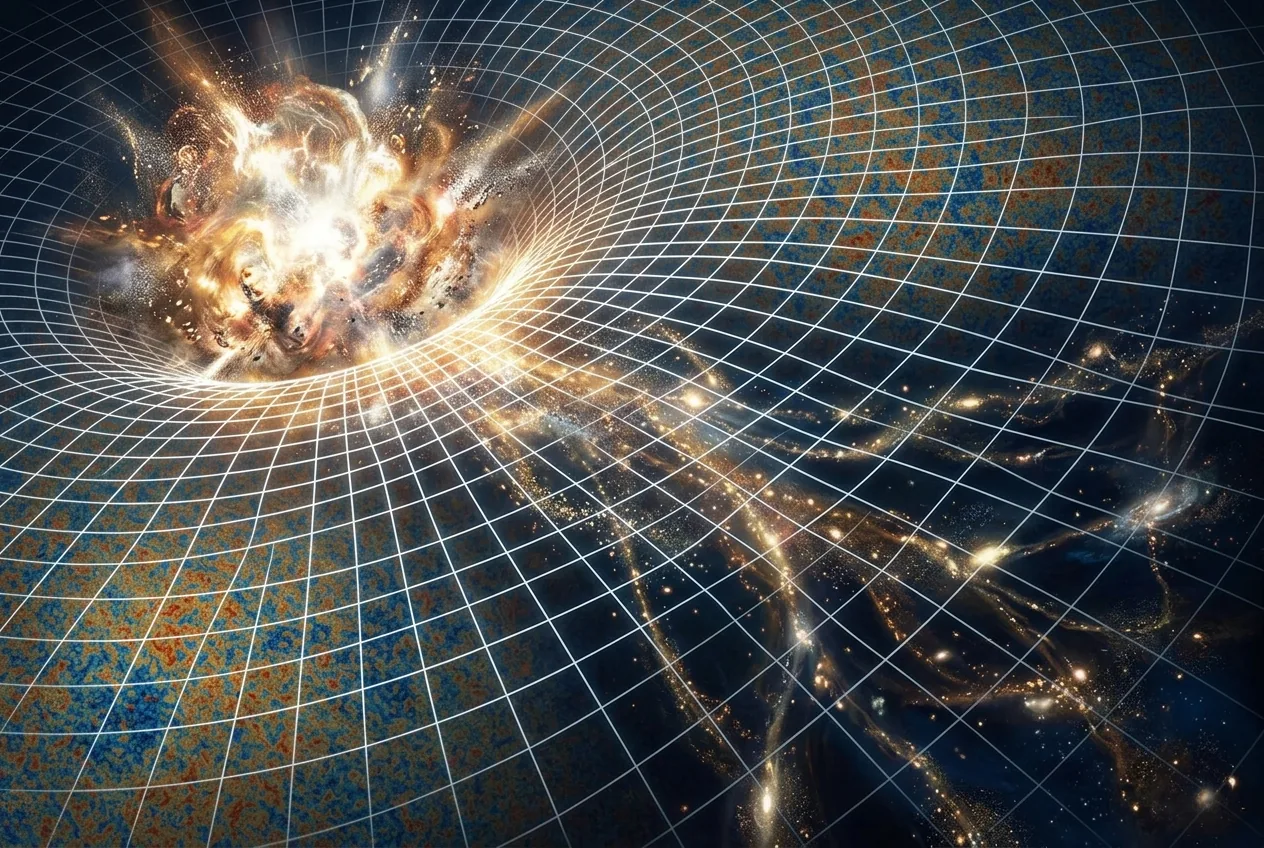
When a paper quietly appeared in Physical Review Letters, it set off a familiar mixture of hope and caution in cosmology circles.
The immediate stake: why a tweak einstein's relativity could matter to cosmology
The singularity at t = 0 is not just an embarrassing footnote; it is a statement that our current theory hits a wall. General relativity has passed every observational test thrown at it from planetary motion to black holes, but it predicts its own failure when curvature and densities diverge. The new QQG proposal is attractive because it aims to remain close to Einstein at ordinary scales while altering gravity's behaviour where classical theory fails. That has two practical implications: it potentially removes the mathematical pathology of a singularity, and it may produce an inflation-like expansion without invoking a separate, unseen inflaton field.
For working cosmologists, that’s not a gratuitous elegance. Inflation as usually modelled requires a specific field with carefully tuned properties. A gravitational mechanism that naturally generates rapid early expansion would change how we think about the ingredients of the infant universe, and — crucially for scientists who love to break models experimentally — it makes slightly different observational predictions for primordial gravitational waves and the cosmic microwave background.
How the tweak einstein's relativity could avoid the singularity
Where the tweak einstein's relativity could be tested
A theory that only changes physics at unattainable energies would be interesting mathematically and not much else. The crucial claim from Afshordi and colleagues is that QQG leaves imprints that are in principle observable. The most promising arenas are the cosmic microwave background and primordial gravitational waves: both are fossils of the early universe and sensitive to the dynamics of its first fractions of a second.
That roadmap has a European angle. The continent hosts world-class CMB groups, and planned projects — from ground-based arrays to satellite concepts — would strengthen the sensitivity needed to separate competing early-universe models. At the same time, the global gravitational-wave network (LIGO, Virgo, KAGRA) demonstrates that observational leaps can be made with investment and coordination; for primordial signals, a mix of CMB, pulsar timing and future detectors will be required.
Sceptics' corner: mathematical and physical hurdles
No new theory of quantum gravity sails through unopposed. Historically, higher-derivative gravity theories often face two kinds of headaches: potential violations of unitarity (ghost states) and the difficulty of embedding the Standard Model consistently. The current paper argues QQG is a mathematically consistent completion in a certain technical sense, but parts of the community will want to see more detailed proofs that ghost modes are either absent or harmless and that the theory couples sensibly to known particles.
On the observational side, the predicted differences are small and could be degenerate with other early-universe physics or astrophysical foregrounds. That means even if nature did follow QQG's rulebook, extracting a smoking-gun signal will require both sensitive instruments and careful statistical work. The cosmology community knows this dance well: many proposals sit on the theoretical shelf for years until an experimental program matures enough to discriminate among them.
European instruments, industrial policy and the political bit that nobody likes
If detecting signatures of a new gravitational regime depends on long-term, expensive instrumentation, then scientific arguments soon cross into policy and budgets — an area Europeans are remarkably adept at complicating. Europe’s planned investments in next-generation observatories, including a proposed Einstein Telescope for gravitational-wave astronomy and strong participation in CMB initiatives, would directly strengthen the experimental leverage over early-universe physics. Germany has industrial strengths in cryogenics, detector manufacturing and high-precision engineering that feed into these projects, but turning capable laboratories into decisive experiments requires Brussels to write cheques and governments to agree host sites.
The upshot is blunt: theoretical progress like QQG gives policymakers a reason to back fundamental infrastructure, but it also exposes the usual European mismatch between technical capacity and timely political commitment. Europe can build the instruments; whether it builds them on the timescales needed to test speculative but plausible tweaks to gravity is another matter.
What would convince the community that the tweak matters?
Evidence that would move QQG from tantalising to compelling must be empirical. A detection of a primordial gravitational-wave spectrum with features statistically inconsistent with standard single-field inflation, or a CMB B-mode pattern that matches QQG predictions better than alternatives, would be persuasive. Complementary theoretical work that demonstrates QQG’s internal consistency when coupled to particle physics — and that rules out pernicious ghost modes — would close the loop.
Until then, QQG sits in the normal sweet spot for theoretical physics: close enough to observational reality to be testable on decade timescales, but distant enough that measured answers will take a mix of patience, instrument-building and, yes, political will.
So where does this leave us?
The paper is a reminder that cosmology's big conceptual problems — the singularity, the origin of inflation, the quantum nature of spacetime — can sometimes admit pragmatic, conservative fixes rather than radical new sectors. That fact makes QQG worth watching even for those predisposed to scepticism. It also highlights the value of European investment in the experimental side of cosmology: the instruments that could confirm or falsify such tweaks will largely be multi-decade projects where continental coordination matters.
In short: the tweak einstein's relativity could erase the Big Bang singularity on paper, but turning that paper into a change of cosmic narrative needs detectors, dollars and patience. Europe has two of the three; Brussels is still negotiating the third.
Sources
- Physical Review Letters (paper on quadratic quantum gravity)
- University of Waterloo (Niayesh Afshordi and research group)
- Perimeter Institute for Theoretical Physics




Comments
No comments yet. Be the first!