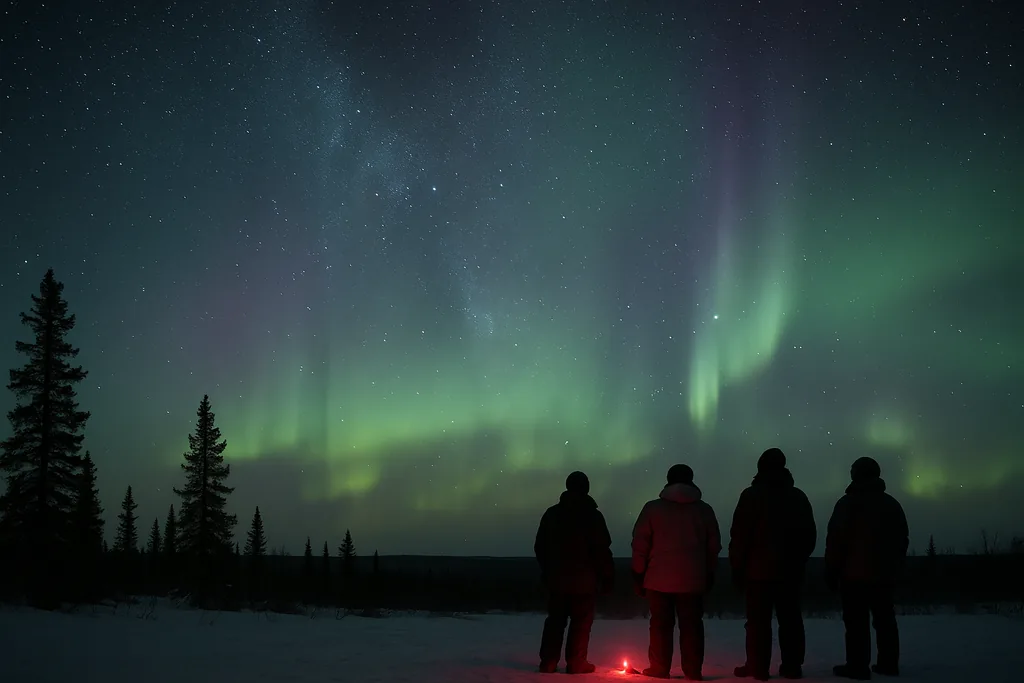
A short window for a rare, northern sky show
Tonight, as solar wind buffets Earth's magnetic field, skywatchers across the northern U.S. have a fresh chance to watch northern lights states stretch from Alaska to the upper Midwest and New England. The National Oceanic and Atmospheric Administration's Space Weather Prediction Center (SWPC) says geomagnetic activity is expected to reach minor storm levels (G1) overnight, and that raises the odds that faint auroras will be visible on the northern horizon between roughly 10 p.m. and 2 a.m. local time. If you plan to go outside, bring extra layers, choose a dark location with a clear view of the northern sky, and keep an eye on live forecasts—conditions can change hour to hour.
What the sun is doing tonight
The immediate driver behind tonight's aurora chance is a stream of fast solar wind—reported in the range of roughly 600 to 700 kilometers per second—emanating from a coronal hole on the Sun. Those high-speed streams compress and twist Earth's magnetic field, allowing charged particles to rain into the upper atmosphere and light up oxygen and nitrogen atoms; the result is the aurora borealis. SWPC characterises the event as a G1, or "minor", geomagnetic storm, which corresponds to a Kp index near 5: enough to push visible aurora down to higher mid-latitudes under dark skies, but not guaranteed to fill the sky everywhere at once.
watch northern lights states: where to look
The SWPC aurora viewline and recent forecasts place the best chances in 11 states that border Canada or are at high northern latitude. Those states include Alaska (where auroras are often bright and frequent) and, in the continental U.S., Washington, Idaho, Montana, Wyoming, North Dakota, South Dakota, Minnesota, Wisconsin, Michigan (especially the Upper Peninsula) and Maine. Within that band, the highest probabilities are generally in the far northern counties and areas with minimal light pollution—think Fairbanks and interior Alaska, the northern reaches of Minnesota and North Dakota, and Michigan's Upper Peninsula. States farther south in the list may only see faint glows low on the horizon, so its helpful to know local geography and pick a wide, north-facing view.
watch northern lights states: how to plan and track
To maximise your chance to watch northern lights states tonight, combine three pieces of information: the aurora forecast (how strong the geomagnetic activity is), the short-term 30-minute aurora maps that show where particle precipitation is occurring, and the local cloud forecast. SWPC provides experimental aurora viewline products and a 30-minute aurora forecast that update frequently; independent trackers and space-weather sites also post live solar wind speeds and Kp estimates. For planning, aim for the core window between 10 p.m. and 2 a.m. local time, with midnight often the most active hour; double-check the moon phase and cloud cover, because a bright, low sky or broken clouds will drown out faint auroral glows even when geomagnetic conditions are favourable.
How conditions affect visibility
Several simple conditions determine whether you'll actually see the lights. First, geomagnetic intensity: a G1 storm (Kp ≈ 5) can push auroras into the northern tier of U.S. states, while stronger storms are required to reach much farther south. Second, darkness and light pollution: auroras that look pale to the naked eye can show clearly on a phone camera if you are away from city lights, so choose a rural or high-elevation site if possible. Third, clouds and local weather: even a modest cloud deck to the north will block the view. Finally, your location relative to the auroral oval matters—being directly under the oval produces the brightest displays; at the edges you may only catch faint curtains near the horizon.
Practical steps to find the best viewing spot
Photographing and spotting faint auroras
Photography both helps you record the event and reveals faint auroras that are hard to see with the naked eye. Many modern smartphones include a Night Mode or Pro mode that can capture long exposures—point them north and keep the phone steady, or use a small tripod. For dedicated cameras, set a wide-angle lens, manual focus to infinity, ISO in the 800–3200 range (adjust by camera sensitivity), and starting exposures from 5 to 20 seconds depending on how fast the aurora is moving; check your results and reduce exposure if stars become trails. If you don't have a camera, sweep the sky slowly: faint auroras can appear as a diffuse green or gray glow low on the horizon and sometimes strengthen into ribbons of color within minutes.
Timing, apps and real-time tracking
The best single-night window is typically late evening through early morning; for tonight, NOAA forecasters recommend looking between 10 p.m. and 2 a.m. local time, with the peak often around midnight. To track activity in real time, use NOAA SWPC’s aurora products and short-term forecasts, monitor reported Kp and solar wind speeds, and consult live aurora maps from well-known space-weather services. Several smartphone apps specialise in aurora alerts and live maps; set notifications, but remember that local cloud cover and horizon obstructions can still make an otherwise promising alert invisible from your location.
Safety, comfort and community etiquette
Cold-weather preparedness matters: bring warm layers, boots, extra batteries (phone and camera batteries drain faster in the cold) and a thermos of something hot. If you drive to a remote spot, tell someone where you are going and watch road conditions—ice or drifting snow can make rural roads hazardous. Be mindful at popular viewing sites: park safely, avoid blocking roads, and minimize bright lights that can impede other viewers' night vision. If you encounter photographers or local guides, respect access rules for private land and follow any posted park regulations.
When the sky finally erupts—whether a faint green ribbon near the treeline or a sudden, vivid curtain—the effect can be quietly profound. Even a minor geomagnetic storm like tonight's can create memorable views for communities that rarely see aurora at all, and for dedicated skywatchers it's another chance to connect directly with the dynamic Sun–Earth relationship.
Sources
- NOAA Space Weather Prediction Center (aurora forecasts and aurora viewline products)
- NASA Heliophysics (solar wind and solar cycle context)
- (solar wind and coronal hole reporting)




Comments
No comments yet. Be the first!