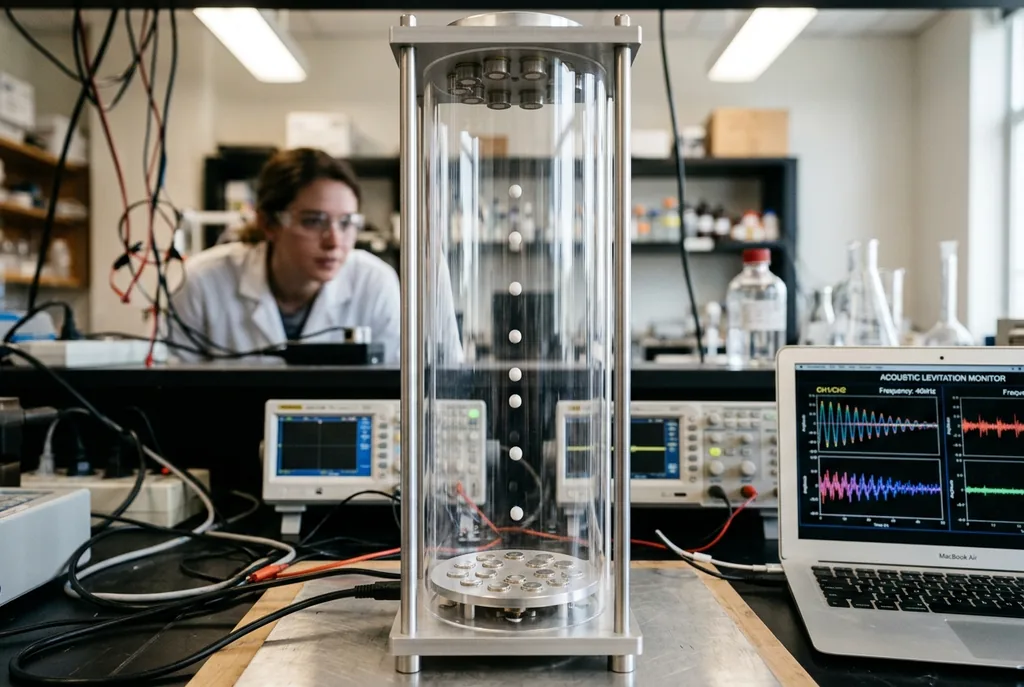
A ring of tiny styrofoam beads hovers in a foot‑tall column of sound and, to anyone watching, begins to pulse with a stubborn, steady rhythm — like a choir of metronomes that won’t fall into step. Inside that small, noisy stage the team at New York University watched motion that felt asymmetric: larger beads nudged smaller ones far more than the reverse, and the whole ensemble settled into a repeating dance that the authors call a time crystal.
The moment matters because this floating time crystal is visible without cryogenics or ultracold atoms and because the interactions that sustain its beat are explicitly nonreciprocal. Published on 22 March 2026 in Physical Review Letters and presented in a New York University release the same day, the experiment reports wave‑mediated forces carried by sound that do not come in equal and opposite pairs at the particle level — a tension with the usual statement of Newton’s third law that has physicists squinting at assumptions about momentum, boundaries and what ‘violation’ actually means.
This floating time crystal on a tabletop, and why people are talking
The setup is deliberately domestic: a compact acoustic levitator about the size of a shoebox, styrofoam beads the size of packing peanuts, and a microphone‑quiet hum of ultrasonic sound. That ordinariness is the point. "Our system is remarkable because it's incredibly simple," the paper’s senior author told university press materials, and the simplicity makes the odd behaviour easy to observe and to probe in detail.
People care for two reasons. First, most time crystals so far have lived in exotic settings — driven quantum systems, superconducting qubits, or laser‑cooled ion chains — and required specialized equipment. A visible, classical table‑top time crystal changes the experimental landscape by inviting a wider set of tests and applications. Second, the interactions here are carried by a field (sound) that can be scattered unevenly by different objects, producing a clear nonreciprocity: one bead pushes another more strongly than it is pushed back.
That asymmetry is what turned a neat lab demonstration into a conceptual headline. If forces between parts of a system aren’t equal and opposite at the scale of the beads, what does that mean for the conservation laws we learned at school? The NYU team frames the finding as a demonstration of nonreciprocal wave‑mediated interactions powering a sustained, classical time crystal — a tidy phrase that glosses a deeper, ongoing debate about open systems and where momentum actually goes.
This floating time crystal and Newton’s third law
Headlines that say "breaks Newton’s third law" are dramatic, and the experiment can justify the shorthand — but only if you accept a narrow reading. Newton’s third law, in its simplest schoolroom form, says forces between two bodies come in equal and opposite pairs. Here, at the level of bead‑to‑bead interactions, that balance is absent: larger beads scatter more acoustic energy and therefore exert a larger influence on their neighbours than the neighbours exert in return.
Physicists, however, have long insisted that conservation laws apply to closed systems. The catch is that the levitated beads do not form a closed, isolated system: the acoustic field and the transducers generating it are part of the larger environment. The momentum transferred by scattered sound can be carried away into the field and then into the apparatus, so total momentum for the full system — beads plus sound source and surrounding air — remains accounted for. The apparent violation is a local, not an absolute, breakdown of reciprocity.
That distinction matters because it reframes the result: the experiment exposes how nonreciprocal forces arise in driven, dissipative settings rather than demolishing an immutable conservation law. Still, it punctures a common intuition that forces between particles must always be point‑for‑point mirrored. The authors call out that wave‑mediated interactions can be explicitly directional, and that directionality is what sustains the crystal’s steady ticking.
Observations, contradictions and what the data reveal
On the bench the effect is concrete: bead sizes, spacing and the acoustic mode structure determine which beads exert stronger influence and which fall into the time‑crystalline cycle. The paper lists numerical parameters and experimental traces that make the behaviour reproducible; the National Science Foundation grants supporting the work are cited in the materials. Those specifics are not incidental — they let others reproduce or challenge the claim.
One contradiction is worth noting: the experiment is classical and macroscopic, yet the term ‘time crystal’ originates from quantum proposals. Critics will ask whether this is a semantic reuse or whether the two phenomena belong in the same taxonomic box. The NYU team argues that the defining feature — a stable, driven oscillation that breaks continuous time‑translation symmetry — holds here, even though the underlying physics is acoustic rather than quantum. That answer will not satisfy purists, but it does broaden the conversation about where time‑crystalline behaviour can occur.
Another practical limit is scale. The levitator produces eye‑catching dynamics, but translating that rhythmic, nonreciprocal behaviour into technologies such as quantum memory or computation would require bridging classical and quantum regimes in ways the current experiment does not attempt. The authors are explicit about those constraints; the work is a demonstration of principle, not a release of an immediate application stack.
How the result connects to broader physics questions
Some of the PAA‑style questions this story prompts have neat, short answers embedded in the paper’s narrative. What is a time crystal? In the pragmatic sense used here, it is a driven system that settles into a repeating temporal pattern distinct from the drive. Can a floating time crystal truly violate Newton’s third law? Not globally — the apparent violation is local and tied to the acoustic field and the drive. What does it mean to 'break momentum conservation' in this context? It means that momentum can be exchanged with the environment via waves, so a subsystem’s momentum need not be conserved independently.
Those clarifications do not remove the sting of the visual contradiction. Watching beads of unequal size rehearsing a directional push‑and‑pull exposes an overlooked implication: many biological and engineered timing systems are inherently open and driven, and nonreciprocal interactions may be more common and exploitable than previously thought. The paper points explicitly to possible analogies in circadian and biochemical processes, suggesting the experiment may provide a physical toy model for asymmetry in living clocks.
Responses, doubts and the next experiments
Within hours of the paper’s release lab groups that build acoustic levitators and groups working on driven many‑body systems began sketching follow‑ups: test reciprocity with different boundary conditions, replace sound with electromagnetic waves, or couple the beads to active elements that supply or remove energy locally. Those are sensible next steps because the present claims rest on controlled but finite experimental conditions; changing the drive geometry or adding additional degrees of freedom could either reinforce the nonreciprocity or show where reciprocity is restored.
There is also a regulatory and ethical subtext, if you look for it. Nonreciprocal devices are the basis for isolators and circulators in photonics and radiofrequency engineering; making mechanical or acoustic analogues at low cost could have practical uses. As with any technology that manipulates momentum flow, questions about safety and misuse will follow once engineers start to scale or embed the effect in consumer devices — but such concerns are still speculative at this early stage.
Why this small, noisy demo will keep physicists talking
There is a pleasingly human element to this result: a simple bench‑top contraption, inexpensive materials, and an observation that translates into a headline about a law of motion. It is rare that such an accessible experiment prompts serious re‑examination of assumptions that most physicists treat as settled for closed systems. The combination of clarity, reproducibility and conceptual bite ensures that the levitated beads will be recreated, contested, and extended in labs that study waves, driven matter and biological rhythms.
Expect heated desktop debates: some will insist the headline overstates the case; others will relish an instance where a tiny apparatus forces a rewrite of commonly taught intuitions about forces and fields. Either way, the experiment does what good lab work should do — it presents a crisp, reproducible puzzle and hands it to the community to solve.
Sources
- Physical Review Letters (paper: Nonreciprocal Wave‑Mediated Interactions Power a Classical Time Crystal)
- New York University (press materials and experimental details)
- NYU Center for Soft Matter Research
- National Science Foundation (grant support and acknowledgements)




Comments
No comments yet. Be the first!