A black dot on a screen crossed the frame before the light that made the frame — scientists just discovered there’s a twist to the old rule
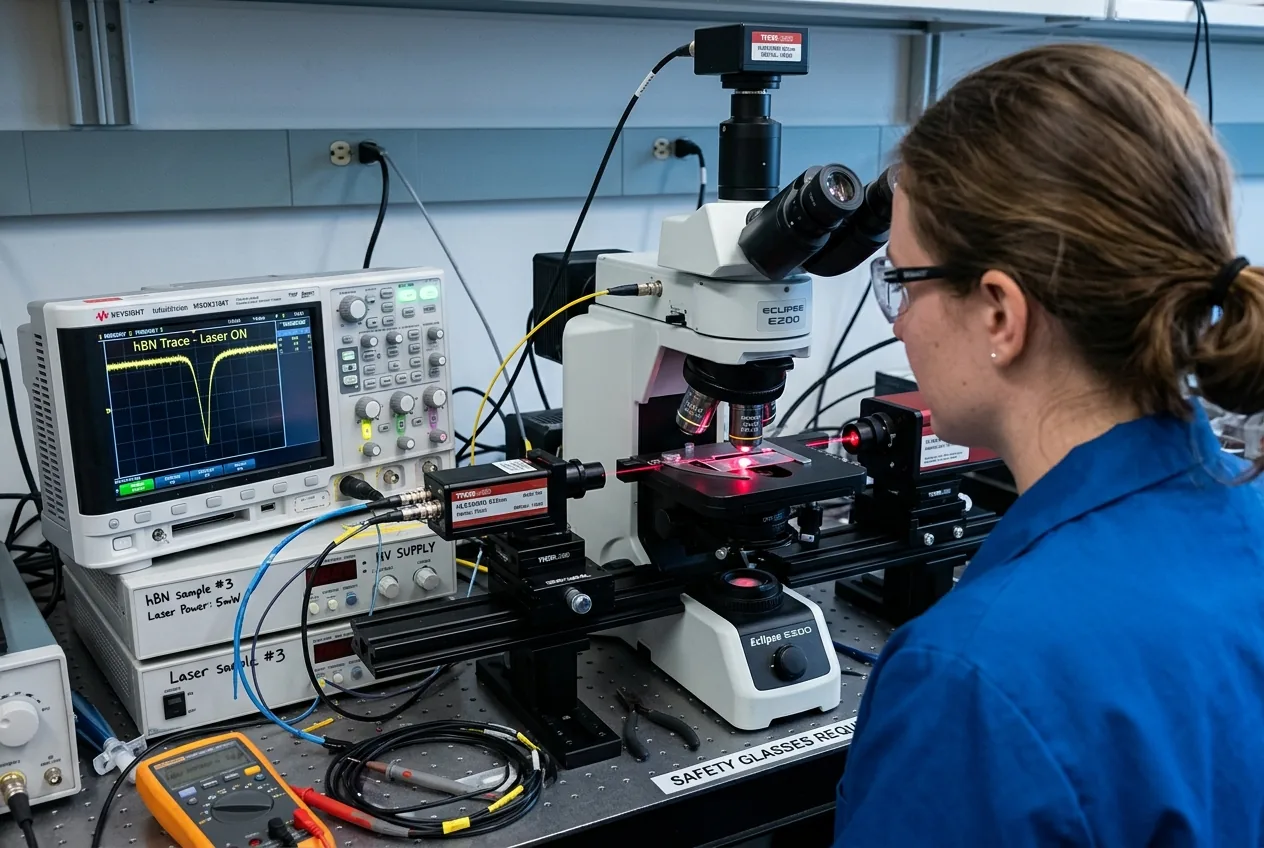
It was not a tidy press conference moment. In a lab in Haifa an advanced microscope and a laser system produced patterns on a wafer of hexagonal boron nitride; the team recorded little nulls — single-wavelength holes where amplitude vanished — and, to their mild astonishment, watched those black points accelerate and, on paper, race past the nominal speed of light. The phrasing that followed in the paper and press materials was blunt: scientists just discovered there’s a measurable, superluminal motion of optical phase singularities. The statement rewires a familiar paradox: something is faster than light, and yet no one is shouting that Einstein was wrong.
scientists just discovered there’s a difference between ‘faster than light’ and ‘faster than causality’
Reporters love a single dramatic clause, and the internet loved this one: something beat the speed of light. The laboratory reality is more specific. The experiment logs an optical phase singularity — a point of zero amplitude embedded in a wave — moving through a medium. That motion can outrun c in the sense that the mathematical locus of darkness is tracked at speeds that exceed 299,792,458 m/s. But those singularities carry no information, no mass and no signal in the sense that would violate Einstein’s stipulation about causality. The distinction between transporting structure and transporting information underpins the entire result.
scientists just discovered there’s an experimental history to superluminal claims — and this one is the cleanest in decades
Physics has long flirted with quantities that exceed c on paper. Phase velocity and group velocity, the two measures that describe different aspects of a wave, routinely exceed c in experiments without cataclysm. Phase velocity describes the motion of a single phase of a wave (think the crest), while group velocity describes the propagation of an envelope containing energy and information. The Technion team’s singularities are a different creature: topological holes in a wavefield whose paths can accelerate uncontrolledly near creation or annihilation events.
Past experiments, from anomalous refractive index setups to tunnelling time measurements, have shown superluminal phase or peak motion, but critics always ask the same question: can information be sent faster than light? The answer from all of these setups, and from the new Nature paper, is no. Information — the causal payload Einstein forbade — remains bounded by c. What this experiment adds is a direct, ultrafast visualisation of optical singularities in a controlled condensed-matter system (polaritons in hBN) and a rigorous temporal record of their acceleration to arbitrarily high apparent speeds.
What the measurement looked like
The team placed a thin hexagonal boron nitride flake on a stage, excited polaritons and recorded the field with an opto-mechanical microscope that resolves fractions of a wavelength and slices of time smaller than a single optical cycle. Those constraints matter: you can only say a null point moves superluminally if you can track it within a sub-wavelength region and at sub-cycle cadence. The data show dark-point vortices forming, twisting and disappearing; near annihilation, trajectories bend sharply and instantaneous velocities spike beyond any bound you’d naively ascribe to light in vacuum.
So does any experiment show something travelling faster than light?
Yes — if you accept the qualifiers. Physicists have repeatedly observed phase fronts, peaks and other non-information-bearing features moving faster than c. The crucial caveat is that none of those observations transmits a controllable signal faster than c. The new Nature result is best read as the cleanest, most direct demonstration to date of a type of superluminal motion predicted by theory: optical singularities whose formal velocities can become arbitrarily large during short-lived events.
Tachyons and the temptation of mythology
When sensational headlines appear, the imagination leaps to tachyons — hypothetical particles that always move faster than light. No experiment, including this one, offers evidence for tachyons. Tachyons remain theoretical curiosities because they would wreak causal paradoxes if they existed as information carriers. What the Technion team observed is topological structure inside a wave: interesting, fast and compatible with relativity because it does not encode a signal that can be used to violate causality.
What the find implies — and what it doesn’t
The team framed the result as a new measurement technique as much as a headline. Ido Kaminer suggested the microscopy could reveal hidden ultrafast processes across physics, chemistry and biology — a plausible pitch, because being able to see sub-wavelength, sub-cycle phenomena in condensed-matter systems is technically useful. Yet another part of the story is cautionary: the public and even some policymakers can hear ‘faster than light’ and imagine a shortcut to starships, instant messaging across light-years, or a deus ex machina for speculative tech funding.
The real trade-off is mundane: the experiment required highly specialised equipment, carefully prepared materials and a lab capable of synchronising lasers and detectors at extreme precision. It is not a near-term path to practical superluminal communications or propulsion. That limitation is an overlooked cost few headlines discuss — precision science that reveals surprising physics does not automatically translate to disruptive engineering overnight.
A broader scientific texture
Three reporting textures stand out in the record. First, the paper is a specific, observed experiment with crisp instrumental detail: sub-cycle timing, hBN polaritons and tracked null-point trajectories. Second, it creates an instructive contradiction — public shorthand versus careful physicists’ wording — that exposes how quickly nuance evaporates outside the lab. Third, there’s a policy-facing angle: sensational misreading could skew research priorities or attract speculative funding, a familiar tension when basic physics becomes clickbait.
Finally, the result sits inside a surprising numeric pattern: the study cites theoretical work going back decades predicting that optical singularities can exhibit superluminal motion, and the new experiment puts a timestamp and hard data on that long-standing prediction. The paper’s appearance in Nature seals that numeric and documentary lineage.
The bottom line most physicists will offer privately is short and wry: yes, something in a lab moved faster than light on paper; no, you can’t use it to send messages to the past. The Technion team measured a beautiful, strange wave phenomenon that exposes universal behaviour across waves; it did not unseat relativity.




Comments
No comments yet. Be the first!