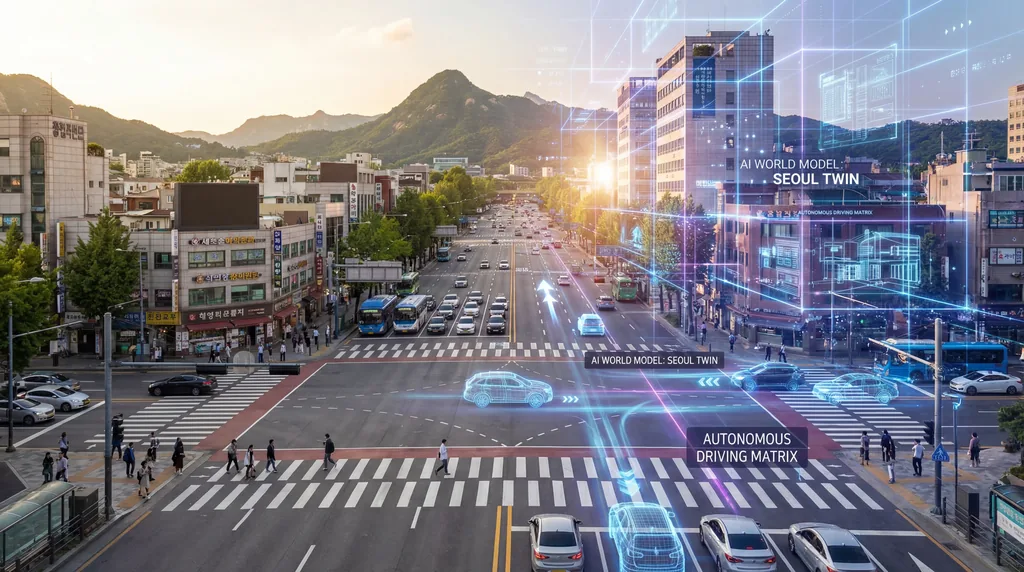

Seoul World Model (SWM) represents a paradigm shift in generative AI by grounding world simulations in actual physical geography rather than synthesized, imagined environments. Unlike traditional models that create visually plausible but fictional landscapes, SWM utilizes retrieval-augmented conditioning on real-world street-view data to generate spatially faithful digital twins. This advancement is a critical step toward achieving embodied AGI, as it allows AI agents to navigate and reason within the constraints of real-world urban topographies.
How does SWM differ from traditional generative world models?
The Seoul World Model (SWM) differs from traditional generative models by anchoring its video synthesis in real-world street-view imagery rather than relying solely on learned internal representations. While standard generative models "imagine" environments based on patterns in training data, SWM retrieves actual geographic references to ensure that the generated video remains consistent with the physical reality of cities like Seoul. This grounding prevents the "hallucinations" common in other video models, where landmarks might shift or disappear over long trajectories.
Traditional generative world models are often unconstrained, meaning they lack a one-to-one mapping with the physical world. Researchers Seungryong Kim, JoungBin Lee, and Jinhyeok Choi identified that for high-stakes applications like robotics and autonomous navigation, "plausible" imagery is insufficient. SWM addresses this by using an autoregressive video generation framework. By conditioning the generation process on nearby retrieved images, the model ensures that the virtual camera’s path reflects the actual layout of the city, maintaining spatial faithfulness across hundreds of meters of travel.
The core innovation lies in the transition from pure pixel-level imagination to a hybrid approach of data-driven reconstruction. By integrating retrieval-augmented generation (RAG) techniques—commonly used in large language models—into the visual domain, SWM can reference specific, real-world coordinates. This allows for the creation of a persistent digital twin, where every generated frame is tethered to a specific longitude and latitude, providing a level of geographic reliability that previous "imagined" models simply cannot match.
How might SWM impact urban planning or autonomous driving?
SWM impacts urban planning and autonomous driving by providing a high-fidelity, safe, and cost-effective testing ground for physical AGI systems and infrastructure designs. The model allows developers to simulate complex "what-if" scenarios—such as extreme weather or infrastructure changes—within a realistic digital twin of an existing city. This capability enables researchers to stress-test autonomous driving algorithms against real-world topologies without the risks associated with on-road testing.
For autonomous vehicle (AV) developers, SWM offers a revolutionary alternative to traditional simulators. Standard simulators often suffer from a "sim-to-real" gap, where the synthetic environment is too clean or simplified. Because SWM is grounded in actual vehicle-mounted captures, it retains the nuanced complexities of urban environments, such as specific lane configurations, signage, and building textures unique to Seoul. This high-fidelity simulation is essential for training AGI to handle the unpredictable nature of city traffic and pedestrian movements.
In the realm of urban planning, SWM serves as a powerful visualization tool. Planners can use text prompts to modify the environment within the simulation, such as adding new bicycle lanes or altering building heights, to see how these changes affect the visual landscape and traffic flow. Key benefits include:
- Risk-Free Prototyping: Testing infrastructure changes in a digital twin before physical implementation.
- Scenario Diversity: Using AI to generate rare edge cases, such as accidents or construction, to evaluate emergency response.
- Global Scalability: The ability to apply the SWM framework to other major metropolises like Busan or Ann Arbor using existing street-level data.
How accurate is SWM in simulating real Seoul environments?
SWM demonstrates superior accuracy in simulating real Seoul environments by outperforming current state-of-the-art video world models in spatial faithfulness and temporal consistency. Through the use of a Virtual Lookahead Sink and cross-temporal pairing, the model maintains a high degree of visual alignment with actual city streets over long-horizon trajectories. This ensures that the generated video does not drift from the intended geographic path even after navigating for several minutes.
Achieving this level of accuracy required the researchers to overcome significant technical hurdles, most notably data sparsity. Real-world street-view images are often captured at sparse intervals by vehicle-mounted cameras, creating gaps in the data. SWM employs a view interpolation pipeline to synthesize coherent training videos from these sparse captures. This pipeline fills the "missing links" between data points, allowing the model to learn smooth camera movements that mimic a continuous drive through the city.
Another breakthrough is the Virtual Lookahead Sink, a mechanism designed to stabilize long-duration generation. This feature works by continuously re-grounding the generation process to a retrieved image at a future location. By "looking ahead" to a target destination, the model can adjust its current trajectory to ensure it eventually meets the real-world visual anchor. This prevents the cumulative errors that typically cause generative videos to degrade into noise or veer off-course, making it a robust platform for AGI research involving long-range spatial reasoning.
Addressing Temporal Misalignment
One of the primary challenges in grounding world models is temporal misalignment. Reference images retrieved from a database may have been taken at a different time of day, season, or weather condition than the target scene. SWM utilizes cross-temporal pairing to synchronize these diverse data points. By training on pairs of images taken at the same location but at different times, the model learns to extract the underlying geometry while remaining flexible to dynamic changes in the scene, such as lighting or traffic.
Expanding the Horizon: From Seoul to the World
While the primary focus is the Seoul World Model, the researchers successfully evaluated the framework across three distinct urban environments: Seoul, Busan, and Ann Arbor. The results consistently showed that SWM's retrieval-augmented approach allows it to adapt to different architectural styles and road layouts with minimal adjustment. This scalability suggests that the future of AGI may not lie in a single, universal world model, but in a series of grounded models that can be swapped or combined to represent the entire physical world.
Looking ahead, the development of SWM marks a transition toward AI that understands physical constraints. Future iterations of the model may incorporate even more sensory data, such as LiDAR or satellite imagery, to further refine its spatial accuracy. As these grounded models become more sophisticated, they will provide the essential "world knowledge" required for AI to step out of the digital realm and into the physical world, ultimately leading to more capable and reliable autonomous systems.




Comments
No comments yet. Be the first!