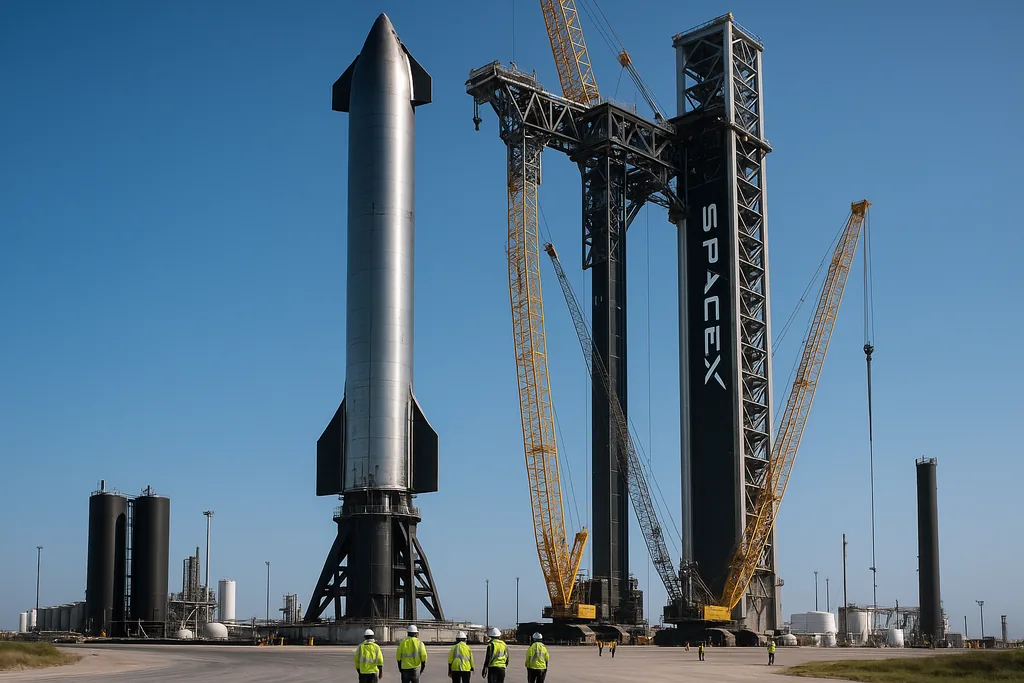
Starship flight 12 slips to early April
Elon Musk signalled another slip for SpaceX's flagship test campaign this week when he posted on X that the company is now targeting early April for what it calls flight 12 — a move that confirms spacex delays starship flight for at least a second public timetable change. The announcement on March 7 came after earlier messages from Musk in late January that implied a March attempt; those earlier estimates have been pushed back as SpaceX completes extra checks and readies a substantially revised vehicle known as Version 3.
The delay matters because flight 12 is meant to be the first test of the upgraded Starship stack that SpaceX hopes will finally reach near-orbital performance and demonstrate refuelling capabilities critical to future lunar and deep-space ambitions. The company has not published a formal launch date or a detailed explanation for the latest slip beyond Musk's social posts and operational updates from SpaceX, leaving observers to read progress milestones and test logs for indications of when an actual window will open.
SpaceX's sequence of public timelines — six weeks from a late-January comment, then four weeks from the March 7 note — illustrates how volatile schedules remain for the world's largest rocket as engineering, ground systems and regulatory clearances converge. For now, early April is the working target; the program could move again if testing uncovers new issues.
spacex delays starship flight: timeline, repeats and context
Delays of this sort aren't unique to SpaceX: rocket development and testing routinely produce slips as hardware and software are exercised in new regimes. But for Starship the stakes are amplified because flight 12 will debut Version 3, a step change in vehicle design and power, and because NASA and the U.S. Space Force are watching closely as Starship matures toward potential lunar-landing roles and U.S. East Coast operations. In short, each schedule shift changes planning for partners, regulatory bodies and the two U.S. launch sites where Starship operations are being prepared.
How many times has flight 12 been delayed? Publicly, the mission has been shifted at least once from an implied March window and again into early April after Musk's March 7 update. Behind the scenes there are likely additional internal hold points and sequencing changes tied to testing and licensing, which can add further slips that don't always appear immediately in public timelines.
spacex delays starship flight — what testing is left
SpaceX has been transparent about specific tests it has completed and about others it is still running. In early March the company announced a successful "cryoproof" test of the next upper stage, Ship 39, demonstrating propellant loading and structural strength at cryogenic temperatures — a necessary milestone for a stacked flight. The company also posted that the Super Heavy lower stage was ready for preflight testing, suggesting the integrated stack is moving through standard hardware checkout sequences.
These tests are exactly the sort of activities that can reveal small or large fixes: valve seals, feed-line plumbing, control‑system firmware, structural resonances, or ground‑support interfaces can all prompt iterative work that delays a launch. Past Starship scrubs have explicitly mentioned ground‑systems issues when operations were halted close to a countdown, and non‑public anomalies discovered in testing can produce multi‑week pauses while engineers investigate. The result is that even though key pieces of the rocket may be mechanically ready, the integrated stack and the pad — including fueling, hold‑down and range safety systems — must all reach mutual readiness.
On the regulatory side, the Federal Aviation Administration has approved three new flight paths for Starship — trajectories that would include overflight of parts of the U.S., Mexico and the Caribbean — which are critical to any orbital attempt. Clearance of those corridors is necessary but not sufficient; SpaceX still needs to demonstrate operations within approved safety and environmental conditions before a full orbital window will be granted.
Version 3 upgrades and why they affect timing
Flight 12 will introduce Starship Version 3, a redesign that is slightly taller and significantly more powerful than the previous iteration. V3 increases thrust and changes structural and propellant‑management arrangements with the explicit aim of making orbital insertion and in‑orbit refuelling possible in future tests. That capability — connecting two Starships in orbit to transfer hundreds of tons of super‑cold propellant — is a complex, novel manoeuvre that requires high confidence in both vehicle hardware and autonomous docking systems before a risky flight test is authorised.
Because Version 3 represents a big technical step, SpaceX engineers are prioritising proof points on the ground: cryogenic load testing, engine runs, structural margins and the new control logic. Each successful test reduces technical risk, but it also creates a new set of checks. The more new features a version brings, the more likely engineers will find small integration items that demand time to address, which helps explain why an upgraded vehicle can take longer to reach a go‑for‑launch decision than a minor modification would.
SpaceX has been candid that V3 is intended to push Starship toward orbital capability and, eventually, to support NASA Artemis missions as a lunar lander. That strategic imperative adds program pressure but also rigorous external scrutiny from partners and regulators — another reason prudence on timing is likely influencing the pattern of delays.
Where you can watch when it finally launches
If the mission proceeds from Starbase in South Texas, SpaceX traditionally streams liftoffs live on its website and posts updates on X in the minutes and hours around launch. For in‑person viewing, crowds still gather at South Padre Island and other coastal vantage points when Starship rolls to the pad; the Starbase complex itself is not open to the public. When Starship operations move to Florida later in 2026, launches will be staged from Kennedy Space Center or Cape Canaveral pads that SpaceX is preparing, and the company will follow the same webcast pattern for those missions.
Practically, anyone planning to watch should expect the familiar volatility of modern launch campaigns: check official SpaceX streams for the live feed and use the company's social channels for last‑minute window updates. If you've travelled to a viewing site, be prepared for scrubs and short notice postponements: weather, range conflicts, or a single instrument reading can flip a countdown even after extensive testing has been completed.
What this means for NASA, Florida and the wider schedule
The delay to early April reorders a tightly packed calendar of tests, regulatory checkpoints and partner expectations. NASA has a direct interest in Starship's maturation because SpaceX's vehicle is a candidate for lunar lander work in the Artemis architecture; slips on flight 12 therefore ripple into NASA planning timelines for crewed and cargo missions. The U.S. Space Force and the FAA, which oversee trajectory approvals and launch licensing, are watching for evidence the new design can meet safety and range requirements before authorising more ambitious profiles.
For Florida's launch plans — SpaceX aims to stage future Starship operations from Kennedy and Cape Canaveral — the delay simply postpones the transfer of crew, cargo and infrastructure work toward the East Coast. U.S. Space Force statements have suggested a Florida debut in late summer or early fall 2026, but whether that schedule will hold depends in part on how quickly SpaceX demonstrates repeatable success with V3 at Starbase.
Sources
- SpaceX (company test and social media updates)
- Federal Aviation Administration (flight path approvals and operations advisories)
- NASA (Artemis program planning and partner oversight)
- U.S. Space Force (launch site and schedule briefings)




Comments
No comments yet. Be the first!