An orbital gambit: mining Bitcoin where the Sun never sets
Starcloud, the Nvidia‑backed orbital data‑centre startup, announced this week that it will put dedicated Bitcoin mining hardware on its second spacecraft and attempt the first off‑Earth Bitcoin mining operation later in 2026. The company says the low‑atmosphere environment — near‑continuous sunlight for power and the vacuum as a giant heat sink — makes "space bitcoin mining: nvidia-backed" deployments an especially attractive use case for orbital compute.
space bitcoin mining: nvidia-backed Starcloud’s announcement and background
The plan surfaced after Starcloud’s CEO, Philip Johnston, posted on X and described the second satellite, Starcloud‑2, as carrying application‑specific integrated circuits (ASICs) tuned for Bitcoin’s SHA‑256 workload. Johnston framed mining as one of the clearest early commercial markets for orbital compute because ASICs are cheaper per watt than GPUs — a key metric when lift and thermal design are already built into a satellite platform.
Starcloud is not a vaporware idea on paper. The company launched Starcloud‑1 in November 2025 with an enterprise‑class NVIDIA H100 GPU aboard and has published white papers arguing for the energy and cooling advantages of training and inference in orbit. That demonstrator is the technical foothold the startup says it will expand into a workstation specialised for cryptomining on Starcloud‑2. Starcloud has also filed regulatory paperwork proposing a very large fleet in the longer term — a constellation described in filings and reporting as up to 88,000 satellites for orbital data‑centre workloads.
space bitcoin mining: nvidia-backed economics and feasibility
At the centre of Starcloud’s pitch is a simple arithmetic argument: Bitcoin mining is a power‑heavy, repeatable compute task where energy cost dominates. In space, the company says, solar arrays can provide steady, high‑intensity power without terrestrial intermittency, and radiative cooling can dissipate heat without massive water or air‑conditioning infrastructure. For a heavily optimised ASIC farm, those conditions can theoretically yield much lower marginal energy costs than many Earth‑based sites.
That arithmetic, however, is only part of the story. Launch costs, radiation hardening, comms, orbital lifetime and the capital needed to build, launch and operate a satellite system remain major fixed expenses. Analysts who have modelled launch, payload and operational budgets argue the break‑even price for space mining is sensitive to Bitcoin’s price and to assumptions about reusability and launch cadence. In short: energy per hour may fall, but up‑front capital and risk rise — a trade‑off that will determine whether the venture is an experimental novelty or a commercially repeatable business.
Engineering and launch: how a satellite enables mining
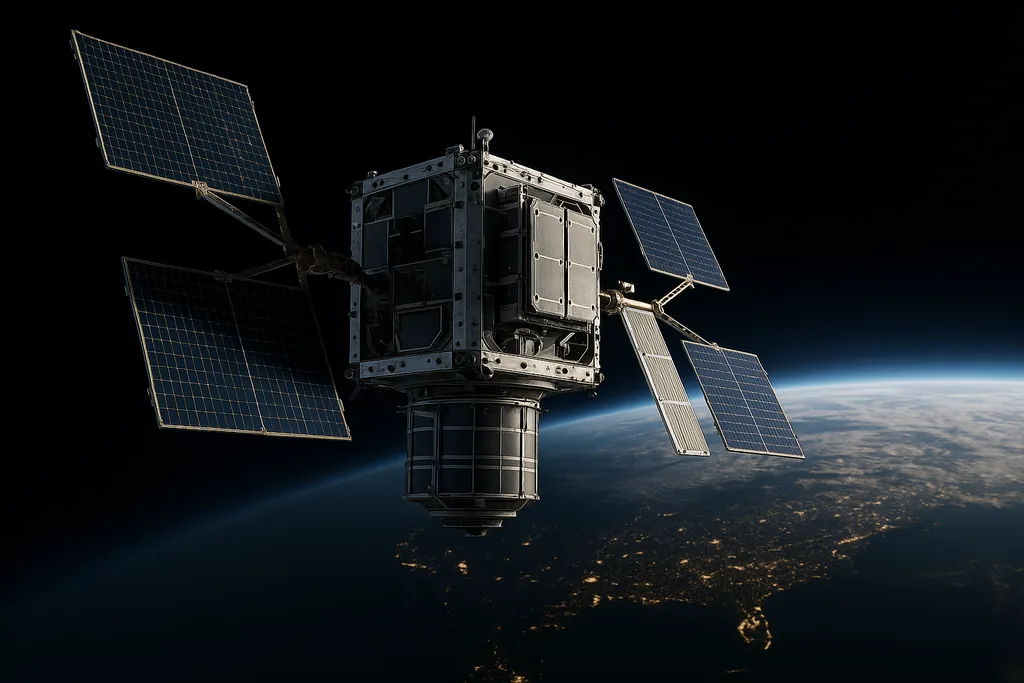
Practically speaking, a Bitcoin miner in orbit looks different to the industrial rigs on Earth. Starcloud says it will carry ASIC modules that are smaller, more power‑densely packed and optimised for continuous operation in vacuum. Power comes from high‑efficiency solar arrays sized and pointed to maximise sun exposure in the chosen orbit, and heat is dumped via large radiators that emit infrared photons into space. Communications handle job assignment and reward transfers: mining results and block templates are small compared with telemetry, but the miners still need reliable timing and downlink capacity to avoid stale work.
The logistical list also includes radiation mitigation for silicon, redundancy for single‑event upsets, and a plan for hardware refreshes. Satellites can be designed with modular payload bays or rendezvous‑and‑repair capability, but those add mass and complexity. Starcloud’s roadmap and the industry’s broader filings presume recurring, cheaper launch cycles — an assumption that depends on scalable reusable rockets and favourable launch economics. Those dependencies feature prominently in Starcloud’s own regulatory narrative.
Regulatory, legal and environmental questions
Space‑based mining raises novel regulatory questions that don't map neatly to terrestrial mining rules. Starcloud has already submitted applications to the Federal Communications Commission that describe a large orbital datacentre architecture; regulators will examine spectrum use, collision risk, de‑orbit plans and interference with existing services. National and international law also governs export controls, dual‑use hardware and the allocation of orbital slots — all of which could affect how quickly a space mining project scales.
Environmental arguments for mining in orbit are mixed. On one hand, moving energy‑intensive workloads to solar‑rich orbits could shrink terrestrial fossil fuel demand for the sector and reduce regional grid stress; Starcloud models projected substantial life‑cycle carbon savings after accounting for launch emissions. On the other hand, the environmental cost of more launches, the growing congestion of low Earth orbit, and the possibility of more debris from larger fleets are real concerns that regulators, insurers and environmental groups are watching closely. The calculus depends heavily on the assumed launch frequency, the lifetime of orbital hardware, and end‑of‑life disposal practices.
Market reaction and the profitability question
Industry reaction has been mixed. Some investors and miners view space as a long‑term hedge against terrestrial power bottlenecks; others call the economics hopeful at best while Bitcoin’s price and network difficulty remain volatile. Several trade commentators have modelled the required Bitcoin price for Starcloud‑style operations to be significantly higher than today’s market to recoup the capital — a striking reminder that mining margins are driven as much by network difficulty and token price as by per‑watt compute costs. Critics also point out that ASICs on Earth already run in the cheapest grids available globally and can be refreshed more easily, which keeps the bar high for orbital competitors.
Broader implications for orbital computing
Whatever happens with Bitcoin, Starcloud’s announcement marks a broader test case for the economics of orbital compute. If ASIC mining proves viable, it could become an early revenue stream that subsidises other orbital services such as in‑orbit training, inference for Earth observation, or edge compute for time‑sensitive applications. The company’s filings and pilot missions are already being read by competitors and regulators as a sign that the market for "compute in space" is entering a more concrete, test‑and‑scale phase. That makes the Starcloud story important not only for crypto watchers but for cloud providers, satellite operators and national regulators.
What to watch next
Key near‑term milestones to follow are the launch date and mission profile for Starcloud‑2, any technical disclosures about the ASIC modules (power envelope, shielding and redundancy), and FCC rulings or public comments on the 88,000‑satellite filing. Observers will also watch Bitcoin price and network difficulty: even a technically successful orbital miner needs favorable market dynamics to become a durable business. If Starcloud moves forward, expect tightened scrutiny from regulators and more technical detail from the company and partners about how they will manage debris, spectrum and in‑orbit servicing.
Sources
- Starcloud technical white paper: "Why We Should Train AI in Space" (company white paper)
- Application for license: Starcloud Orbital Datacenter System (FCC filings and regulatory narrative)
- NVIDIA blog: "How Starcloud Is Bringing Data Centers to Outer Space" (company technical blog)




Comments
No comments yet. Be the first!