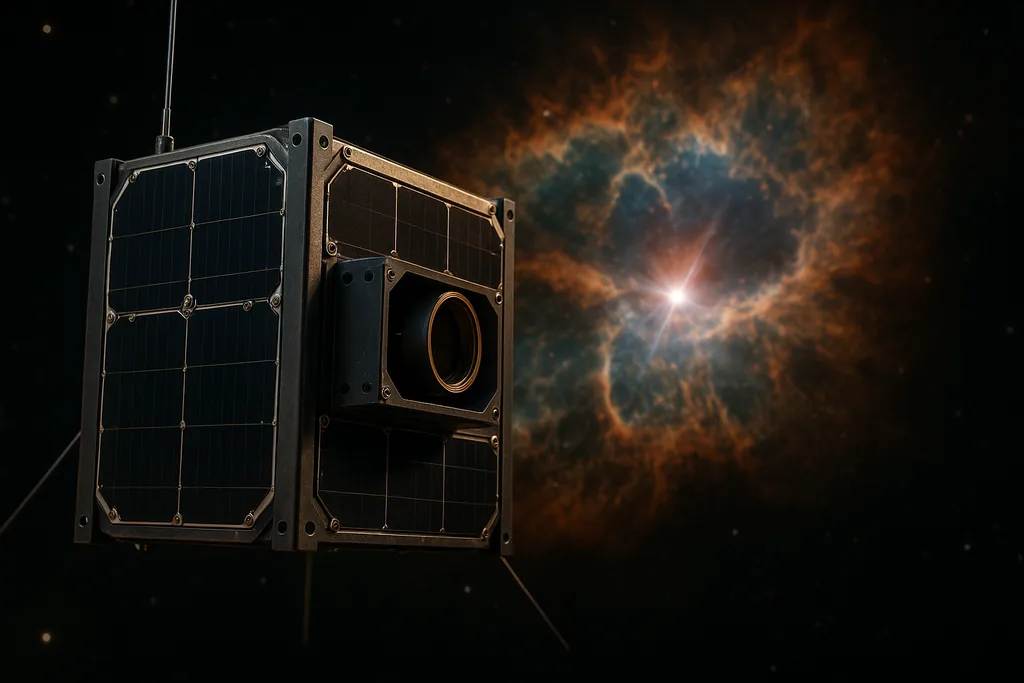
The Crab Pulsar is a rapidly spinning neutron star that serves as a vital "standard candle" for X-ray astronomy, allowing researchers to calibrate high-energy sensors with extreme precision. Recently, the SpIRIT CubeSat, an 11-kilogram nanosatellite, successfully measured the pulsar’s 33-millisecond rotation, proving that miniature spacecraft can achieve results previously reserved for billion-dollar flagship observatories. By capturing 57,000 photons in a brief 730-second window, researchers T. Chen, M. Fiorini, and S. Zhang have demonstrated a new era of cost-effective, high-resolution space science that challenges the traditional dominance of massive space telescopes.
What is the Crab Pulsar and why is it important?
The Crab Pulsar is a highly magnetized, rapidly rotating neutron star located at the center of the Crab Nebula, roughly 6,500 light-years from Earth. It is considered a fundamental benchmark in X-ray astronomy because its predictable, high-frequency pulses—rotating approximately 30 times per second—provide a reliable signal for testing the timing accuracy and sensitivity of new space instruments.
Formed during a supernova explosion observed on Earth in 1054 AD, the pulsar emits beams of electromagnetic radiation across the entire spectrum, from radio waves to high-energy gamma rays. For the SpIRIT Mission, the pulsar’s stable rotation served as the ultimate test of the satellite's internal clock. By successfully resolving the 33-millisecond "heartbeat" of this stellar remnant, the mission confirmed that small-scale hardware can maintain the rigorous timing standards required for deep-space observation.
High-energy emissions from the Crab Pulsar are particularly useful for calibrating broadband spectrometers. Because the pulsar is one of the brightest persistent sources in the high-energy sky, it allows scientists to verify the temporal resolution of their equipment. In this study, the researchers utilized the canonical Crab ephemerides provided by the Jodrell Bank catalog to synchronize their data, ensuring the satellite's readings matched the known physical properties of the star.
What is the HERMES instrument and what does it do?
The HERMES instrument is a compact X-ray and gamma-ray spectrometer specifically designed for the SpIRIT CubeSat platform to monitor cosmic transients. It provides unique broadband sensitivity ranging from a few keV to several MeV, allowing it to detect everything from soft X-rays to high-energy gamma-ray bursts with a temporal resolution of just half a microsecond.
Developed as part of a modular ensemble, the HERMES payload occupies a 6U CubeSat form factor, yet it manages to punch well above its weight class. Key technical capabilities include:
- Temporal Precision: Achieving resolution down to 0.5 microseconds for high-speed event tracking.
- Energy Coverage: A wide detection range from 3 keV to 2 MeV, bridging the gap between X-ray and gamma-ray science.
- Wide Field of View: Designed to scan large swaths of the sky for sudden, unpredictable transient events.
- Compact Mass: Integrating sophisticated silicon drift detectors into an 11 kg satellite frame.
According to the research team, including T. Chen and colleagues, the payload is particularly well-suited for observing Gamma-Ray Bursts (GRBs). The ability to fit such high-performance hardware into a modular 11 kg frame represents a significant leap in aerospace engineering, moving away from the single, massive observatory model toward more agile, distributed space networks.
How do CubeSats detect X-rays from pulsars?
CubeSats detect X-rays from pulsars by utilizing miniaturized solid-state detectors that convert incoming high-energy photons into electrical signals, which are then timestamped with microsecond precision. The SpIRIT CubeSat specifically employs the HERMES spectrometer to record the exact arrival time of each photon, creating a data set that can be "folded" or synchronized with the pulsar's known rotation period.
The detection process involves filtering background noise and focusing on specific energy bands where the signal-to-noise ratio is highest. During a single 730-second operation, the SpIRIT/HERMES system collected 5.7 x 10^4 photons. By analyzing these particles in the 3–11.5 keV energy band, the researchers were able to construct a double-peaked pulse profile, which is the signature "fingerprint" of the Crab Pulsar.
The success of this methodology is measured by its statistical significance. The team achieved a 5-sigma pulse profile significance, a rigorous mathematical threshold that confirms the detection was not a random fluctuation. This level of accuracy was previously thought to be the exclusive domain of flagship missions like the Chandra X-ray Observatory or the ESA’s XMM-Newton. The fact that an 11 kg CubeSat achieved this result demonstrates that advanced X-ray astronomy is becoming increasingly accessible.
Results: Achieving Millisecond Accuracy in the X-Ray Domain
The analysis of the SpIRIT/HERMES data revealed that the instrument could achieve millisecond timing accuracy even within a very short observation window. Despite the small collection area of a CubeSat compared to a massive telescope, the high efficiency of the sensors allowed the team to capture enough Crab Pulsar photons to verify the satellite’s performance across a broad energy spectrum, from a few keV up to 2 MeV.
This millisecond accuracy is critical for the future of multi-messenger astronomy. When Gamma-Ray Bursts or gravitational wave events occur, scientists need to know exactly when the signal arrived to triangulate its position in the sky. The results from T. Chen, M. Fiorini, and S. Zhang prove that a constellation of these small satellites could work together to pinpoint the origins of the universe's most violent explosions with unprecedented speed and lower costs.
The Future of Distributed Space Observatories
The success of the SpIRIT Mission marks a turning point for the use of "distributed" space architectures over single-satellite missions. By deploying a swarm of CubeSats equipped with HERMES instruments, space agencies could create a global network for Gamma-Ray Burst monitoring. This "ensemble" approach ensures that even if one satellite is out of position, others in the constellation can capture the event, providing 24/7 coverage of the high-energy sky.
Furthermore, the cost-to-performance ratio of these missions is revolutionary. While flagship observatories cost billions and take decades to develop, CubeSats like SpIRIT can be built and launched for a fraction of the price. This allows for more frequent technological iterations and more daring scientific inquiries. The researchers emphasize that the SpIRIT/HERMES performance underscores a new capability for the ESA and other space agencies to contribute to global transient monitoring using compact, modular form factors.
Looking ahead, the team plans to refine the instrument’s sensitivity to even higher energy ranges. As more 11 kg units are launched, the potential for a "digital eye" spanning the entire orbital plane becomes a reality. This would allow for the simultaneous detection of Crab Pulsar pulses and distant cosmic collisions, providing a deeper understanding of the high-energy physics that governs our universe.




Comments
No comments yet. Be the first!