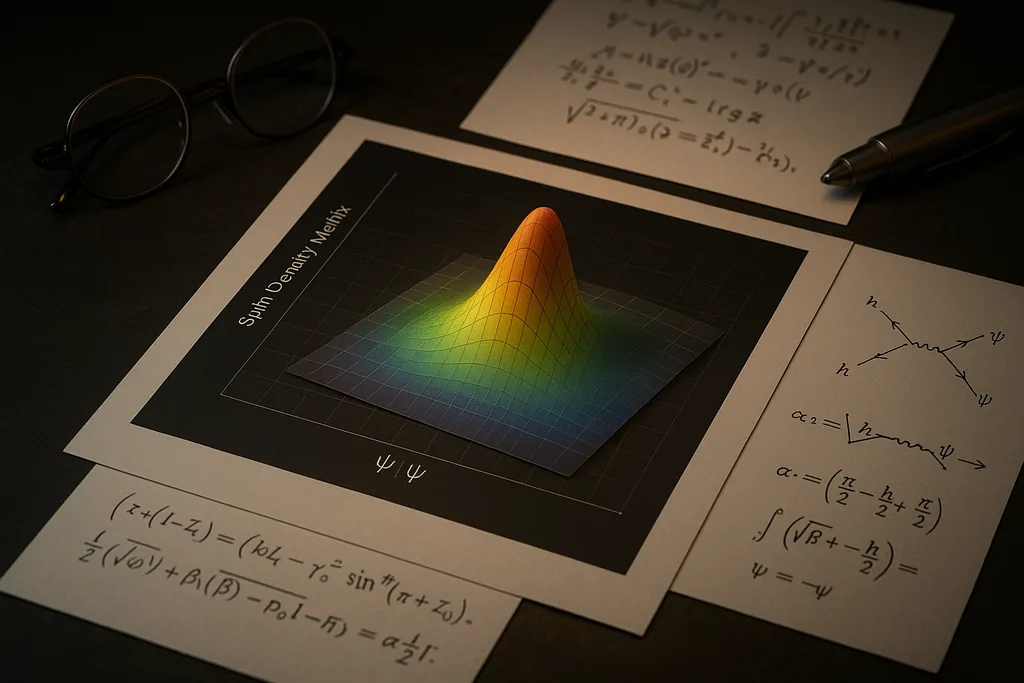
Researchers have developed a comprehensive theoretical framework based on the Spin Density Matrix (SDM) formalism to track how quantum information survives complex particle transitions. By analyzing the decay of the $\psi^\prime$ meson into the $\psi$ meson, scientists have discovered that certain subatomic pathways act as nearly perfect transmitters of polarization, effectively preserving the initial quantum state for experimental observation. This breakthrough, authored by Lei Zhang, Jin Zhang, and Yilun Wang, provides a unified "Rosetta Stone" for particle dynamics, allowing physicists to probe the same angular-momentum structures found in everything from charmonium decays to the production of the Higgs Boson.
What is the spin density matrix formalism in particle physics?
The spin density matrix (SDM) formalism in particle physics describes the spin state of a quantum system, particularly for ensembles of particles, using a density operator that captures both pure and mixed states. This mathematical framework generalizes the standard wavefunction approach by representing the state as a matrix whose elements encode probabilities and quantum coherences, which are essential for calculating spin observables and angular distributions. By utilizing the SDM, researchers can track how polarization is transferred or modified throughout a decay chain.
Spin density matrices serve as the foundational language for understanding the internal orientation of particles created in high-energy collisions. In the context of the research by Zhang et al., this formalism was applied to the process $e^+e^- \to \psi^\prime \to \psi\pi\pi$. Historically, analyzing these transitions relied on partial-wave models that often lacked a complete treatment of spin. The new framework generalizes previous methods, such as Cahn's analysis, into a comprehensive treatment that accounts for all possible spin correlations, providing a rigorous basis for extracting polarization data in experiments like those conducted at BESIII.
Quantum tracking of spin is notoriously difficult because particles exist in a superposition of states that can be easily disturbed. The SDM formalism addresses this by offering a consistent mathematical structure to describe the polarization transfer from a parent particle, like the $\psi^\prime$, to its daughter, the $\psi$. This ensures that experimentalists can measure the final state and accurately reconstruct the conditions of the initial collision, effectively "reversing" the decay process to study fundamental interactions at the smallest scales.
Why is the $\psi$ meson an ideal probe of the initial polarization state?
The $\psi$ meson, a vector meson with spin-1, is an ideal probe of the initial polarization state because its decay angular distributions directly reflect the elements of the spin density matrix of the parent particle. Because its production in high-energy collisions often preserves the parent's spin information, the $\psi$ meson acts as a clean quantum analyzer. Subsequent decays into specific final states allow for the precise measurement of polarization parameters without significant interference from background noise.
Vector mesons like the $\psi$ are particularly valuable because they possess a clear spin-1 structure that mimics the photons or Z bosons that often mediate particle interactions. In the specific decay chain studied—where a $\psi^\prime$ transitions into a $\psi$ and two pions—the researchers demonstrated that the $\psi$ meson remains in a state that is nearly identical to its parent. This polarization preservation means that the $\psi$ meson can be used to study the underlying dynamics of the original electron-positron collision with extreme fidelity.
Experimental precision is significantly enhanced by this discovery, as the $\psi$ meson can be observed in continuum-background-free environments. By establishing that the SDM of the daughter particle ($\rho_\psi$) is effectively equal to the SDM of the parent ($\rho_{\psi^\prime}$), the study proves that the daughter particle acts as a "mirror" of the parent's quantum state. This provides a robust methodology for future amplitude analyses, where scientists seek to determine the strength and phase of different physical processes occurring during the decay.
What is the role of S-wave $\pi\pi$ emission in preserving quantum information?
S-wave $\pi\pi$ emission refers to a decay where two pions are emitted in a relative orbital angular momentum state of zero, which does not introduce additional angular momentum changes to the system. This simplicity preserves the quantum information encoded in the initial spin density matrix because the decay lacks the complex phase shifts or partial wave mixing that typically obscure polarization details. Consequently, the angular distribution in these decays provides a faithful map of the original spin state.
Partial wave analysis shows that when the pion pair is emitted in this $S$-wave state, the angular momentum of the system is essentially unchanged, leading to the relation $\rho_\psi = \rho_{\psi^\prime}$. This result is critical for researchers because the $S$-wave contribution is the dominant mechanism in charmonium transitions. However, the framework developed by Zhang, Zhang, and Wang does not stop at ideal scenarios; it also quantifies the deviations caused by $D$-wave contributions, where the pions carry away two units of orbital angular momentum.
Quantifying deviations is a major step forward for the field. While $S$-wave emission is dominant, the presence of $D$-wave interference can subtly shift the observed polarization. The researchers proposed a self-consistency experimental test that allows physicists to measure these $D$-wave amplitudes directly. By comparing the theoretical predictions of the SDM framework against collider data, experiments can simultaneously validate the mathematical model and place tighter constraints on the fundamental forces governing meson decays.
Scaling the Framework: From Charmonium to the Higgs Boson
The beauty of the SDM formalism lies in its universality; it is not limited to the study of charmonium but extends to the entire Standard Model of physics. The same angular-momentum structures that govern the transition of $\psi$ mesons are present in Bottomonium transitions, such as $\Upsilon(nS) \to \Upsilon(mS)\pi\pi$. More importantly, this framework can be applied to electroweak processes, specifically the production of the Higgs Boson in the reaction $e^+e^- \to Z^\ast \to ZH$, where the spin-1 $Z$ boson and the spin-0 Higgs Boson interact in a similar geometric manner.
- Charmonium: The framework provides a consistent basis for extracting $\psi$ polarization in transitions like $\psi^\prime \to \psi\pi\pi$ and $\psi^\prime \to h_c\pi^0$.
- Bottomonium: It allows for the exploration of $\Upsilon$ states, helping to map the heavier bottom quark dynamics with the same precision used for charm quarks.
- Higgs Sector: The formalism offers a unified probe of dynamics, potentially revealing new physics in how the Higgs Boson couples to vector bosons like the Z.
Unified dynamics across these different scales suggest that the mathematical rules governing quantum spin are remarkably consistent. Whether observing a meson decay at a medium-energy accelerator or searching for rare Higgs Boson interactions at the next generation of high-energy colliders, the ability to track the Spin Density Matrix ensures that no quantum information is lost. This creates a bridge between different subfields of high-energy physics, allowing discoveries in meson spectroscopy to inform our understanding of the most fundamental particles in the universe.
Experimental Validation at Particle Accelerators
To move from theory to discovery, the researchers have proposed specific self-consistency tests that can be performed at existing particle accelerators. These tests involve measuring the angular distribution of decay products and checking if they align with the predicted relations of the SDM formalism. If the data matches the framework, it confirms that the polarization transfer is understood; if deviations are found, it could signal the presence of unknown physical processes or higher-order partial wave contributions.
Precision measurements in hadronic transitions are the next frontier for facilities like BESIII and future electron-positron colliders. By using the $\psi$ meson as a calibrated probe, experimentalists can reduce systematic uncertainties in their measurements of CP violation and other rare phenomena. The framework's ability to operate in a continuum-background-free environment is a significant advantage, as it allows for cleaner signals and more reliable data extraction than was previously possible with less sophisticated spin models.
Future directions for this research include applying the SDM analysis to more complex decay chains and searching for "leaks" in quantum information. As we move toward an era of precision Higgs physics and advanced meson spectroscopy, the work of Lei Zhang, Jin Zhang, and Yilun Wang provides the necessary mathematical tools to ensure we are seeing the subatomic world as it truly is. By mastering the Spin Density Matrix, physicists are one step closer to a complete map of the quantum interactions that define our reality.




Comments
No comments yet. Be the first!