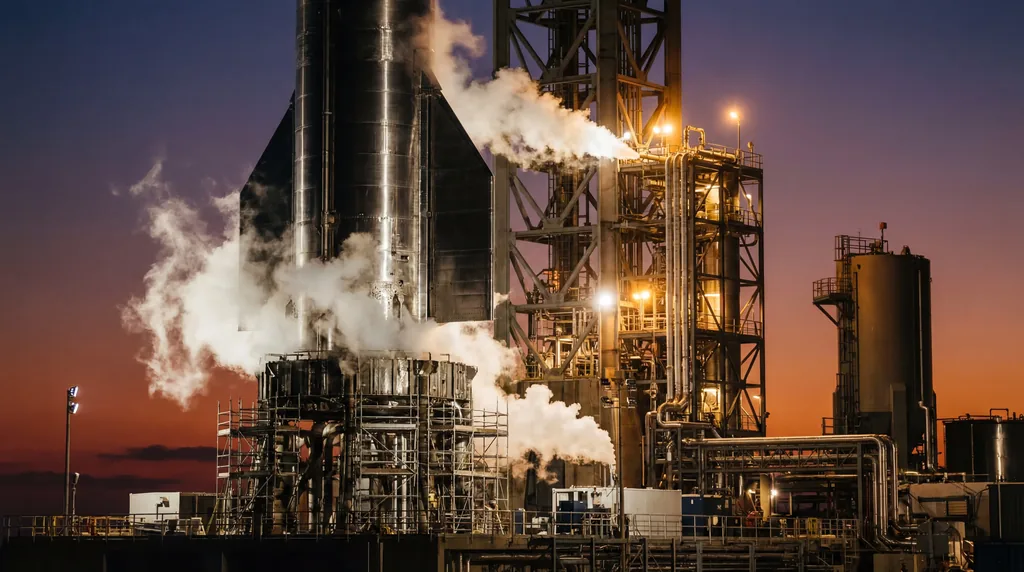

SpaceX has reached a pivotal milestone in its Starship development program as Booster 19, the first of the upgraded Block 3 Super Heavy vehicles, successfully concluded its initial test campaign on the newly commissioned Pad 2 at Starbase. This achievement marks a transition toward a dual-pad operational model in South Texas, specifically designed to accelerate the flight cadence for the Starship launch system and refine the infrastructure required for rapid reusability.
What are the differences between Block 2 and Block 3 boosters?
The primary differences between Block 2 and Block 3 boosters include the integration of Raptor 3 engines, a shift from four grid fins to three larger fins in a T-shape, and a five-foot increase in vehicle height. These structural refinements focus on weight reduction and simplified manufacturing, removing the engine heat shield and integrating the hot-stage ring directly into the vehicle's primary structure.
Block 3 boosters represent a significant leap in Starship engineering, prioritizing performance and "catchability" at the launch tower. By utilizing Raptor 3 engines, SpaceX has eliminated much of the external plumbing and shielding required in previous iterations, resulting in a cleaner, more efficient propulsion assembly. Furthermore, the three-fin configuration, featuring fins that are 50% larger than those on Block 2, is optimized for better control during the boost-back and descent phases, providing more robust catch points for the launch tower’s mechanical arms.
The Strategic Role of Pad 2 in Starbase Operations
The commissioning of Pad 2 at Starbase Texas is a strategic move to decouple vehicle testing from active launch operations. Historically, a single orbital launch mount meant that any testing on a new booster or ship would halt the preparation of the next flight vehicle. With Pad 2 now operational, SpaceX can conduct high-pressure cryogenic proofing and structural tests on vehicles like Booster 19 without delaying the launch processing of older vehicles on Pad 1.
This dual-pad infrastructure is essential for SpaceX to meet the ambitious launch schedules required by NASA’s Artemis program and the deployment of the Starlink Gen 3 constellation. By increasing the available "pad time," engineers can gather more data on propellant transfer systems and manifold pressure stability in a controlled environment. The successful testing of Booster 19 on this new infrastructure validates the design of the upgraded launch mount hardware, which must withstand the immense acoustic and thermal loads of the Super Heavy booster's ascent.
What tests did Booster 19 undergo on Pad 2?
Booster 19 underwent a comprehensive series of cryogenic proofing and structural stress tests on Pad 2 to validate its redesigned propellant systems and internal stringer reinforcement. These tests involved loading the vehicle with sub-cooled liquid nitrogen and oxygen to simulate the extreme pressures and thermal gradients experienced during an actual orbital ascent and stage separation.
During this initial campaign, SpaceX focused on the interaction between the new Block 3 architecture and the upgraded launch mount. Specifically, engineers monitored the performance of the redesigned manifold systems and the structural integrity of the stretched fuel tanks. The campaign also included validation of the propellant transfer systems, ensuring that the new plumbing could handle the flow rates required by the 33 Raptor engines. These tests are critical for identifying any potential points of failure in the Starship hull before the vehicle progresses to static fire testing and eventual flight.
Analyzing the Block 3 Evolution and Raptor 3 Integration
The structural refinements in the Block 3 architecture are driven by the need for simplified mass-production and enhanced reliability. By increasing the tank length by approximately five feet, SpaceX has added more internal volume for liquid oxygen and methane, providing the extra delta-v needed for heavier payloads. To support this additional weight and the increased thrust from the Raptor 3 engines, the internal stringers—vertical structural reinforcements—have been redesigned to provide greater rigidity without significantly increasing the dry mass of the booster.
One of the most notable changes is the removal of the separate, jettisoned hot-stage ring. In Block 3, this component is built directly into the vehicle, which reduces complexity during the stage-separation sequence. This integration, combined with the Raptor 3 engine's internal cooling channels that replace traditional heat shielding, allows for a more streamlined manufacturing process at the "Starfactory." These improvements are expected to result in a booster that is not only more powerful but also significantly easier to refurbish between missions, a core requirement for SpaceX’s goal of rapid reusability.
When is Starship Flight 12 expected to launch?
While SpaceX has not yet announced an official date for Starship Flight 12, the conclusion of Booster 19’s initial testing suggests a launch window in late 2026, pending FAA licensing. The timeline remains fluid as SpaceX must complete static fire campaigns and full vehicle integration with the upper-stage Ship before seeking final regulatory approval for the mission.
The Starship Flight 12 mission will be a critical test for the Block 3 hardware. Because Booster 19 is the first of its kind, the FAA and SpaceX will likely conduct a more thorough review of the flight data from preceding missions (Flights 7 through 11) before committing to a launch date. Regulatory updates from the Federal Aviation Administration (FAA) often hinge on the environmental impact of the new dual-pad operations and the safety protocols surrounding the expanded Starbase footprint. However, the successful conclusion of the Booster 19 campaign on Pad 2 is a clear indicator that the hardware is moving toward flight readiness at a steady pace.
Roadmap to Flight 12 and the Future of Starship
The remaining milestones for Booster 19 involve a return to the production site for final outfitting before it moves back to the launch site for a full static fire test. This next phase will be the first time all 33 Raptor 3 engines are ignited simultaneously, providing definitive data on the performance of the new propulsion system. Following a successful static fire, Booster 19 will be integrated with its corresponding Starship upper stage to form the full 120-meter-tall stack, the most powerful launch vehicle ever built.
Looking ahead, SpaceX aims to use the data from the Booster 19 campaign to further optimize the Block 3 design for high-frequency operations. The ultimate objective is to achieve "airline-like" reusability, where boosters can be caught, refueled, and relaunched within hours. As Starbase transitions into a multi-pad spaceport, the lessons learned from Booster 19’s time on Pad 2 will serve as the blueprint for the next era of deep-space exploration and lunar logistics under the Artemis program.
- Vehicle: Booster 19 (Super Heavy Block 3)
- Location: Pad 2, Starbase, Texas
- Key Upgrades: Raptor 3 engines, 3 large grid fins, 5ft height increase
- Milestone: Initial cryogenic and structural test campaign concluded
- Target: Preparation for Starship Flight 12





Comments
No comments yet. Be the first!