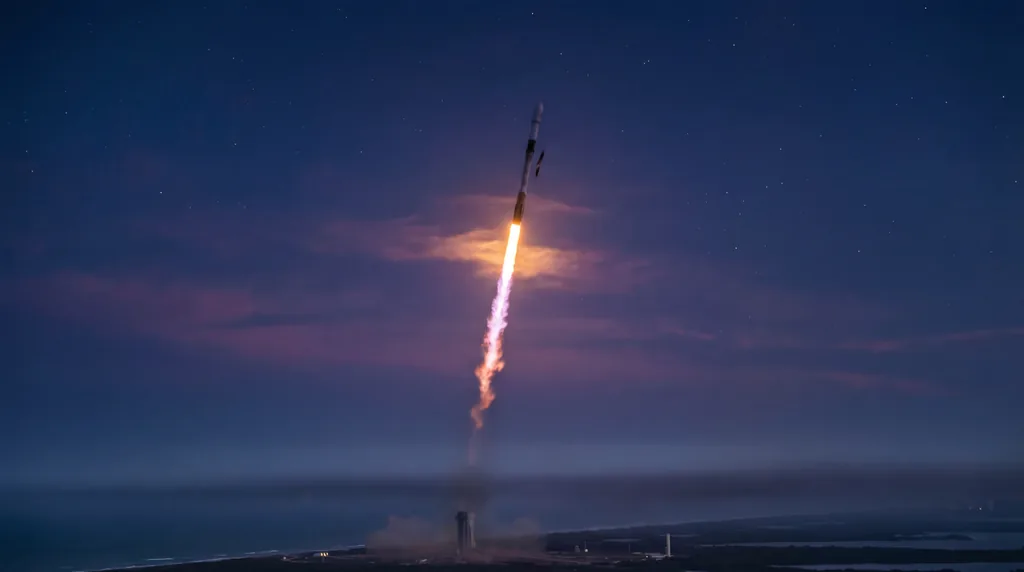

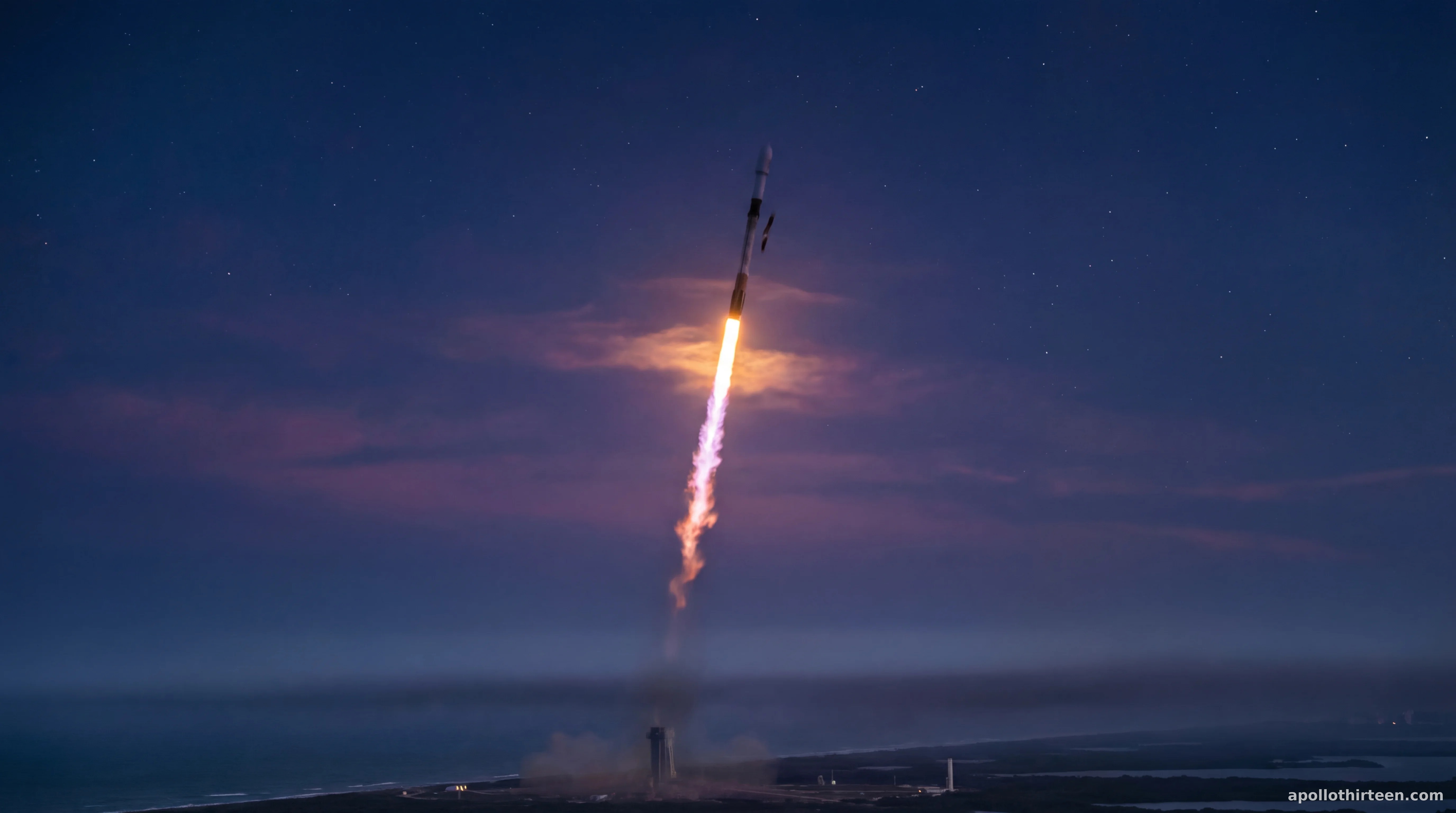
SpaceX Falcon 9 Launches 25 Starlink Satellites into Polar Orbit: How to Spot the Deployment
SpaceX is set to expand its global internet constellation today with the Starlink 17-20 mission, launching 25 satellites into a unique polar orbit from Vandenberg Space Force Base. Following the deployment, observers on the ground may have a brief window to spot the distinctive "Starlink train" as the satellites maneuver into their final positions. This launch, the seventh Starlink mission of 2026, underscores the aerospace company's relentless pace in establishing high-speed, low-latency broadband coverage across every corner of the globe, including the most remote high-latitude regions.
Launch Details and Mission Timeline
The Starlink 17-20 mission is scheduled for liftoff from Space Launch Complex 4 East (SLC-4E) at Vandenberg Space Force Base in California. The launch window is precisely set for 7:38:20 a.m. PST (1538:20 UTC). According to reports from Will Robinson-Smith of Spaceflight Now, the Falcon 9 rocket will follow a southerly trajectory upon departure, a characteristic path for missions targeting polar inclinations. This flight marks a significant milestone for the first-stage booster, identified by tail number B1097, which is making its sixth flight into the upper atmosphere. Previously, this specific booster supported high-profile missions including Sentinel-6B, the Twilight rideshare, and three prior Starlink batches.
The mission’s logistical precision extends to the recovery phase. Approximately eight and a half minutes after liftoff, the B1097 booster is slated to perform a precision landing on the autonomous drone ship, "Of Course I Still Love You," stationed in the Pacific Ocean. If successful, this will represent the 173rd landing for this particular vessel and the 563rd successful booster recovery for SpaceX to date. Such refurbishment and reuse of orbital-class rockets remain the cornerstone of SpaceX's strategy to reduce the cost of access to space while maintaining a blistering launch cadence.
The Science of Polar Low Earth Orbit
While most communications satellites are launched into equatorial or mid-inclination orbits to serve the majority of the world's population, the Starlink 17-20 mission targets a polar Low Earth Orbit (LEO). A polar orbit is one in which a satellite passes above or nearly above both poles of the body being orbited on each revolution. This trajectory is technically more demanding than equatorial launches because the rocket cannot take advantage of the Earth’s rotational velocity—approximately 1,000 miles per hour at the equator—to help achieve orbital speed. Instead, the Falcon 9 must provide the entirety of the delta-v required to reach its southern heading.
The necessity of polar orbits for the Starlink constellation lies in global inclusivity. Without these high-inclination shells, regions such as Alaska, northern Canada, Scandinavia, and researchers stationed in Antarctica would remain outside the footprint of the satellite beams. By populating these orbits, SpaceX ensures that maritime traffic in the Arctic Circle and transpolar aviation routes have access to the same high-speed connectivity as urban centers. This capability is critical for scientific research and search-and-rescue operations in environments where traditional terrestrial infrastructure is impossible to maintain.
Understanding the "Starlink Train" Phenomenon
In the hours and days immediately following deployment, ground-based observers often report seeing a "train" of bright lights moving across the night sky in a single-file line. This phenomenon occurs because the 25 V2 Mini Optimized satellites are released from the Falcon 9 second stage in a tight cluster. As they begin their "orbit-raising" phase, using on-board krypton-fueled Hall thrusters to move from their initial injection altitude to their operational home, they remain relatively close together. During this period, the satellites are highly visible due to the reflection of sunlight off their chassis and large solar arrays.
The visibility is most pronounced when the satellites are still at a lower altitude and have not yet adjusted their orientation to minimize their "brightness footprint." Over time, the "train" begins to disperse as individual satellites maneuver into their specific orbital slots within the plane. Eventually, they become much dimmer and harder to see with the naked eye as they reach their final operational altitude and adopt a "shark-fin" orientation designed to reduce light pollution—a concession SpaceX made to the astronomical community to mitigate the impact of mega-constellations on ground-based observations.
Observer's Guide: How to Track the Satellites
For enthusiasts hoping to catch a glimpse of the Starlink 17-20 batch, timing is everything. The best opportunities for visibility occur during the dawn and dusk windows. During these times, the observer on the ground is in darkness, but the satellites—hundreds of kilometers overhead—are still illuminated by the sun. To provide the best chance of a sighting, observers should look for a steady, non-twinkling point of light moving rapidly across the celestial sphere, often crossing from horizon to horizon in just a few minutes.
Several digital tools are available to assist in real-time tracking. Resources such as "Heavens-Above" and "FindStarlink" utilize orbital elements provided by the U.S. Space Force to predict exactly when the constellation will pass over specific geographic coordinates. Users should pay close attention to the "magnitude" of the pass; a lower numerical magnitude indicates a brighter object. Given the polar trajectory of this mission, observers at higher latitudes may have a particularly advantageous vantage point as the satellites converge near the Earth’s axis.
Implications and Future Directions
The Starlink 17-20 mission represents more than just another launch; it is a testament to the maturation of the Starlink V2 Mini architecture. These satellites feature more powerful phased-array antennas and increased backhaul capacity compared to the first-generation versions, allowing SpaceX to serve a growing subscriber base that has already surpassed millions of users globally. As noted in Spaceflight Now’s archives, the company reached a milestone of launching 1,900 satellites in 2025 alone, and 2026 is on track to exceed that figure significantly.
Looking ahead, the expansion into polar orbits paves the way for the full operational capability of the Starlink constellation. As SpaceX continues to refine its Falcon 9 turnaround times—recently breaking pad turnaround records at Cape Canaveral—the focus is shifting toward the integration of Starlink with direct-to-cell technology. Future missions will likely continue to prioritize these high-latitude shells, ensuring that the promise of "connectivity everywhere" becomes a literal reality for the entire planet, from the equatorial tropics to the frozen reaches of the poles.




Comments
No comments yet. Be the first!