
SpaceX Eyes Historic $50 Billion IPO Timed to Rare Jupiter-Venus Conjunction
SpaceX, the aerospace manufacturer and satellite communications giant that has come to dominate the commercial launch sector, is reportedly preparing for the most ambitious initial public offering (IPO) in financial history. According to a report by the Financial Times, the company is targeting a mid-June 2026 debut on the public markets, seeking to raise an unprecedented $50 billion. The timing of the move is not merely a matter of fiscal readiness; it is also a display of celestial symbolism, choreographed to coincide with a rare planetary alignment of Jupiter and Venus and the 54th birthday of the company’s founder, Elon Musk.
The $50 Billion Ambition: A Valuation Without Precedent
The reported IPO target represents a transformative moment for the aerospace industry. By seeking to raise $50 billion at a total company valuation of approximately $1.5 trillion, SpaceX is positioning itself as one of the most valuable corporate entities on the planet. To put this into perspective, a $50 billion capital raise would comfortably eclipse the previous record held by Saudi Aramco, which raised $29 billion in its 2019 debut. This transition from a privately held venture to a public entity marks a significant shift for a company that has, for over two decades, operated under the close control of Musk and a select group of private equity investors.
Analysts suggest that this valuation reflects SpaceX's near-monopoly on high-mass orbital delivery and the burgeoning success of Starlink, its satellite internet constellation. While the company has historically functioned as a research and development powerhouse funded by private rounds and government contracts, the move to the public market indicates a maturation of its business model. However, the transition will also subject the company to the rigorous transparency and quarterly reporting requirements of the U.S. Securities and Exchange Commission (SEC), a level of oversight that Musk has famously found restrictive in his management of Tesla.
Celestial Mechanics: The Jupiter-Venus Conjunction
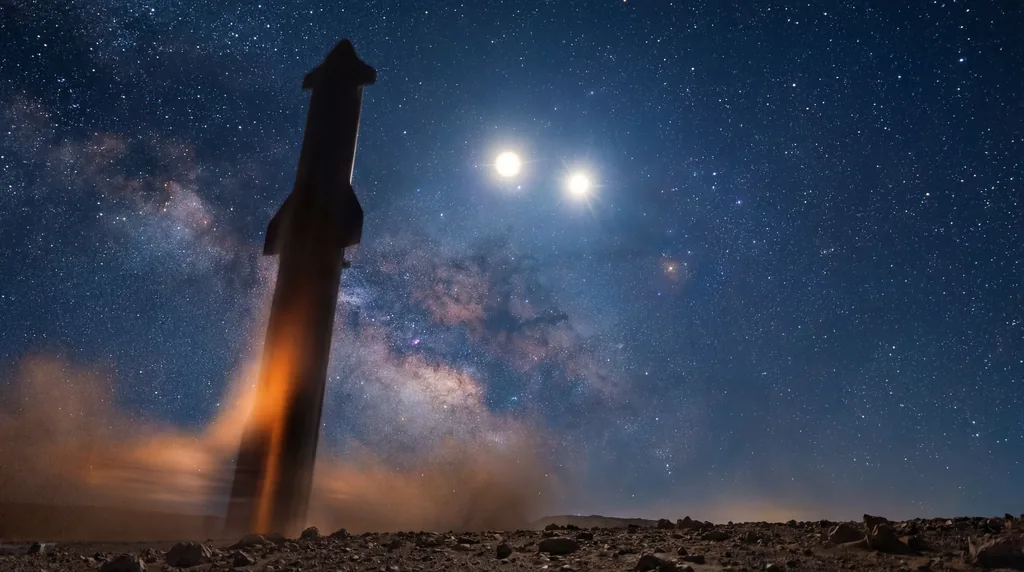
A distinctive feature of the reported IPO plan is its alignment with astronomical events. Sources familiar with the matter indicate that SpaceX is eyeing the window of June 8-9, 2026, for the launch of its public offering. Astronomically, this date marks a rare planetary conjunction where Jupiter and Venus will appear in close proximity in the night sky as seen from Earth. This phenomenon, which has not occurred in this specific configuration for more than three years, provides a symbolic backdrop for a company whose ultimate mission is the expansion of human consciousness into the solar system.
The choice to tie a major financial milestone to a planetary alignment is consistent with the "cosmic" branding that has defined SpaceX’s public persona. From the perspective of celestial mechanics, a conjunction of the two brightest planets in the sky is a visible and dramatic event. While it holds no direct impact on market fundamentals, the psychological and branding implications are significant. It serves as a reminder to investors that SpaceX’s objectives are not merely terrestrial, but are fundamentally linked to the exploration and colonization of the celestial bodies involved in the alignment.
Strategic Timing and Symbolic Milestones
Furthering the personal and symbolic nature of the timing, the mid-June window places the IPO in the immediate vicinity of Elon Musk’s 54th birthday on June 28. Musk has a documented history of weaving personal preferences and cultural references into high-stakes business decisions. The Financial Times noted that such eccentricities are a hallmark of Musk’s leadership style, recalling the 2018 episode in which he proposed taking Tesla private at a price of $420—a number widely interpreted as a reference to cannabis culture. This tendency toward unconventional timing has often served to galvanize his base of retail investors while occasionally drawing the ire of regulatory bodies.
By launching the IPO in June 2026, SpaceX creates a narrative of "destiny" that appeals to the imagination of the public and the investment community alike. This "cosmic" timing is intended to generate a level of sentiment and media saturation that a standard corporate announcement might lack. For SpaceX, the IPO is not just a fundraising exercise; it is a cultural event designed to reinforce the company's status as the vanguard of a new space age.
Funding the Path to Mars and Advanced Infrastructure
The primary driver behind this massive capital injection is the urgent need for liquidity to fund SpaceX’s most capital-intensive projects. Central to this is the development of Starship, the largest and most powerful rocket ever built. Starship is the cornerstone of Musk’s vision for a permanent human presence on the Moon and Mars. Despite successful test flights, the path to full reusability and human certification requires billions of dollars in continued investment in manufacturing, launch infrastructure, and life-support systems.
Beyond planetary exploration, the $50 billion raise is expected to bolster SpaceX’s expansion into space-based data centers for artificial intelligence. By utilizing the Starlink satellite network to host processing power in orbit, SpaceX aims to provide low-latency AI services globally, bypassing terrestrial infrastructure limitations. The integration of Starlink’s massive revenue potential with the long-term goals of Starship makes the company a unique hybrid of a telecommunications utility and a deep-space exploration firm, a combination that justifies its trillion-dollar valuation in the eyes of many institutional backers.
Regulatory Hurdles and Market Volatility
Despite the optimism surrounding the announcement, the transition to a public company is fraught with challenges. The SEC’s stringent disclosure requirements mean that SpaceX will have to reveal detailed financial data regarding its launch costs, profit margins for Starlink, and the actual burn rate of the Starship program. Historically, Musk has expressed concern that the short-term demands of public shareholders could conflict with his long-term mission of making life multi-planetary. Public investors typically demand consistent quarterly returns, which may be at odds with the high-risk, high-reward nature of deep-space research and development.
Furthermore, timing a market entry based on planetary conjunctions rather than purely economic indicators carries inherent risks. Market volatility, interest rate fluctuations, and geopolitical tensions can shift rapidly, potentially making a June 2026 launch date less than ideal from a purely financial standpoint. If the broader tech sector or the aerospace market experiences a downturn, the company may be forced to choose between its symbolic timeline and its fiscal targets. The Financial Times report noted that the mid-June date remains subject to change, reflecting the inherent unpredictability of both spaceflight and global finance.
What’s Next for the Private Aerospace Giant
As the projected 2026 date approaches, the industry will be watching SpaceX’s private secondary market valuations closely. Currently, the company holds a dominant position in the launch market, with its Falcon 9 and Falcon Heavy rockets serving as the workhorses for NASA, the Department of Defense, and international commercial clients. The upcoming IPO will likely act as a catalyst for the entire "New Space" economy, potentially prompting competitors to accelerate their own public offerings or seek strategic partnerships.
If successful, the SpaceX IPO will provide the necessary "war chest" to transform the company from a launch provider into a multi-planetary infrastructure provider. With the capital secured, the focus will shift from fundraising to execution—specifically, the establishment of the first Lunar outposts and the preparation for the initial uncrewed missions to Mars. For Elon Musk and his team, the planetary alignment of 2026 may represent more than just a visible phenomenon; it may mark the moment when the resources of the global public are finally harnessed to fuel the expansion of humanity into the stars.




Comments
No comments yet. Be the first!