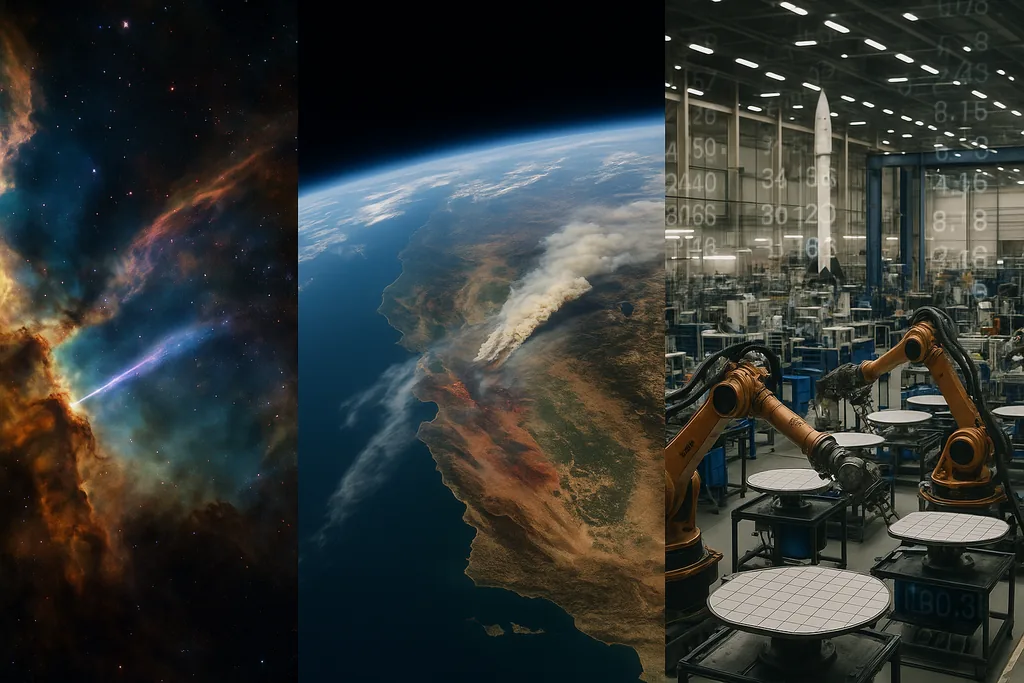
One word, three kinds of fire
On 26 January 2026 an investment column titled “Space is Ablaze” crystallised a sensation many in tech and finance were already feeling: the space sector has become a mainstream story for traders and venture capitalists. The phrase is apt because the same week produced literal images of fire viewed from orbit and images of space itself luminous with newborn stars. Those three threads — financial frenzy, Earth-observation of real wildfires, and astrophysical fireworks — are different faces of the same global trend: more capacity in orbit, more eyes on the planet, and new economic forces reshaping how humans use space.
The juxtaposition is striking. Financial markets are pricing a future built on thousands of cheap launches and satellite constellations, while observatories and Earth-observation satellites are showing both the beauty and fragility of that future: Hubble pictures of jets and glowing nebulae remind us of how stars are born, and Landsat and Envisat imagery show how quickly our own landscapes can ignite and belch smoke visible from hundreds of kilometres above the ground. Together they map a universe where science, risk and commerce are increasingly entangled.
Market ignition: why investors think space will burn bright
The investment column argued that SpaceX’s planned public listing in 2026 — discussed in investor circles as potentially targeting a valuation near US$1.5 trillion — has set off a scramble across aerospace stocks and startups. The logic driving that enthusiasm is straightforward: reusable rockets and high launch cadence have slashed the cost of access to low Earth orbit, and the result is an emerging layer of infrastructure that can carry communications, manufacturing, sensing and energy concepts that were unaffordable a decade ago.
Contributions to the narrative are concrete. SpaceX reportedly ran more than 170 launches in 2025, and an enormous industrial ecosystem has grown around Starlink terminals, orbital hardware and logistics. Numbers discussed in public commentaries — for example, revenue figures attributed to SpaceX in 2025 and the millions of Starlink subscribers — fuel a story in which satellites are not niche assets but mass-market infrastructure. Alongside that, a raft of private firms are pitching novel business models: manufacturing pharmaceuticals in microgravity, near-real-time wildfire detection services, and proposals for space-based solar power beaming energy back to Earth.
That story explains why some public equities in adjacent industries can spike dramatically on space news. But it is also exactly the sort of fevered phase that precedes consolidation. The column's author warned that a large fraction of space startups will fail as the market matures. For investors and policy-makers alike, the challenge will be distinguishing scalable infrastructure from speculative dreams while ensuring regulation and oversight keep pace with rapid commercialisation.
Star-forming fireworks: Hubble’s view of objects ablaze
“Ablaze” is literal when it comes to star formation. Hubble Space Telescope images released in January 2026 show jets and shock-heated gas glowing across molecular clouds. One vivid example is the pair of Herbig–Haro objects designated HH 80/81, where a massive protostar shoots supersonic jets that slam into surrounding gas and cause optical emission lines to glow in colours we associate with heat and excitation.
Herbig–Haro objects are the visual fingerprints of the violent birth throes of stars. As matter falls onto a nascent star, magnetic fields and rapid rotation can channel part of the inflow into narrow bipolar jets. When those jets collide with slower-moving or stationary material, the resulting shock waves compress and heat the gas to the point where atoms are excited and emit light. Hubble’s instruments, including the Wide Field Camera 3, resolve tiny structural details and motion within those jets, allowing astronomers to measure speeds, densities and energy budgets of outflows that stretch for many light‑years.
Hubble’s multi-filter snapshots of other galaxies, such as the tilted spiral NGC 3511, show networks of glowing hydrogen clouds and blue clusters of newly formed, massive stars. Those red hydrogen regions mark sites where ultraviolet radiation from young stars ionises surrounding gas, and the combination of stellar clustering, gas dynamics and feedback determines how efficiently a region converts interstellar gas into stars. In short, when astronomers say a region is "ablaze", they mean it in the astrophysical sense: intense, energetic, and fundamentally creative.
Earth ablaze: satellites watching landscapes burn
From the ground it is easy to think of wildfires as local disasters; from space they become planetary signals. Instruments on Earth-observation satellites see smoke plumes and thermal hotspots across entire regions, quantifying burned area, plume height, and evolving fire fronts. Imagery captured by Landsat 9’s Operational Land Imager-2 and earlier sensors like Envisat’s MERIS shows the distribution and scale of fires such as the Jones Road blaze in the Pine Barrens and the larger, historic blazes imaged by ESA’s Envisat.
Operational satellites provide more than striking photographs: their multispectral data allow emergency services to map active fire perimeter, estimate fuel consumption, and prioritise evacuations. Infrared channels detect hotspots through smoke; short-wave infrared bands reveal burn severity and residual heat after visible flames subside. By combining satellite-derived vegetation indices, surface temperatures and meteorological forecasts, analysts can create near-real-time situational awareness that materially improves response and resource allocation.
As launch costs fall and constellations proliferate, more satellite assets — both government and commercial — will supply higher-cadence imagery. That’s critical for early detection and for monitoring the aftermath of fires, but it raises questions about data access, interoperability and long-term continuity of the observation record as commercial models and ownership change.
Where flame meets fallout: risks at the intersection
The three kinds of blaze we have described meet at several practical fault lines. First, the environmental costs of a large space economy are not yet fully accounted for: rocket emissions, regulatory oversight of orbital traffic, and the long-term problem of debris must be managed to avoid creating hazards that undermine both scientific research and commercial operations. Second, commercialisation raises geopolitical and regulatory questions — spectrum use for megaconstellations, export controls on space hardware, and national security reviews for satellite services all matter for investors and operators.
Third, the idea that space infrastructure will automatically deliver global public goods — such as continuous wildfire monitoring or ubiquitous connectivity — is optimistic. Service coverage, pricing, hardware reliability, and resilience to extreme weather or deliberate interference determine real-world benefit. Finally, rapid financialisation injects cyclicality and risk: when markets assume perfect scale-up, smaller firms and nascent technologies can be undercapitalised or overhyped, producing an eventual consolidation that may be brutal for employees and communities dependent on the startups that fail.
Why this convergence matters
The convergence of high-frequency launches, detailed astronomical imaging, and near-real-time Earth observation is not a coincidence; it reflects three linked drivers. Cheaper access to orbit creates commercial pathways and scientific opportunities in parallel. Better sensors and more platforms produce richer data on both cosmic and terrestrial phenomena. Capital chases potential new markets, accelerating deployment but also exposing the sector to market cycles and regulatory shocks.
For scientists the payoff is immediate: Hubble and successor observatories deliver sharper views of star formation and galactic ecology, while satellite constellations and government missions supply continuous environmental monitoring. For policy-makers and investors, the imperative is to build governance, resilience and realistic expectations. If the space economy is to be an enduring public-and-private good, it will require careful stewardship of orbital commons, sustained investment in Earth observation, and a calm appraisal of which business models can survive the hard realities of engineering, logistics and climate-driven demand.
In other words, the fires we see from orbit can simultaneously be warnings and sources of wonder. They remind us that the same technologies lighting up markets also give us the sensors to watch our planet, and the telescopes to witness the Universe creating light for the first time.
Sources
- NASA (Hubble Space Telescope image releases; Wide Field Camera 3 observations)
- European Space Agency (Envisat Earth-observation imagery)
- USGS / NASA (Landsat 9 Operational Land Imager-2 Earth-observation data)




Comments
No comments yet. Be the first!