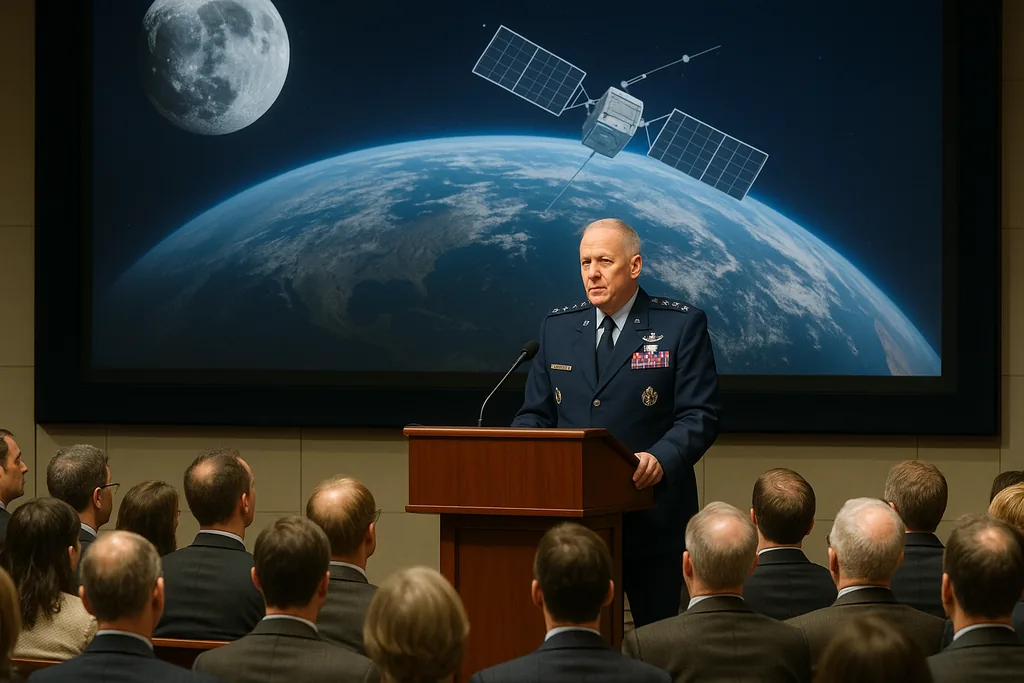
From enabler to integrated warfighting partner
For the past half-century, U.S. military planners treated space largely as a support domain — an infrastructure that supplied GPS timing, global communications and missile warning to forces on land, at sea and in the air. Bratton described a different model: a Space Force that not only keeps those functions running but also integrates space capabilities into combat plans as an equal partner alongside Army, Navy and Air Force units.
Bratton framed the change in blunt terms: the Space Force will have to work inside combatant commands and build tailored components that let space operators plan and fight alongside warfighting partners, not merely provide services from afar. He said that the service is being pushed by the other services to move faster and deliver capabilities that did not previously exist.
Planning for 2040: force design and the Objective Force study
To translate that mandate into concrete choices, the Space Force has launched a long-range planning effort known as the Objective Force study. Unlike traditional program-driven roadmaps, the study asks what missions the service needs to perform in contested environments out to the mid-2030s and 2040, and how to structure a force able to sustain operations when satellites and ground infrastructure come under attack.
The Space Warfighting Analysis Center is leading the planning project; Bratton suggested the organization could eventually be elevated to a command responsible for future force design. The study examines trade-offs across people, doctrine, and architectures: how many operators and engineers are required, which functions should be hardened or distributed, and what commercial ties are necessary to ensure options in conflict.
Missile warning, secure satellite communications and precision navigation and timing will remain core missions, Bratton said, but the way those missions are executed — their tempo, distribution and survivability — will change. The study will help decide whether to invest in more resilient constellations, larger operational headquarters embedded in combatant commands, or novel capabilities such as distributed autonomous sensing and rapid reconstitution after attack.
Cislunar and commercial pressures
Bratton highlighted another strategic shift: an expanding focus beyond low Earth orbit to the cislunar region between Earth and the Moon. As national and commercial activity around the Moon grows — from communications relays to logistics nodes — protecting and knowing what is operating hundreds of thousands of kilometers from Earth becomes a new problem set.
Commercial launches and new constellations are relevant here. The same week Bratton spoke, commercial operators continued to place satellites into higher orbits and test new services. The rapid growth of private launch cadence and constellation deployments makes more capabilities available to U.S. forces but also complicates attribution and deconfliction in crises. Bratton warned that operations beyond the Moon will require new command-and-control capabilities to manage spacecraft far from Earth and harder to observe or defend.
He also said the Space Force is watching commercial activity closely, not to nationalize it but to assess how private infrastructure and foreign partners change the operational picture and what national-security risks they introduce.
Dynamic space operations and the refueling debate
One debated enabler of dynamic operations is on-orbit servicing and refueling. Proponents argue refueling extends satellite life and enables repeated maneuvering; skeptics — Bratton among them — counter that the military advantage is not obvious. He noted that unlike aircraft, satellites do not gain range from refueling: they keep orbiting. In his view, the fiscal argument for refueling is stronger than the wartime-operational one, and wargaming has not yet shown a convincing combat benefit that outweighs the new vulnerabilities added by more complex on-orbit infrastructure.
Bigger force, broader role: structure, people and posture
Doubling the Space Force’s size, as Bratton expects, would be a major institutional change with practical implications. The service must recruit and train thousands more operators, space engineers and analysts; expand civilian expertise in acquisition, cyber and software; and grow headquarters and forward‑deployed liaison elements inside combatant commands.
Bratton said the other services are already leaning on the Space Force for faster capability delivery. To meet that demand the service plans new components inside geographic and functional commands so space planners and operators can shape theater operations in real time. That shift requires different career structures, a larger acquisition workforce, and more flexible authorities to buy and task commercial services.
Implications for deterrence, allies and competitors
The Space Force’s growth and role change come against a backdrop of rising counterspace capabilities abroad. Competitors have increased the number and sophistication of surveillance satellites, tested proximity and refueling demonstrations, and invested in jamming, cyber and kinetic options to hold satellites at risk. That makes resilience, distributed architectures and alliance integration core to deterrence: allies need to understand what U.S. space capabilities will look like in a fight and where they will be sourced or hosted.
For partners and commercial providers, the Space Force’s expanding mission set raises questions about how close industry will be asked to operate with defense planners and how the service will avoid creating single points of failure in networks that cross national and corporate boundaries.
What to watch next
- Objective Force study outputs: follow-up design decisions and whether SWAC is elevated to command status.
- Recruitment and authorization requests: personnel growth will require specific congressional funding and new manpower authorities.
- Doctrine and tasking changes: announcements about embedded Space Force components in combatant commands and new rules for using commercial satellite services in contested scenarios.
- Technology choices: investments in resilient constellations, dispensable smallsats, or on-orbit servicing will indicate whether dynamic operations move from concept to practice.
Bratton’s presentation framed a paradox at the heart of the modern space age: satellites are more central to how militaries fight than ever before, and at the same time they are becoming easier for adversaries to contest. The Space Force’s response — more people, closer integration with combatant commanders, and a planning horizon that stretches to cislunar space — acknowledges that the service must both underpin everyday utility and be ready to shape outcomes on the battlefield when space is an active theater.
Sources
- U.S. Space Force (official statements and planning documents)
- Space Warfighting Analysis Center (force design and planning materials)
- Johns Hopkins University Bloomberg Center (event hosting Gen. Shawn Bratton)
- U.S. Department of Defense (annual assessments and China-related military reports)



Comments
No comments yet. Be the first!