Lede: a late‑2025 preprint that turned heads this week
A sticky analogy: what the model actually says
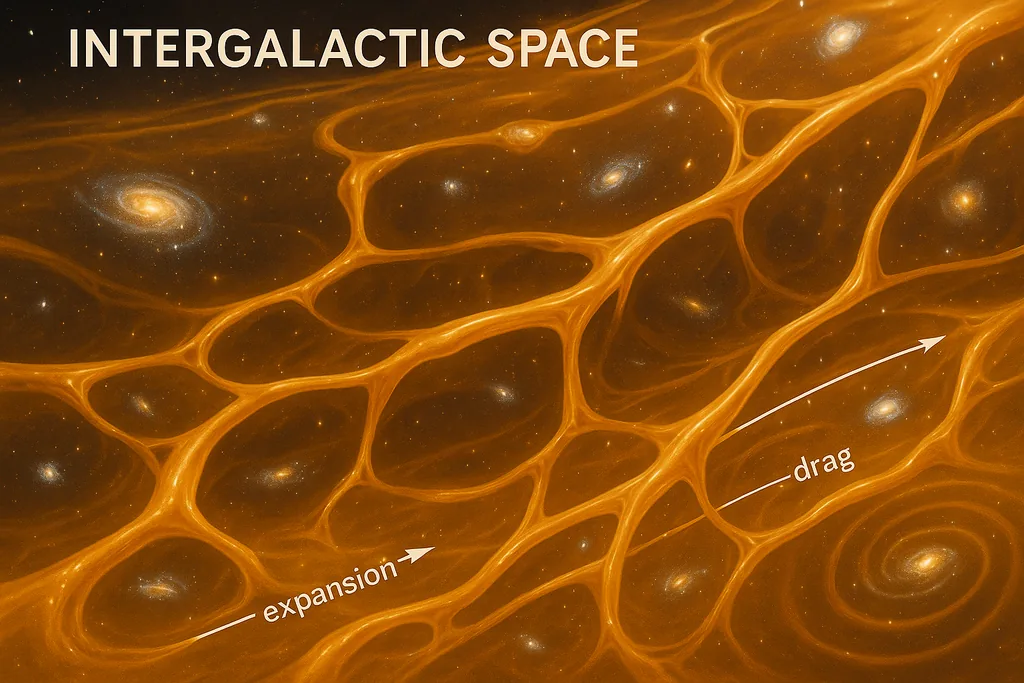
Khan’s proposal borrows metaphors from solid‑state physics and fluid dynamics and then casts them into relativistic cosmology. Space is treated as an elastic three‑brane with a uniform tension; small compressions and rarefactions of that brane are described by scalar fields that play the role of phonons in a crystal. When those phonons interact and dissipate, the collective response can be encoded as a bulk viscosity for the vacuum — a ghostly, cosmological drag that resists expansion much as honey resists being poured. In the model, that bulk viscosity is transient: it becomes important around a particular Hubble scale and then decays, leaving an asymptotic behavior close to a cosmological constant at very early and very late times.
Why this was proposed: tensions in DESI and the standard model
The motivation for the phenomenology is empirical. The Dark Energy Spectroscopic Instrument (DESI) collaboration released precision baryon‑acoustic‑oscillation (BAO) measurements from its first year of data that, when combined with other probes, suggest a mild preference for a dark‑energy history that departs from a time‑independent cosmological constant. Put simply: certain distance and expansion measurements at intermediate redshift fit a slightly different expansion history than the canonical ΛCDM fit to the cosmic microwave background. Khan’s viscous model produces a redshift‑dependent effective equation of state, w_eff(z), that can mimic the behavior favored by DESI’s analyses across the redshift range most relevant to those BAO points. That is the headline claim the paper sets out to show.
How the math maps to physical intuition
At the technical level the paper constructs an effective action for the brane and phonon fields and derives an energy–momentum tensor with both elastic (bulk modulus) and dissipative (bulk viscosity) pieces. The viscous pressure enters cosmological evolution as an extra, negative pressure term proportional to the Hubble rate times a viscosity coefficient; the author models relaxation with a Maxwell‑type viscoelastic law, so the viscous response has a characteristic timescale tied to the expansion rate. With a compact set of dimensionless parameters the model can produce a temporary "phantom" dip (w_eff < -1) and then relax toward w ≈ -1 at late times, which is how the phenomenology tracks the trends in the DESI‑motivated parameterizations. The paper is explicit about the assumptions and where phenomenology — rather than first‑principles microphysics — is being used.
What the paper gets right — and where caution is needed
There are good reasons for both excitement and caution. On the positive side, the work is valuable because it sets out a concrete, falsifiable mapping from physical assumptions to observables: change the phonon sound speed, the relaxation timescale or the brane tension and the predicted w_eff(z) and distance measures shift in calculable ways. That makes the proposal testable with additional BAO, supernova and lensing data. On the cautionary side, the paper is currently a preprint and has not undergone peer review; its microphysical underpinnings — why space should behave like a brane with the required phonon spectrum and why viscous dissipation at the suggested scale should occur — are not derived from an established high‑energy theory but are instead modeled phenomenologically. The author himself positions the work as a plausibility study that motivates more detailed microphysics and observational tests.
Where the idea sits among other alternatives
Physicists have long entertained the possibility that dark energy is not a pure cosmological constant but rather the emergent effect of new fields, modified gravity, phase transitions or interacting dark sectors. What makes the viscous/elastic picture distinctive is its use of collective, geometry‑level degrees of freedom and dissipative dynamics rather than adding a new, minimally coupled scalar field or invoking a new particle species. Some prior work has reinterpreted vacuum energy as geometric tension or elastic response; Khan’s paper builds on that literature and adds an explicit dissipative channel tied to phonon excitations. Whether this approach is a genuine new mechanism or a rephrasing of existing ideas in a different language is a point future critics and reviewers will probe.
How it will be tested
The model’s strengths are also its vulnerabilities: because it produces a distinct redshift dependence for w_eff(z), it can be confronted directly with ongoing and upcoming datasets. DESI will continue to release more BAO and redshift‑space distortion results; the European Space Agency’s Euclid mission and further Type‑Ia supernova compilations will tighten constraints on the expansion history and growth of structure, providing the lever arm needed to distinguish a viscous transient from systematic errors or other dynamical dark‑energy models. The preprint points to specific parameter regions that future analyses can exclude or confirm, which is exactly the structure of a healthy, scientific proposal. Observational closure — not metaphorical appeal — will decide whether the idea survives.
Scholarly context and reproducibility
The arXiv manuscript is explicit about methods and offers equations and ansätze that other researchers can reproduce and test. It cites DESI constraints and situates its parameter scans against the observationally preferred Chevallier–Polarski–Linder parametrization. The author also acknowledges having used a generative language model to help polish some passages of the manuscript; that transparency is a reminder that modern preprints increasingly combine human calculation with algorithmic editing. Independent groups will now be able to plug the model into Boltzmann solvers and Markov chain Monte Carlo pipelines to check whether the claimed fit to the data holds up under different priors and joint datasets.
What this would mean if it held up
If the viscous‑space picture survived scrutiny and independent confirmation it would amount to a radical reframing of dark energy: instead of an inscrutable constant of nature, the late‑time accelerated expansion would be the macroscopic consequence of elastic and dissipative properties of spatial geometry. That would link cosmology to condensed‑matter intuitions in a concrete way and could open new theoretical avenues toward embedding cosmology in a microscopic theory. For now, however, the model’s main contribution is provocative: it converts a loose empirical tension into a clearly stated, testable alternative.
Sources
- arXiv (preprint: "Spatial Phonons: A Phenomenological Viscous Dark Energy Model for DESI", M. G. Khuwajah Khan, arXiv:2512.00056).
- DESI Collaboration (DESI 2024 VI: Cosmological constraints from the measurements of baryon acoustic oscillations, arXiv:2404.03002).




Comments
No comments yet. Be the first!