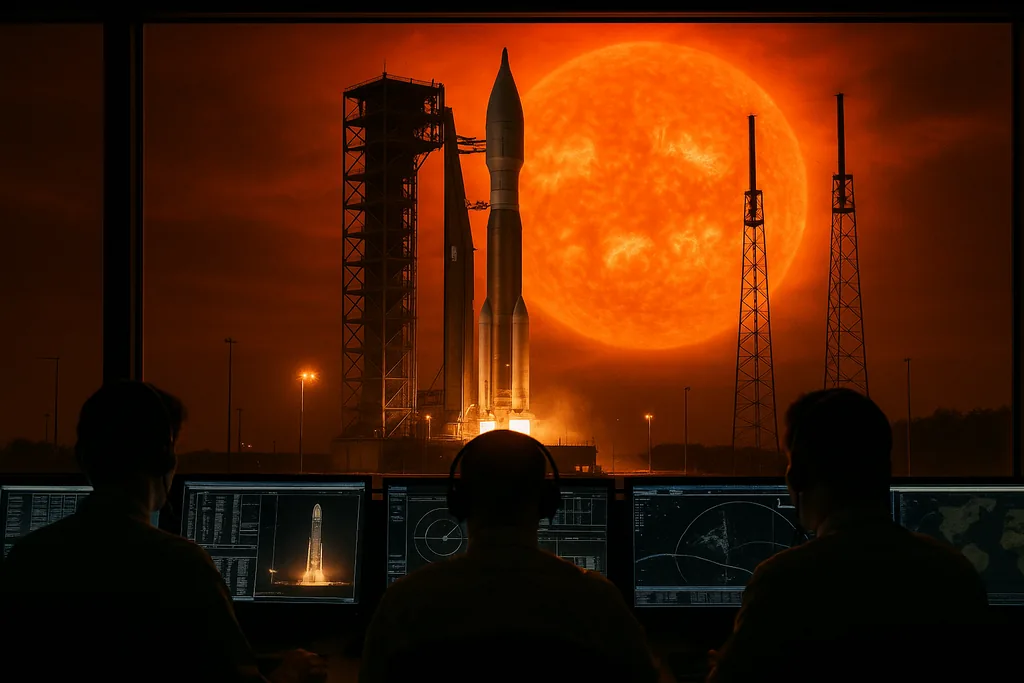
Physicist says intense solar activity could concentrate danger in early 2026
This week a Mexican physicist told Starlust that "physicist says intense solar" conditions are lining up to create a window of elevated risk for crewed lunar operations in the first half of 2026. Dr Victor M. Velasco Herrera, a nuclear physicist at the National Autonomous University of Mexico (UNAM), says his team’s analysis of decades of GOES satellite data reveals repeating patterns—roughly 1.7‑year and 7‑year oscillations—during which very large solar eruptions, or superflares, are significantly more probable.
Velasco Herrera argues that the pattern is not random: the 37 historical superflares recorded in the GOES X‑ray archive cluster in particular times and heliographic latitudes, creating temporal and spatial "high‑risk" zones on the Sun. If those cycles are entering a constructive phase this year, he says, that raises the odds of a powerful flare or coronal mass ejection (CME) coinciding with a crewed mission such as NASA’s Artemis II—bringing operational and safety decisions sharply into focus.
Physicist says intense solar cycles point to early-2026 risk
Velasco Herrera’s team bases its approach on the GOES X‑ray record and statistical analysis of extreme events. They report two dominant periodicities—about 1.7 and 7 years—that combine to make certain epochs more likely to produce superflares (events above the X10 scale). In plain terms, the Sun’s activity isn’t purely chaotic: there are harmonics that, when aligned, raise the probability of very large eruptions.
That conclusion is provocative because most operational space‑weather products focus on the short term: sunspot monitoring, magnetic complexity indices and heliospheric imaging that produce warnings a day or two before a flare or CME reaches spacecraft. Velasco Herrera’s claim is that mission‑level planning could use a separate, longer‑horizon probability forecast to avoid scheduling crewed departures during periods of heightened risk.
Experts familiar with space‑weather science caution that probabilistic windows are complementary rather than replacement tools. The physical drivers that produce a specific flare at a particular time still require local magnetic conditions on the Sun, so a months‑ahead signal increases odds but does not guarantee an event. That means any decision to shift a launch window would weigh new forecast information against engineering readiness, logistics and international commitments.
Physicist says intense solar activity: implications for Artemis II
Artemis II is planned to be the first crewed flight test of NASA’s Orion spacecraft beyond low Earth orbit. Any time astronauts leave the magnetosphere they lose the large natural shield that deflects much of the Sun’s charged particle radiation. A direct hit from a large solar particle event or CME could deliver a dangerous dose of ionising radiation within hours, and smaller but still harmful bursts of energetic protons can create medical and electronic hazards for crews and hardware.
For mission planners the key questions are lead time and mitigations. Short‑term warnings (tens of hours) let teams shelter crew in better‑shielded parts of a spacecraft, curtail extravehicular activity or move an unlaunched vehicle back into a safe configuration. A longer, months‑ahead probability would let agencies consider rescheduling launches, strengthening temporary storm shelters on the vehicle, or revising orbital insertion profiles to minimise exposure.
NASA retains operational control over Artemis launch decisions and routinely integrates many sources of space‑weather intelligence. Velasco Herrera’s proposal—if validated—would offer an extra layer of risk assessment: not an absolute veto but a statistical signal that could trigger preemptive measures. Agency engineers and mission directors will need independent verification before using such a model to move astronauts’ flight dates.
Physicist says intense solar activity and how flares influence missions
Solar flares and CMEs are distinct but related hazards. A flare is a sudden release of magnetic energy that produces intense X‑rays and extreme UV radiation; a CME is a large eruption of magnetised plasma that can drive geomagnetic storms when it hits Earth or a spacecraft. Solar proton events—high‑energy particles launched from the Sun during flares or CME shocks—are the most direct occupational hazard for astronauts because they can penetrate spacecraft and spacesuits, delivering biologically harmful doses.
For spacecraft electronics, both charged particles and induced geomagnetic currents from a CME can cause single‑event upsets, latchups and long‑term degradation. On the ground, a very large geomagnetic storm can induce currents in power grids and damage transformers; in low‑Earth orbit, satellites can suffer surface charging, increased drag, or loss of attitude control. For a crewed lunar sortie, a combination of particle radiation and degraded communications would complicate every phase of a mission.
That is why real‑time monitoring—GOES satellites, solar imagers, coronagraphs and heliospheric models—remains essential. But as space activities and human missions proliferate, planners are pressing for better probabilistic forecasting too, so they are not forced into costly or politically sensitive last‑minute changes.
Operational measures, limitations and what agencies do now
Space agencies and commercial operators already use several layers of protection. On the hardware side, radiation‑hardened electronics, redundant systems and on‑board storm shelters with extra mass shielding reduce acute risk. For crews, mission rules include radiation dose limits, storm‑sheltering procedures and abort options. Ground monitors from NOAA, NASA and international partners provide near‑real‑time alerts so mission controllers can command protective actions.
But scientists say more data and modelling improvements are needed. A recent review of extreme space‑weather preparedness emphasised that while we can predict some elements of solar activity, we still lack the predictive resolution and continuous monitoring needed to forecast the worst events with confidence. That gap is what motivates research into longer‑range signals such as those reported by Velasco Herrera’s group.
Ultimately the choice to delay—or to accept—an elevated statistical risk involves technical judgement, astronaut safety policy and programme costs. History shows agencies prioritise crew safety; delaying a launch for a credible space‑weather reason would be unpopular but defensible. The opposite choice—launching into an avoidable high‑risk epoch—could produce incidents that reverberate politically and scientifically for years.
What this means for the near term
In the immediate term, agencies will continue to rely on short‑term, physics‑based forecasts from GOES and other assets, and they will watch the Sun closely. If multiple independent analyses converge on a heightened probability for early 2026, NASA and partners would likely discuss whether to adapt Artemis II’s schedule or to add conservative protective measures. Until then, the announcement serves a useful purpose: it sharpens attention on the Sun and reminds planners that the space environment is a dynamic hazard that can and should shape mission timelines.
Sources
- National Autonomous University of Mexico (UNAM) — Dr Victor M. Velasco Herrera research on solar superflares
- NOAA / GOES satellite program — geostationary X‑ray solar monitoring records
- NASA — Artemis program and operational space‑weather products
- Space Weather research and forecasting community (space‑weather modelling and monitoring)




Comments
No comments yet. Be the first!