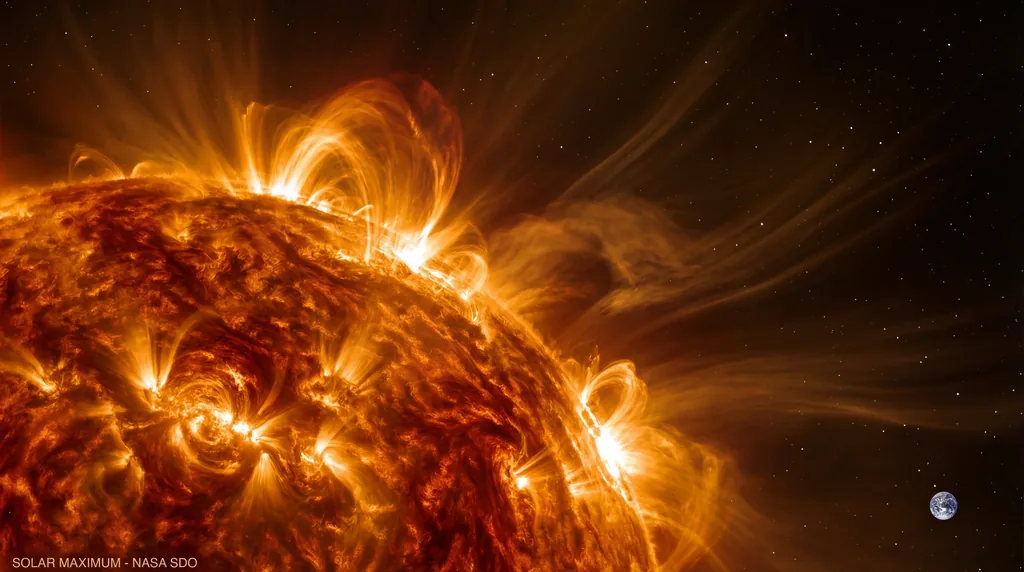

Traveling to Mars during the solar maximum is significantly safer than during the solar minimum because peak solar activity creates a magnetic "shield" that deflects high-energy galactic cosmic rays (GCRs). While solar flares are more frequent during this period, they are easier to shield against compared to the relentless, high-velocity particles originating from outside our solar system. New research published in Space Weather on March 9, 2026, confirms that launching during a boisterous solar cycle could reduce an astronaut’s total radiation exposure by up to 50%.
What are galactic cosmic rays and why are they dangerous during solar minimum?
Galactic cosmic rays (GCRs) are high-energy protons and heavy ions from outside the solar system that travel at nearly the speed of light. They are particularly dangerous during solar minimum because the flux of these particles increases significantly, reaching levels of 150-300 mGy/year. This exposes astronauts to severe carcinogenic and neurological risks that are much harder to mitigate than solar-derived radiation.
Galactic cosmic rays represent a constant bombardment that originated from cataclysmic events like supernovae. Unlike solar particles, which arrive in bursts, GCRs are a steady stream of "hard" radiation that can penetrate standard spacecraft hulls with ease. During a solar minimum, the Sun’s magnetic influence is at its weakest, allowing these interstellar particles to flood the inner solar system. Research led by Chao Zhang from the University of Science and Technology of China indicates that without the Sun's active interference, GCR levels can approach the 1000 millisievert (mSv) career limit set by the European Space Agency (ESA) in a single mission.
How do solar storms protect against galactic cosmic rays during a Mars mission?
Solar activity modulates GCR exposure by strengthening the heliospheric magnetic field, which acts as a physical barrier against interstellar particles. During solar maximum, increased solar wind and magnetic turbulence "sweep away" incoming galactic cosmic rays. This reduces the overall radiation flux reaching a Mars-bound spacecraft, making the transit safer despite the increased frequency of solar flares.
Solar wind serves as the primary mechanism for this paradoxical protection. As the Sun reaches its peak activity, it ejects vast amounts of plasma and magnetic energy that expand the heliosphere. This expansion creates a more chaotic and dense magnetic environment that scatters incoming Galactic Cosmic Rays. An international team using data from ESA’s ExoMars Trace Gas Orbiter (TGO) and the Cosmic Ray Telescope for the Effects of Radiation (CRaTER) found that this natural shielding effect is so potent it outweighs the risks posed by solar storms. According to Anna Fogtman, ESA’s radiation protection lead, targeting specific launch windows during these peaks allows mission planners to quantify exactly how much radiation "gain" is achieved through solar modulation.
What shielding is needed for solar particle events on Mars missions?
Effective shielding for solar particle events (SPEs) typically involves hydrogen-rich materials like polyethylene or water-filled "storm shelters" within the spacecraft. While thin aluminum walls can stop many solar protons, they are ineffective against GCRs and can even produce harmful secondary radiation. During a Mars mission, astronauts would retreat to these reinforced areas during unpredictable solar eruptions to minimize acute exposure.
Spacecraft design for deep-space travel must account for the different "hardness" of radiation types. Solar energetic particles, while intense, possess lower energy than GCRs and can be blocked by several centimeters of shielding. The recent study utilized a layered water-ball model to simulate how human organs absorb radiation, finding that water-based shielding is highly effective against solar flares. In contrast, Galactic Cosmic Rays are so energetic that they often trigger showers of secondary particles when they hit shielding, which can be even more damaging to human tissue. This makes the "Solar Maximum Shield" provided by the Sun itself far more effective than any heavy armor humans could currently launch into orbit.
The Comparative Risks of Interplanetary Trajectories
Mission logistics play a critical role in determining the cumulative radiation dose an astronaut receives during the journey to Mars. The research team analyzed transfer orbits over the last 60 years, comparing energy-efficient long routes with high-consumption fast routes. They discovered that faster transfer orbits could reduce radiation exposure by 55% when synchronized with the solar maximum. Even fuel-saving trajectories showed a reduction of 45% in radiation dose compared to similar trips taken during a solar minimum. These findings are vital for organizations like NASA and ESA as they finalize the Moon-to-Mars architecture, ensuring that crew safety is balanced with propulsion constraints.
Radiation measurements from the Liulin-MO dosimeter onboard TGO have provided a 15-year dataset that confirms these theoretical models. The study suggests that while a Mars mission remains a high-risk endeavor, the "radiation paradox" provides a clear window of opportunity. Co-author Robert Wimmer‐Schweingruber of the University of Kiel emphasizes that mission planners must carefully target these windows to stay within career radiation limits. Once on the Martian surface, the risk drops even further; the planet's bulk provides a natural shield, reducing exposure by 60% compared to deep space. Future habitats in lava tubes or caves could further eliminate the remaining GCR threat.
Implications for the Future of Space Exploration
Solar Cycle 25 and the upcoming Cycle 26 are now being viewed as prime windows for human exploration rather than periods to be feared. The current G1 Moderate intensity solar activity, which has recently caused auroras visible in Fairbanks, Alaska and Stockholm, Sweden (at a Kp-index of 5), is a visible reminder of the Sun's power. This same energy that illuminates the northern skies is currently working to clear the inner solar system of the much more dangerous interstellar radiation. By working with the natural rhythms of our star, humanity can venture further into the cosmos with a reduced risk of long-term health effects.
Real-time solar monitoring will become the cornerstone of astronaut safety during these peak periods. While the solar maximum offers a GCR shield, it requires sophisticated "weather" forecasting to alert crews to incoming Solar Particle Events. Advancements in dosimeter technology and magnetic modeling are turning the Sun from a primary threat into a strategic ally. As we prepare for the next era of discovery, the radiation paradox proves that in the harsh environment of space, the most active periods of our home star are actually the ones that provide the safest harbor for travelers heading toward the Red Planet.
- Primary Finding: Solar maximum is safer than solar minimum for deep-space travel.
- Data Sources: ESA’s ExoMars TGO (Liulin-MO) and NASA’s LRO (CRaTER).
- Reduction Metric: Up to 55% lower radiation dose during peak solar activity.
- Key Risk: Galactic Cosmic Rays (GCRs) are more dangerous than solar flares.
- Protection: Solar wind deflects GCRs; water-based shelters block solar particles.





Comments
No comments yet. Be the first!