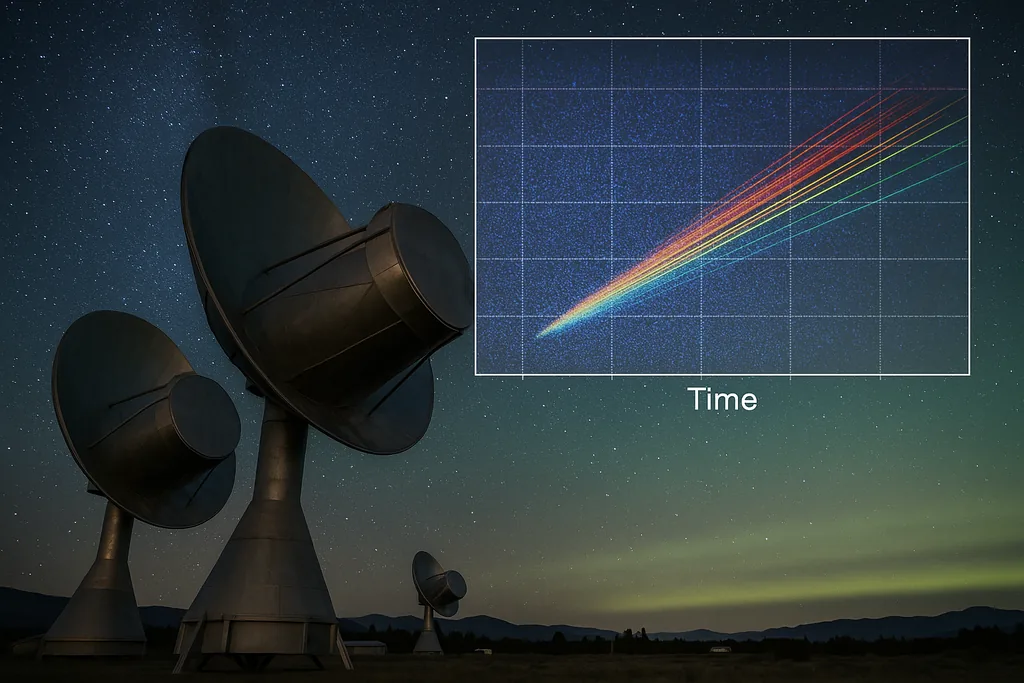
When the Search for Extraterrestrial Intelligence says it is rethinking decades of listening, the change is both methodological and practical. In a paper published this week, SETI researchers argue that common phenomena they call "space weather"—stellar winds, flares and coronal mass ejections—can smear otherwise purposefully narrow radio beacons so thoroughly that Earth-based telescopes would easily miss them. The idea helps explain why, as the headline put it, seti thinks could have been missing signals that were sent to us in plain sight.
Why seti thinks could have missed alien signals
The team did two things to make the case more than speculative. First, they reviewed archival recordings of humanity's own probes—Mariner, Pioneer, Helios and the Viking missions—and measured how S‑band transmissions were altered by our Sun's plasma as those probes transmitted from different distances and during different levels of solar activity. Second, they translated those Solar System measurements into models for other kinds of stars, especially active, low-mass M dwarfs. Both analyses suggest that stellar flares and dense, variable stellar winds can produce "spectral broadening" and time-dependent smearing that would hide a narrow broadcast from conventional narrowband searches.
What space weather does to radio messages
Space weather creates several physical effects that matter to radio astronomy. Charged particles and magnetic turbulence in a star's wind cause scattering, refraction and frequency-dependent delays in a passing radio wave. On short timescales, an initially narrow carrier can be Doppler-broadened and split into a complex pattern of sub-signals. Over longer paths, these disturbances act like fog on a laser pointer: the signal's energy is spread across many channels in a spectrogram rather than concentrated into a single, easy-to-spot spike.
The SETI paper quantifies that smearing with examples. Transmissions recorded from NASA probes in and near the inner Solar System showed measurable broadening at 2.3 GHz during active solar conditions; Pioneer-era S‑band signals recorded at distances of several million miles already exhibited spectral widening, and that widening increased during solar storms. That empirical baseline lets researchers estimate how transmissions from planets orbiting active M dwarfs—stars that are both common and magnetically volatile—might arrive at Earth. The upshot: signals could be stretched and weakened in ways that mimic natural astrophysical noise or human radio interference, complicating detection.
How seti thinks could have to adapt its searches
SETI's new work is not a dismissal of past efforts but a call to broaden them. The institute proposes three practical changes: expand search pipelines to include wider-band features with characteristic smearing patterns, reprocess archival datasets with models that predict stellar-weather distortions, and pair radio searches with contemporaneous monitoring of stellar activity. If a star is flaring, a search algorithm tuned to look for broadened, time-variable features could find what a narrowband filter would discard as noise.
Adapting pipelines means harder trade-offs. Broader searches admit more false positives—from pulsars, masers and human-made interference—so teams will need improved statistical tools and cross-checks. SETI already runs multi-telescope confirmation procedures and volunteer projects that can triage candidate signals; the new approach would add models of spectral broadening to the triage checklist, looking for telltale time-frequency correlations rather than only single-channel spikes. The researchers also recommend coordinated observations across facilities—Allen Telescope Array, Murchison Widefield Array, and other arrays—to separate local radio-frequency interference from astrophysical phenomena and to look for the same distorted pattern arriving at different sites.
Why intermittent or weak beacons are easy to miss
Even without space weather, intermittent or weak transmissions are intrinsically hard to find. A civilization could beam a tight, short-duration message timed to its own orbital position, to moments when a specific target is visible, or to periods when its star is quiet. If Earth isn't listening at that precise moment—or if the signal is smeared by its star's storm—the window closes. The SETI study emphasizes that smearing compounds the problem: what might have been a short, high‑SNR (signal-to-noise ratio) pulse becomes a longer, weaker feature spread in frequency and time, which is much more likely to be classified as noise and discarded during automated scans.
Operational constraints make this worse. Most radio surveys trade sensitivity against sky coverage and integration time. Long dwell times on single targets improve the chance of catching weak or intermittent signals, but they reduce the number of targets that can be monitored. The new modeling suggests that search strategies should be adaptive: prioritize long monitoring for active or nearby systems and apply optimized, weather-aware filters to archival data where short-duration beacons might have been smeared into the noise floor.
How SETI distinguishes noise from potential signals
Distinguishing genuine technosignatures from noise is central to SETI's work and has become more sophisticated over time. Traditional radio searches look for narrowband peaks that exceed surrounding background by orders of magnitude, because such sharp carriers are unlikely to be produced by natural astrophysical processes. But the new research shows that natural-looking, broadened features could retain fingerprints of artificial origin: consistent modulation patterns, harmonic structure, or correlated behavior across multiple frequency channels and epochs.
To separate false positives from candidates, researchers combine automated ranking metrics, human vetting, multi-site confirmation, and increasingly machine-learning classifiers trained on known RFI and astrophysical signals. The proposed change is to feed the machine-learning systems with examples of spectrally broadened but artificial-looking signals—derived from spacecraft broadcasts passing through plasma—to teach algorithms what a smeared technosignature might look like. That reduces the risk that a real message, stretched into an unfamiliar shape, will be relegated to a discarded folder of 'noise.'
Broader context: the Fermi paradox and what this means
SETI's updated perspective does not solve the Fermi paradox—there remain many possible reasons we haven't heard from other technological civilizations—but it does add a plausible observational bias to the list. If even intentionally narrow beacons can be distorted by stellar environments, our non-detections could partly reflect limitations of our search methods rather than the absence of transmitters. That matters scientifically because it is a testable hypothesis: reprocessed archival data and new, weather-aware searches can be judged by whether they turn up convincing candidates.
Ultimately, this work is methodological: it asks the field to match search strategies to the messy, plasma-filled reality of the galaxy. If SETI teams and partner observatories adopt the recommendations—wider-band pipelines, reanalysis of old data, more coordinated observing campaigns, and improved statistical safeguards—then the claim that seti thinks could have missed messages becomes an actionable research program rather than an excuse for silence.
The next steps are straightforward: implement the models, re-run archival scans, and test the pipelines on controlled examples—human-made transmitters seen through active stellar analogues—then scale up. If these efforts produce plausible technosignature candidates, they will have changed both the search and our expectations about where and how extraterrestrial signals might be heard.
Sources
- Astrophysical Journal (SETI Institute study on spectral broadening and technosignatures)
- SETI Institute press materials and research statements
- Murchison Widefield Array (MWA) observational program
- Allen Telescope Array (ATA) and SETI observational facilities
- NASA spacecraft telemetry (Mariner, Pioneer, Helios, Viking) used as empirical baselines




Comments
No comments yet. Be the first!