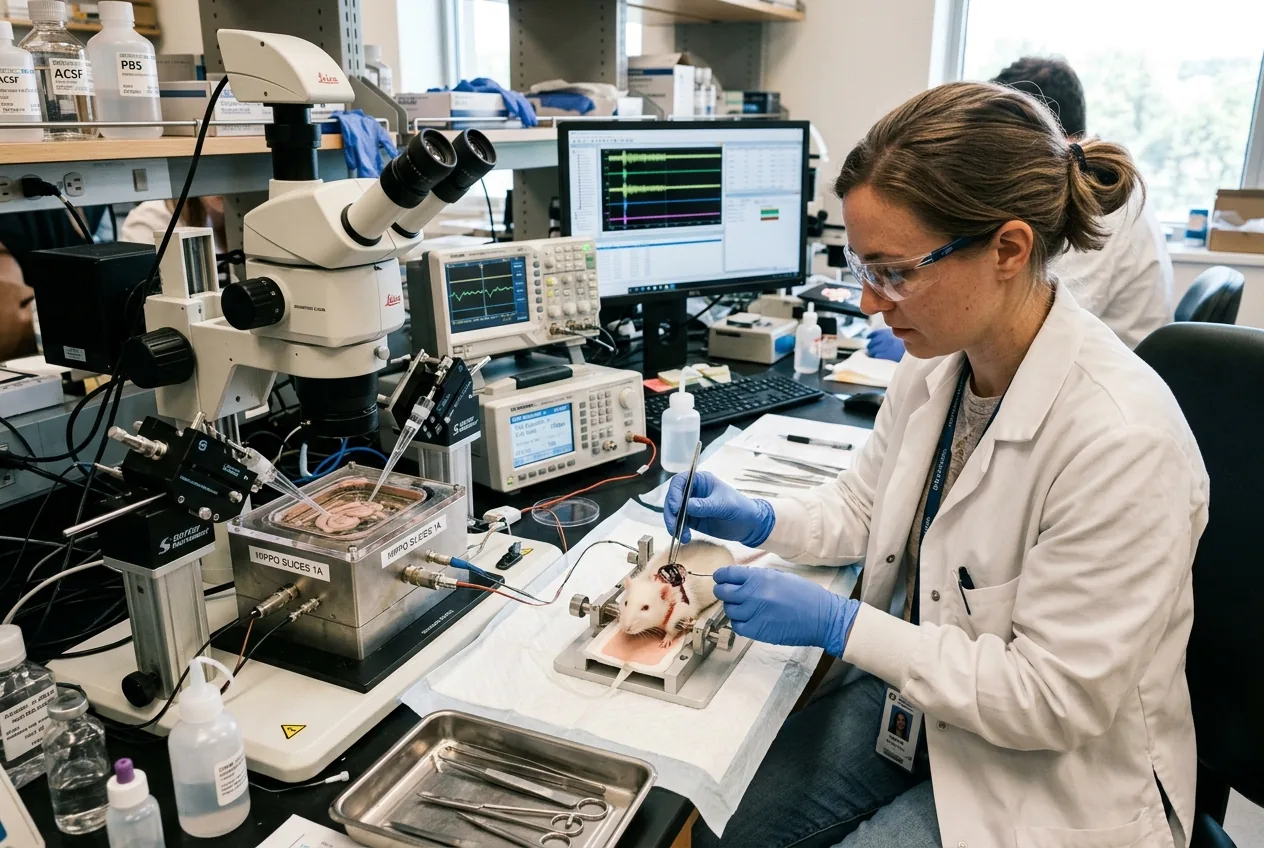
The moment came in a dim electrophysiology suite: an old mouse that had been failing simple memory tasks suddenly remembered where a hidden platform lay after researchers nudged its gut‑to‑brain signalling. It wasn’t magic. It was a sequence of experiments — microbiome transfers, immune analyses, targeted bacteriophages and vagus nerve stimulation — that converged on a single, testable idea. In short, scientists identify biological pathway signals outside the brain that cascade into hippocampal circuits and, in mice, can be manipulated to restore lost memory.
Why this matters now is obvious. For decades Alzheimer’s and age‑related memory loss research has largely focused on plaques, tangles and the neurons where memory is stored. A string of studies published in high‑profile journals this year reframes the problem: ageing signals from the gut, metabolic decline inside neurons, and even RNA splicing errors can each break memory circuits — and, crucially, each can be repaired. That opens several druggable routes, from bacteriophages and metabolic supplements to neuromodulation and gene‑level interventions, but it also raises questions about which approach is safest, scalable and ready for trials in humans.
scientists identify biological pathway linking gut microbes to memory
The result is a behavioural phenotype: young mice that receive an old microbiome show memory deficits similar to aged animals. Several interventions reversed the effect in mice — broad antibiotics (not a long‑term fix), bacteriophages that selectively reduced P. goldsteinii and pharmacological activation of vagal pathways using CCK or GLP‑1 receptor agonists. Vagus nerve stimulation, a device‑based therapy already used clinically for epilepsy and post‑stroke recovery, also restored more youthful performance on memory tests. These experiments answer one of the central PAA questions: can memory loss be reversed by targeting a specific biological pathway? In mice, yes — by interrupting a gut → immune → vagus → hippocampus cascade.
scientists identify biological pathway inside neurons and stem cells
While gut signals explain a body‑to‑brain route, other studies show complementary, cell‑intrinsic pathways that also restore memory when repaired. Teams at the National University of Singapore identified a transcription factor, DMTF1, whose restoration revives the proliferative capacity of aged neural stem cells. In laboratory models with telomere dysfunction — a cellular ageing hallmark — increasing DMTF1 reactivated chromatin remodellers and helper genes, allowing stem cells to re‑enter the cell cycle and regain regenerative potential. That matters because reduced neurogenesis in the hippocampus is tightly linked to learning deficits.
At Johns Hopkins, researchers spotlighted Cystathionine γ‑lyase (CSE), an enzyme that produces tiny, protective quantities of hydrogen sulfide. Mice lacking CSE developed Alzheimer’s‑like features — oxidative stress, DNA damage, blood–brain barrier defects and impaired neurogenesis — and failed spatial memory tasks. Restoring CSE expression or its downstream effects supported neurotrophin signalling and neuronal health, pointing to another internal pathway whose modulation may protect cognition.
How researchers found the pathways — methods, trade‑offs and limits
These discoveries were deliberately multi‑modal. The gut‑brain study combined microbiome transplants, targeted bacteriophages, immune profiling and selective neuromodulation to build a causal chain rather than a correlation. The DMTF1 team used chromatin mapping and transcriptomics on human and engineered models to move from molecular mechanism to functional readouts. NAD+ and EVA1C work used cross‑species validation — nematodes, mice and human brain tissue — plus AI‑assisted protein interaction models to explain how metabolic supplements correct RNA processing errors.
That experimental diversity is a strength but also a constraint. None of the interventions have yet been shown to reverse clinical dementia in humans. Antibiotics and bacteriophage therapies carry off‑target risks and regulatory challenges; metabolic supplements like NAD+ precursors and CaAKG have favourable safety profiles but mixed efficacy signals in human trials so far. Neuromodulation is already clinically available, but optimal stimulation parameters for aged memory systems are not yet standardised. In short, the path to translation is plausible yet nontrivial.
Europe, funding and the path to human trials
For Europe the timing is both an opportunity and an administrative headache. The continent’s ageing population provides both a clinical need and a large pool for pragmatic trials, and European research programmes already sponsor geroscience and neurotechnology initiatives. Clinics in Germany, France and the Netherlands have experience with vagus nerve stimulation and device regulation under the Medical Device Regulation (MDR), which could accelerate device‑based protocols for cognitive endpoints.
At the same time, gene‑level or bacteriophage therapies face complex regulatory and manufacturing hurdles under the EU framework. Bringing a targeted phage to market requires specialised GMP production, environmental risk assessments and harmonised cross‑border trial approvals. The upside is that Europe has pockets of manufacturing excellence in biologics and a growing healthy‑longevity industry backed by Horizon and national innovation funds. The practical bottleneck will be coordinating neurobiology labs, clinical neurology units and biotech manufacturers — not to mention convincing regulators that memory endpoints are robust and clinically meaningful.
Industry players and public funders will also have to weigh which route to prioritise: a metabolic supplement with easier regulatory paths but incremental benefits, or high‑reach synthetic biology solutions that could be transformative but expensive and slow to clear compliance checks.
If the last decade taught us anything, it is that promising pathways can survive the peer‑review gauntlet yet stumble at scale. Nevertheless, the convergence of gut‑derived inflammation, metabolic decline and RNA splicing errors into a coherent map of cognitive ageing is a rare and welcome thing: it provides multiple therapeutic entry points rather than a single, brittle hypothesis.
Europe has the clinics and the regulatory scaffolding; it will need diplomats for ethics boards, engineers for biomanufacturing and a touch of patience. Someone also needs to bring a bacteriophage to Brussels for a very different kind of summit. Progress is not a neat headline — it is a tangle of labs, investors and regulators learning to speak the same language — but for the first time in a long time, that language includes practical routes to restore memory, not only to slow decline.
Sources
- Nature ("Intestinal interoceptive dysfunction drives age‑associated cognitive decline")
- Science Advances (DMTF1 up‑regulation rescues proliferation defect of telomere dysfunctional neural stem cells)
- Aging Cell (Alpha‑ketoglutarate ameliorates synaptic plasticity deficits in APP/PS1 mice)
- Proceedings of the National Academy of Sciences (Cystathionine γ‑lyase is a major regulator of cognitive function)
- National University of Singapore, Johns Hopkins Medicine, University of Oslo (research institutes and laboratories cited above)



Comments
No comments yet. Be the first!