Sitting in a notebook in Cologne, a simple phrase kept repeating: scientists thought there was a black hole.
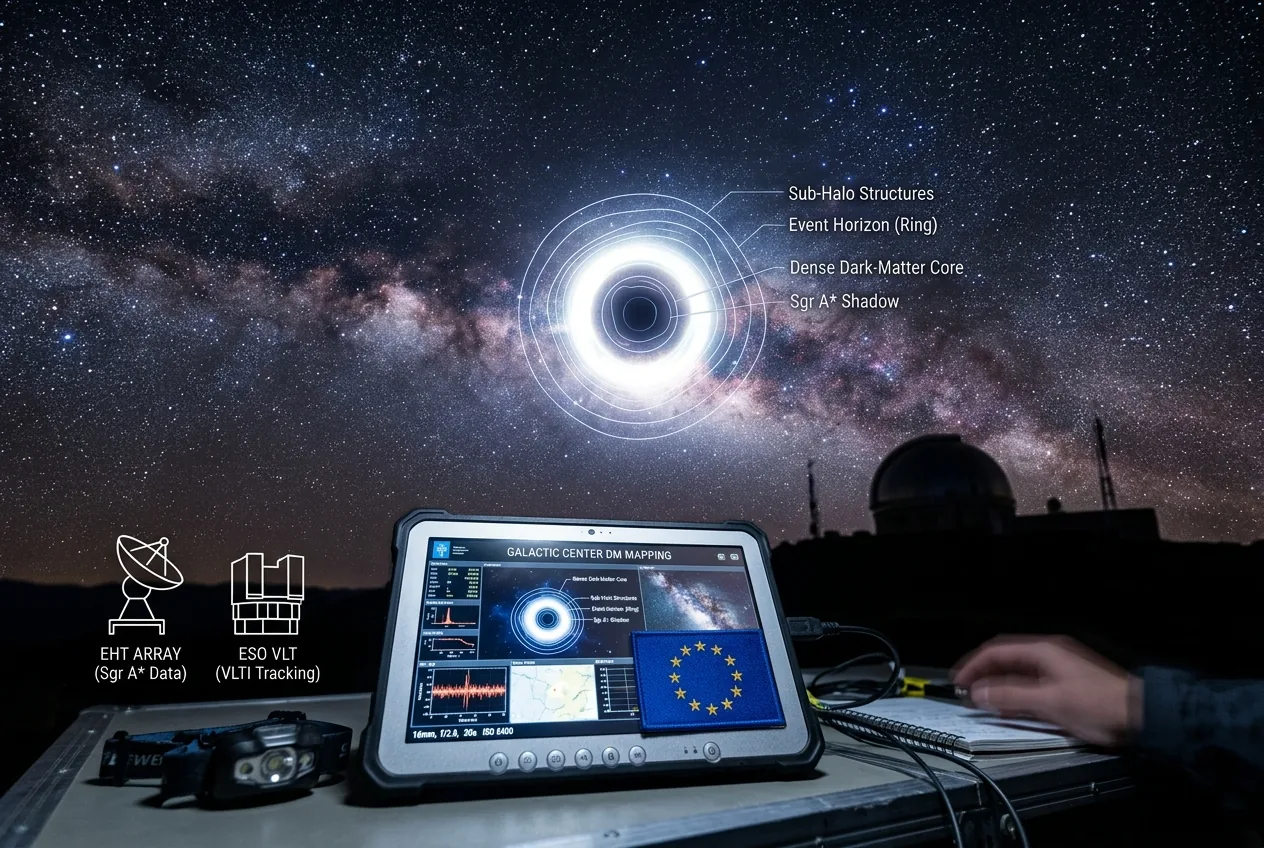
At a seminar last week an old image of the Milky Way’s centre flickered across the screen — the bright ring, the dark middle, the tidy caption: Sagittarius A*. For decades that tidy caption carried near‑gospel certainty. But a new paper in Monthly Notices of the Royal Astronomical Society argues the neat explanation may be hiding something stranger: a compact clump of fermionic dark matter that mimics many of the signals astronomers have used to claim a supermassive black hole.
Why scientists thought there was a black hole
Observers have long pointed to a handful of dramatic facts that made the black‑hole story compelling. A cluster of stars, the so‑called S‑stars, orbit an invisible mass at astonishing speed; infrared monitoring of those orbits implies a four‑million‑solar‑mass compact object in a volume no larger than our Solar System. The Event Horizon Telescope produced a ring‑and‑shadow image in 2022 that looked — visually, at least — like the silhouette expected from a hungry, relativistic black hole. Those two lines of evidence, motion and shadow, are why scientists thought there was a black hole sitting at the Milky Way’s heart.
Evidence tug‑of‑war: orbits, shadows and the gamma‑ray glow
The new work does not deny the observations; it offers an alternative interpretation that ties disparate datasets into a single framework. Using GAIA DR3 constraints on the Galaxy’s rotation curve together with the bullet‑fast S‑star orbits and recent radio images, Crespi, Argüelles and colleagues construct a model where a ultra‑compact fermionic dark‑matter core sits inside a more extended halo. Close in, the core’s gravity produces the S‑star dynamics. Far out, the halo shapes the Milky Way’s rotation in a way that — the authors argue — fits GAIA’s measured Keplerian decline better than standard cold‑dark‑matter profiles.
How the new model rewrites what scientists thought there was
Practically, the change matters because it alters predictions for several decisive observables. A true event horizon should produce narrow photon rings and particular interferometric signatures that stem from light executing near‑horizon orbits. The dark‑matter core, by contrast, does not produce the same series of sharp, relativistic photon rings; its lensing pattern is smoother and its variability properties differ. The teams behind the model are explicit: current stellar data alone cannot yet rule out either picture, but forthcoming precision measurements can.
Tests, instruments and the European angle
Europeary observatories sit on the frontline of the test. ESA’s GAIA delivered the rotation curve data that sharpened the halo constraints. The GRAVITY instrument at ESO’s Very Large Telescope, which tracks S‑star positions with microarcsecond precision, can tighten stellar orbit fits and search for the tiny deviations that a dark‑matter potential would cause. The Event Horizon Telescope network can push deeper on the presence and structure of photon rings, while the Cherenkov Telescope Array — with sites in La Palma and the Atacama — will probe the gamma‑ray environment and the broader population of potential pulsar sources.
There is also a German thread. One of the institutions named on the science release is the Institute of Physics at the University of Cologne, which contributed to the dynamical modelling. Germany’s strengths in theoretical astrophysics and interferometric instrumentation give it leverage: building the models is one thing, but producing the strict, independent tests that collapse the alternatives is another. The catch is bureaucratic: funding cross‑cutting campaigns between VLTI, EHT, and CTA requires international coordination and quick access to target‑of‑opportunity time — something Europe has habitually been good at delivering when ministers sign the paperwork, and less good at when they do not.
Alternative exotic ideas and why they matter
The fermionic dark‑matter core is not the only exotic alternative on the table. Theoretical proposals from quantum gravity suggest even stranger possibilities: long‑lived white‑hole remnants, or the idea that evaporating primordial black holes could leave tiny, quasi‑stable objects that collectively behave like dark matter. These ideas are more speculative and harder to test, yet they illustrate an important point: the central object’s nature is a nexus for particle physics, relativity and cosmology.
Meanwhile, explanations for related signals add further complexity. The puzzling gamma‑ray glow near the Galactic centre has been alternately attributed to annihilating dark matter, a hidden population of millisecond pulsars, or cosmic‑ray interactions. Each hypothesis ties back into what we infer about the core: a dark‑matter core that also produces gamma‑rays would be a two‑for‑one solution; a pulsar population would point to more mundane astrophysics. Upcoming CTA maps and deeper pulsar searches will narrow that field.
What to watch for next
Practical falsification is within reach. The simplest decisive tests are: (1) detection of multiple narrow photon rings with the EHT and next‑generation mm‑VLBI, which would favour an event horizon; (2) a mismatch between high‑precision S‑star trajectories and a point‑mass Keplerian potential, which would favour an extended core; and (3) a clean gamma‑ray morphology consistent with particle annihilations, which would strengthen the dark‑matter case. None of these is easy. They require coordinated, high‑cadence observations and careful control of systematics — exactly the kind of slow, stubborn work that astrophysicists secretly prefer to grand proclamations.
For now, the headline is modest but important: the evidence that once made the black‑hole interpretation compelling is no longer uniquely diagnostic. That is not a conspiracy of data, it is science doing what it always does — replacing tidy certainties with better, messier models that explain more phenomena.
Europe has a shot at resolving this one. We have the theoretical teams, key institutions like the Institute of Astrophysics La Plata collaborating internationally, the EHT consortium, GAIA from ESA, GRAVITY at ESO, and the soon‑to‑deliver CTA hardware. What we lack at times is the single coordinating push to get all instruments and teams to stare at the same patch of sky until the Universe gives up a clear answer. Whether Brussels will sign that cheque before someone else cuts a more dramatic observational deal is the less romantic, but real, part of the story.
In short: scientists thought there was an incontrovertible black hole in the Milky Way’s core. The data are better now, and the alternatives are not only plausible but specific. Expect the next two years of observations to be characteristically European — careful, slightly bureaucratic, and quietly decisive. If the dark‑matter core holds up, we will have to rewrite a tidy chapter of galactic astrophysics; if it does not, the black‑hole picture will return stronger and more constrained than before. Either way, the centre will not keep behaving predictably for long.




Comments
No comments yet. Be the first!