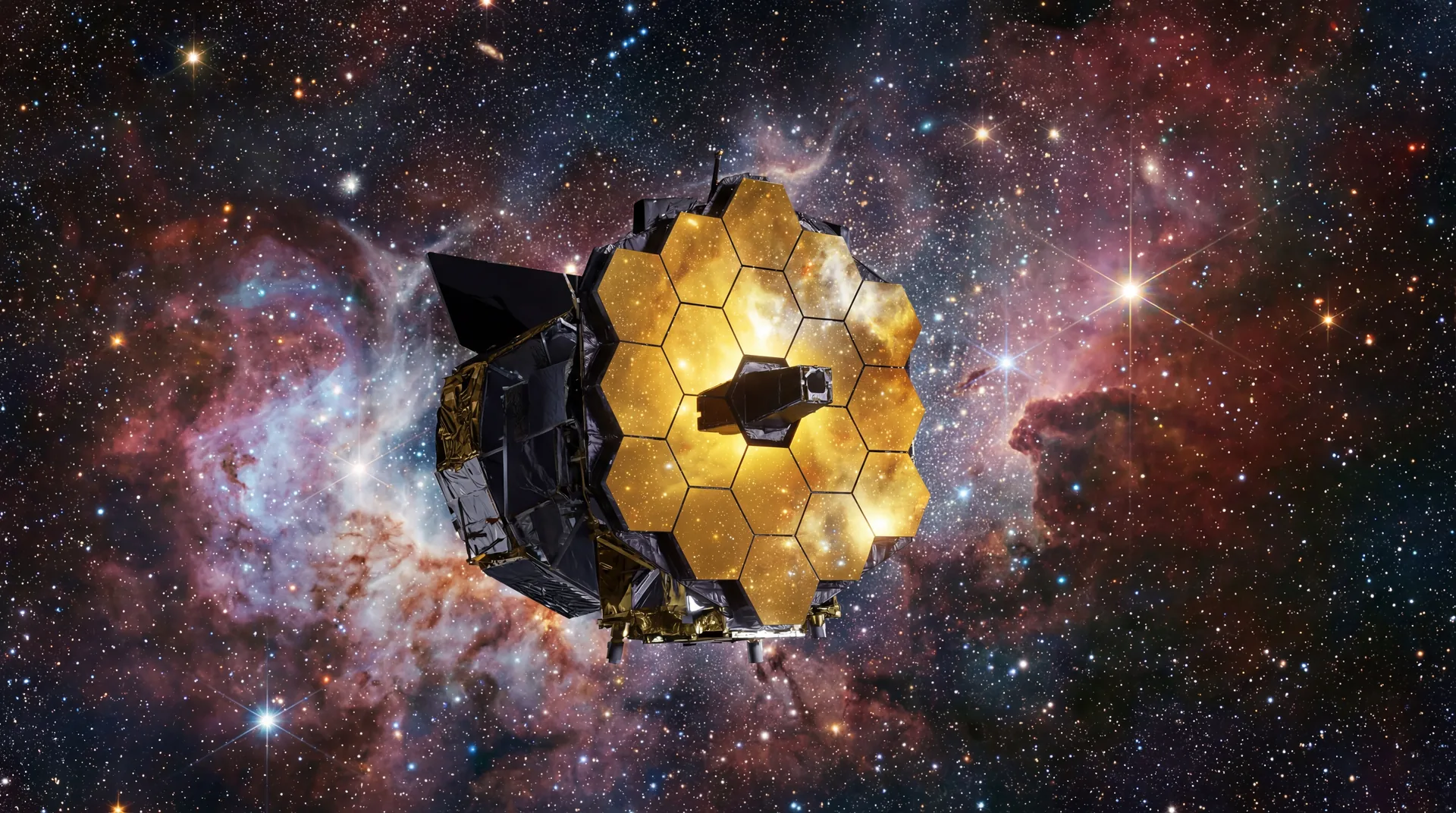

The Nancy Grace Roman Space Telescope has officially completed its construction phase at NASA’s Goddard Space Flight Center in Greenbelt, Maryland, marking a monumental achievement in the agency's pursuit of understanding the "dark" universe. Following the successful integration of its two primary segments, the observatory is now undergoing final environmental testing to ensure it can withstand the rigors of launch and the vacuum of space. This flagship mission, named after NASA’s first chief astronomer, is currently on track for a launch window as early as fall 2026, though the formal commitment remains May 2027.
How does the Roman Telescope compare to Hubble?
The Nancy Grace Roman Space Telescope features the same 2.4-meter primary mirror as the Hubble Space Telescope, but it possesses a field of view that is 100 times larger. This technical leap allows Roman to capture vast panoramic images of the cosmos with the same high resolution as Hubble, but at a speed 1,000 times faster.
While Hubble is often described as a "pencil beam" observatory—capable of looking deeply at specific, localized points in space—the Nancy Grace Roman Space Telescope is designed for wide-area surveys. Over its first five years of operation, Roman is expected to image more than 50 times as much sky as Hubble has covered in over three decades. This capability is essential for statistical studies of the universe, allowing scientists to move from observing individual celestial objects to cataloging entire populations of galaxies and stars.
The technical evolution of Roman also includes enhanced infrared sensitivity. By operating in the near-infrared spectrum, Roman can peer through thick clouds of interstellar dust that often obscure the view of visible-light telescopes. This allows for a clearer look at the center of our Milky Way and distant galaxies, providing a more comprehensive census of the universe’s evolutionary history. The mission is a collaborative effort involving NASA Goddard, the Jet Propulsion Laboratory, and international partners including the European Space Agency (ESA) and the Japan Aerospace Exploration Agency (JAXA).
What is the Roman Telescope's role in dark matter research?
The Nancy Grace Roman Space Telescope will investigate dark matter and dark energy by conducting high-precision surveys of hundreds of millions of galaxies. By measuring the subtle distortions caused by "weak lensing" and tracking the expansion history of the universe through supernovae, Roman aims to map the invisible scaffolding of the cosmos.
Dark energy, the mysterious force causing the expansion of the universe to accelerate, remains one of the greatest enigmas in modern physics. To tackle this, Roman will employ its Wide Field Instrument to perform a three-dimensional survey of the universe. According to Julie McEnery, the Roman telescope senior project scientist at NASA Goddard, the observatory’s panoramic view will allow researchers to see how the distribution of galaxies has changed over cosmic time. This data will help determine whether dark energy is a constant property of space or a field that evolves over time.
In addition to dark energy, the telescope will provide critical insights into dark matter. Although dark matter does not emit or reflect light, its gravity pulls on visible matter. Roman will use gravitational lensing—the bending of light from distant galaxies by the gravity of foreground matter—to create a "map" of where dark matter is concentrated. This will help scientists understand how dark matter has acted as the "gravitational glue" that allowed galaxies to form and cluster throughout the history of the Big Bang.
Can the Roman Telescope image exoplanets directly?
The Nancy Grace Roman Space Telescope will demonstrate groundbreaking direct imaging of exoplanets using its advanced Coronagraph Instrument. This technology uses a complex system of masks and mirrors to suppress the glare of a host star to a factor of one part per billion, enabling the detection of planets millions of times fainter than their suns.
Direct imaging is traditionally difficult because the light from a star typically overwhelms the faint reflection of any orbiting planets. The Roman Coronagraph Instrument is a technology demonstration that will pave the way for future missions, such as the Habitable Worlds Observatory, which will search for Earth-like planets. By blocking the starlight, Roman will be able to perform spectroscopy on the atmospheres of "cold" gas giants, similar to Jupiter and Saturn, identifying their chemical compositions.
Beyond direct imaging, Roman will utilize a technique called gravitational microlensing. This method relies on the chance alignment of two stars: as the foreground star passes in front of a background star, its gravity acts like a magnifying glass. If the foreground star has a planet, that planet creates a secondary "blip" in the light. This search is expected to find:
- Approximately 2,600 exoplanets located in the inner Milky Way.
- "Rogue planets" that do not orbit any star and drift through the galaxy alone.
- Planets orbiting at great distances from their host stars, which are difficult for other telescopes to detect.
The Final Assembly and Prelaunch Testing Phase
The recent completion of construction at NASA Goddard marks the culmination of years of engineering. Project manager Jamie Dunn noted that the integration of the telescope’s two major segments—the instrument carrier and the optical assembly—was a high-precision operation conducted in one of the world's largest clean rooms. The team is now wrapping up prelaunch testing, which includes thermal vacuum tests to simulate the extreme temperature swings of the space environment and acoustic testing to mimic the vibrations of a rocket launch.
NASA has invited media to a briefing on Tuesday, April 21, to view the fully integrated flagship telescope before it is prepared for transport. Participants in the briefing will include NASA leadership and lead scientists who have overseen the development of the Wide Field Instrument and the Coronagraph. This event represents one of the last times the hardware will be visible on Earth before it is shipped to NASA’s Kennedy Space Center in Florida for its eventual ride to the second Lagrange point (L2).
Scientific Implications and Data Accessibility
The mission is expected to revolutionize the way astrophysical data is handled and shared. Unlike previous missions that often restricted data access to specific teams for a proprietary period, Roman’s data will be open to the global community immediately after processing. This "open science" approach is intended to accelerate the pace of discovery, allowing researchers worldwide to search for everything from black holes to distant stellar nurseries within the massive Roman datasets.
The Nancy Grace Roman Space Telescope also serves as a critical bridge between current and future missions. While James Webb provides high-resolution spectroscopy of individual targets, Roman provides the "big picture" context. By identifying interesting targets across its wide field of view, Roman will essentially create a treasure map for Webb and other observatories to follow up on, ensuring that every minute of telescope time is used to its maximum potential.
Looking Ahead: The Journey to the Stars
As the mission nears its launch date, the focus shifts to the logistical challenge of moving the flagship observatory to its launch site. Once launched, Roman will travel to a stable orbit approximately 1 million miles from Earth. From this vantage point, it will begin its primary five-year mission, though many scientists expect the hardware to remain operational for a decade or more, similar to the longevity seen with the Hubble and Chandra missions.
The Nancy Grace Roman Space Telescope represents a significant investment in the future of space exploration, with primary industrial partners including BAE Systems Inc., L3Harris Technologies, and Teledyne Scientific & Imaging. As testing concludes this spring, the international scientific community waits with anticipation for the first light of an observatory that promises to turn the "dark" mysteries of the universe into a clear, panoramic reality.





Comments
No comments yet. Be the first!