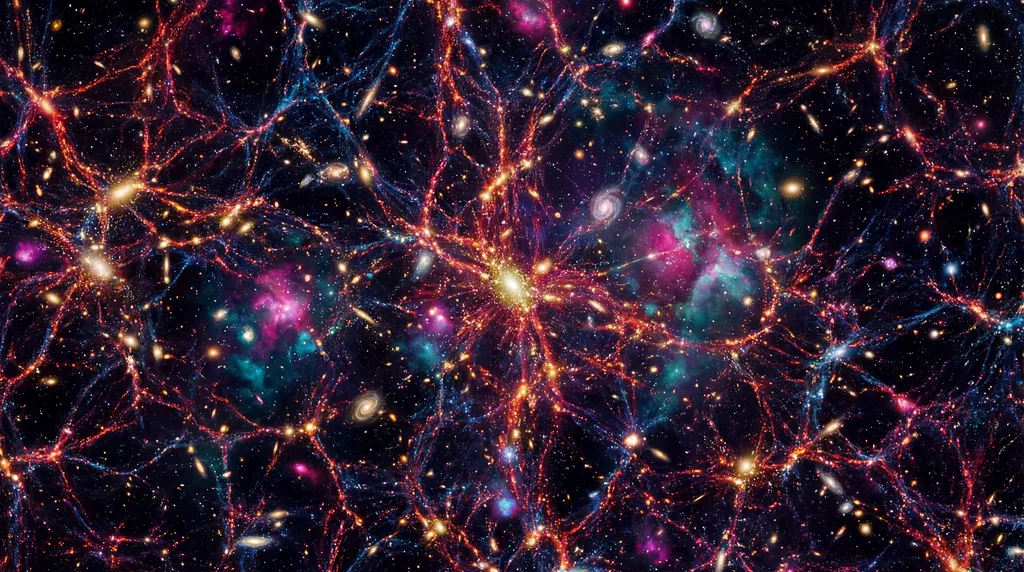

An international research team has released REGALADE, the most extensive full-sky galaxy catalogue currently available to the astronomical community. Containing nearly eighty million galaxies, this monumental dataset provides a high-precision framework for exploring the structure and evolution of our universe. By merging data from 14 major surveys and the Gaia Mission, the project offers an unprecedented 3D map of the cosmos reaching out to more than six billion light-years.
How many galaxies are in the REGALADE catalogue?
The REGALADE catalogue contains nearly 80 million galaxies across the entire sky, covering approximately 10% of the volume of the observable universe. Reaching distances of more than six billion light-years, the dataset provides precise measurements of galaxy size, distance, and stellar mass, marking a significant improvement over previous maps that were often incomplete beyond 300 million light-years.
The University of Barcelona and the Institute of Space Studies of Catalonia (IEEC) led this monumental effort to unify fragmented astronomical data. Published in the journal Astronomy & Astrophysics on February 18, 2026, the study addresses a long-standing "user experience" issue in astronomy: the lack of a single, standardized resource for identifying galactic coordinates. Lead author Hugo Tranin, a researcher at ICCUB, notes that prior to this release, scientists had to navigate multiple, often conflicting, catalogues to locate transient events. By merging 14 widely used datasets and deep imaging surveys, the team created a comprehensive "atlas" that simplifies the daily workflows of researchers worldwide.
Precision mapping of this scale allows for the exploration of cosmic events with a degree of accuracy never before achieved. The catalogue does not merely list objects; it provides a high-purity inventory of the nearby universe, ensuring that the "gaps" in older maps—particularly those caused by galactic dust or instrument limitations—are effectively filled. This enables the scientific exploitation of the new generation of time-based cartographies, such as those generated by ground-based and space-based observatories.
How does REGALADE use Gaia mission data?
REGALADE uses Gaia mission data to clean and validate combined galaxy survey data by removing stars that have been mistakenly classified as galaxies. This rigorous filtering process utilizes the Gaia Mission’s high-precision astrometry to identify and eliminate "cosmic noise," ensuring that the final catalogue possesses the high purity and integrity required for advanced astrophysical research.
Identifying distant galaxies among a sea of foreground stars is a persistent challenge in deep-sky imaging. The research team, which included ICCUB-IEEC experts Nadia Blagorodnova, Marco Antonio Gómez Muñoz, and Maxime Wavasseur, applied parallax and photometric data from Gaia to distinguish between point-like stars in our own Milky Way and the billions of distant stellar systems beyond. This cross-referencing is critical for ensuring that researchers do not waste observatory time studying misidentified objects when a sudden transient event is detected.
Data integration techniques developed for this project represent a significant leap in multi-messenger astronomy. By combining expertise in binary star evolution and large astrophysical catalogues, the researchers have created a resource that provides stellar masses for the majority of the 80 million entries. This data point is essential for understanding the environment of cosmic phenomena and helps astronomers model the life cycles of galaxies within the large-scale structure of the universe.
Why is REGALADE important for gravitational wave follow-up?
REGALADE is important for gravitational wave follow-up because its comprehensive all-sky coverage and accurate distance measurements allow astronomers to quickly identify host galaxies for cosmic events. This capability significantly improves strategies for tracking neutron star mergers and black hole collisions, enabling the rapid classification of rare phenomena like luminous red novae immediately after detection.
Gravitational wave observatories, such as LIGO and Virgo, often provide a broad area of the sky where a merger might have occurred, but they cannot pinpoint a specific galaxy on their own. The REGALADE catalogue serves as the essential "phone book" that allows electromagnetic telescopes to scan that area and find the specific host. According to co-author Nadia Blagorodnova, upcoming facilities like the Vera C. Rubin Observatory will detect millions of cosmic events every night. Having a pre-established, high-precision map ensures that the most interesting transients can be identified and studied before they fade from view.
Multi-messenger astronomy relies on the synchronization of different types of signals—light, gravitational waves, and neutrinos. The team reports that the catalogue now allows them to obtain distances for more than 75% of the transient phenomena reported worldwide each day. This efficiency is vital for studying supernova host galaxies and other short-lived events that provide clues about the expansion of the universe and the fundamental laws of physics.
Is the REGALADE interactive sky viewer available to the public?
Yes, the REGALADE interactive sky viewer is available to the public, allowing users to explore the catalogue and navigate millions of galaxies. This online platform democratizes access to high-level astronomical data, permitting students, educators, and citizen scientists to visualize the large-scale structure of the universe through an intuitive web-based interface with just a few clicks.
Public accessibility was a core goal for the international team, bridging the gap between professional research and science communication. The viewer provides a window into the cosmic map, showing how galaxies are clustered into filaments and voids across billions of light-years. By making this data available, the University of Barcelona and its partners are encouraging a new generation of enthusiasts to engage with the complexities of modern astrophysics and the ongoing quest to chart the heavens.
Future research involving REGALADE will likely focus on updating the dataset as new surveys come online. As the Vera Rubin Observatory begins its ten-year Legacy Survey of Space and Time (LSST), the catalogue will serve as a foundational reference, helping to categorize the millions of new "moving parts" detected in the night sky. The work of Tranin and his colleagues has established a new standard for astronomical transparency and utility, ensuring that as we look deeper into the cosmos, we have the most accurate map possible to guide our journey.
- Institution: Institute of Cosmos Sciences (ICCUB) / University of Barcelona
- Total Galaxies: Nearly 80 million
- Coverage: 10% of the observable universe
- Key Technology: Gaia Mission data cleaning
- Primary Application: Gravitational wave and transient follow-up





Comments
No comments yet. Be the first!