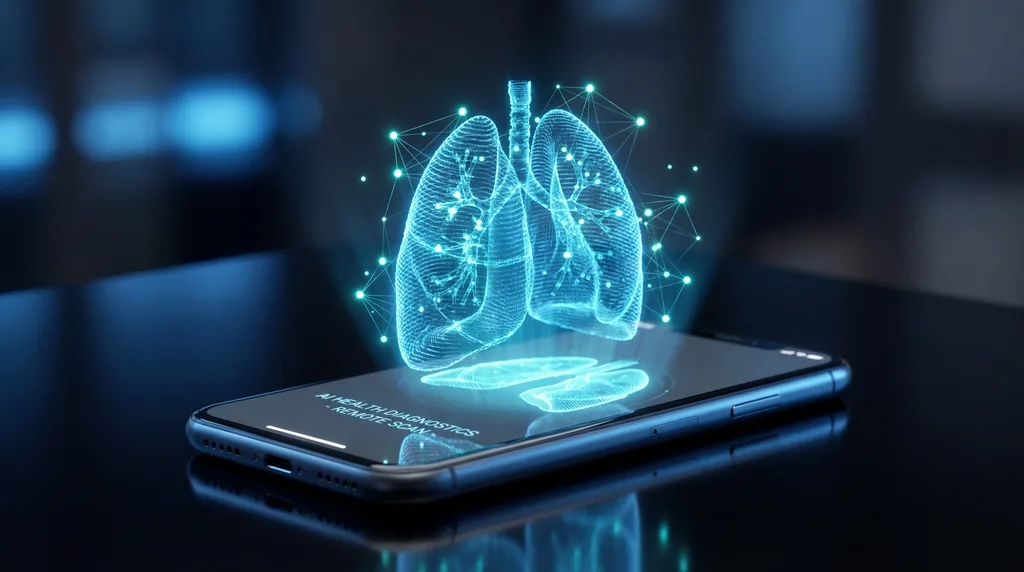

RAMoEA-QA is a hierarchically routed generative model designed for respiratory audio question answering that unifies diverse question types and supports both discrete and continuous targets within a single multimodal system. Developed by researchers including Cecilia Mascolo, Tong Xia, and Gaia A. Bertolino, the system employs a two-stage conditional specialization: an Audio Mixture-of-Experts (MoE) routes recordings to suitable encoders, while a Language Mixture-of-Adapters (MoA) selects specific LoRA adapters to match query intents. This advancement represents a significant milestone for Artificial Intelligence in Healthcare, enabling more reliable diagnostic insights from non-invasive audio captured via consumer-grade mobile microphones.
The Challenge of Remote Respiratory Monitoring
Current limitations of general-purpose Artificial Intelligence in Healthcare involve the inability of monolithic models to handle highly heterogeneous medical data. In the context of respiratory care, audio recordings vary significantly depending on the smartphone hardware, environmental background noise, and the specific acquisition protocols used by the patient. Traditional AI systems often struggle to maintain accuracy when transitioned from controlled laboratory settings to the "noisy" reality of home-based monitoring.
The problem of noise and device variability in smartphone-based audio recordings creates a distribution shift that can degrade the performance of standard diagnostic algorithms. Because different respiratory sounds—such as coughs, breathing, or vocalizations—require different acoustic processing, a single, inflexible model often fails to capture the nuanced features necessary for a clinical-grade analysis. This research addresses these hurdles by moving away from monolithic architectures toward a more specialized, modular framework.
What is RAMoEA-QA and how does it work?
RAMoEA-QA is a specialized generative framework that utilizes a hierarchical routing system to provide accurate answers to respiratory health queries based on audio input. By integrating an Audio Mixture-of-Experts with a Language Mixture-of-Adapters, the model can adapt its internal processing to the specific characteristics of a recording and the clinical intent of the user's question, significantly reducing parameter overhead.
The core methodology of RAMoEA-QA involves a shift from one-size-fits-all systems to a "specialization-per-example" approach. Under the leadership of Professor Cecilia Mascolo, the research team implemented a routing mechanism that directs audio data through the most relevant pre-trained encoders. Simultaneously, the language component utilizes Low-Rank Adaptation (LoRA) on a shared, frozen Large Language Model (LLM) to ensure the output format matches the specific needs of the clinician or patient, whether they are looking for a simple diagnosis or a complex descriptive analysis.
How does the Audio Mixture-of-Experts handle different recording environments?
The Audio Mixture-of-Experts in RAMoEA-QA handles diverse recording environments by dynamically routing each audio signal to the most appropriate pre-trained encoder based on its acoustic profile. This conditional specialization ensures that the system remains robust across variations in hardware, background noise levels, and recording modalities, such as deep breathing versus forced coughing.
Handling diverse recording environments is critical for the scalability of Artificial Intelligence in Healthcare. By automatically identifying the characteristics of the input signal, the MoE layer can mitigate the effects of different microphone sensitivities and environmental echoes. This allows RAMoEA-QA to achieve a level of robustness that previously required extensive manual data cleaning. The system's ability to maintain high-quality acoustic representations across different smartphone brands and settings makes it a viable tool for widespread, longitudinal patient monitoring.
Can RAMoEA-QA predict spirometry values from audio?
Yes, RAMoEA-QA can predict continuous spirometry values from audio by leveraging its specialized Language Mixture-of-Adapters to process query intents requiring numerical output. This dual-purpose capability allows the system to handle both categorical diagnostic tasks and the prediction of continuous lung function metrics, such as forced expiratory volume, within a unified framework.
Predicting spirometry values directly from audio signals is a significant leap forward for non-invasive diagnostics. Traditionally, measuring lung function requires specialized hardware that many patients do not have at home. By supporting continuous targets, RAMoEA-QA transforms a standard smartphone into a functional medical tool capable of tracking disease progression. The system's ability to switch between descriptive question answering and quantitative measurement highlights the versatility of its Mixture-of-Adapters architecture in clinical applications.
Real-World Performance and Validation
Evidence of model reliability in non-clinical settings was a primary focus of the validation phase conducted by the researchers. In comparative testing, RAMoEA-QA consistently outperformed strong state-of-the-art baselines, achieving an in-domain test accuracy of 0.72, compared to 0.61 and 0.67 for existing monolithic systems. This improvement is particularly notable given the minimal parameter overhead required to implement the hierarchical routing, demonstrating that specialized efficiency is more effective than sheer model size.
- Improved Generalization: The model showed the strongest performance under domain, modality, and task shifts.
- SOTA Performance: Accuracy reached 0.72, outperforming previous benchmarks in respiratory audio analysis.
- Robustness: The system maintained stability even when faced with significant "distribution shifts" common in real-world deployments.
Future Implications for Healthcare
The potential for scalable screening and longitudinal monitoring at home could redefine the management of chronic respiratory conditions like asthma and COPD. By integrating smartphone-based diagnostics into primary care workflows, clinicians can receive more frequent, objective data points between visits. This capability is central to the evolution of Artificial Intelligence in Healthcare, shifting the focus from reactive treatment to proactive, data-driven wellness management.
Next steps for the research team include validating these AI-driven "smartphone stethoscopes" in broader clinical trials to ensure safety and efficacy across diverse patient populations. As these systems become more refined, they may serve as a critical bridge between patients and healthcare providers, offering real-time clinical insights without the need for expensive, specialized equipment. The success of RAMoEA-QA paves the way for a new generation of multimodal medical AI that is both specialized and accessible.





Comments
No comments yet. Be the first!