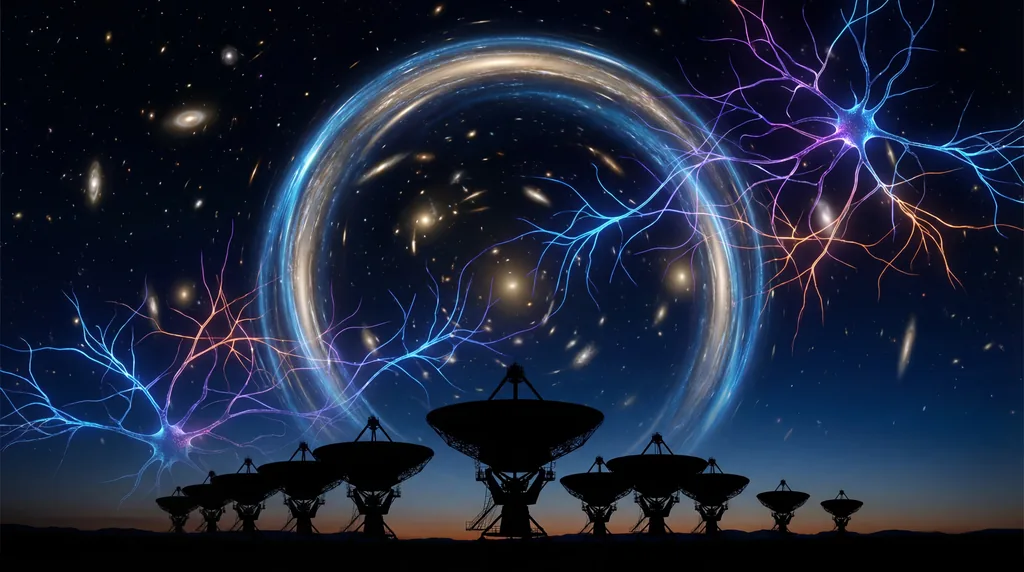

Strong lens discovery in astronomy involves identifying rare gravitational lensing systems where a massive foreground object, such as a galaxy or cluster, bends light from background sources to create multiple images, arcs, or complete Einstein rings. These cosmic phenomena are vital for probing dark matter and the expansion of the universe, though they occur in only about 1 in 10,000 massive galaxies. While the broad pursuit of AGI (Artificial General Intelligence) continues in the tech sector, specialized deep learning frameworks like POLISH are already delivering superhuman performance in identifying these elusive structures within massive radio telescope datasets.
Radio interferometry is a cornerstone of modern astrophysics, allowing scientists to synthesize a large effective aperture from an array of smaller antennas to achieve high-resolution imaging. However, the data produced by these arrays is often sparse and requires complex deconvolution to reconstruct a clear image of the sky. Traditional methods, such as the CLEAN algorithm, have served the community for decades but often struggle with high dynamic range and wide fields of view. This research, led by Katherine L. Bouman, Samuel McCarty, and Liam Connor, introduces a transformative approach to these historical challenges by leveraging deep learning to automate and refine the imaging process.
What is strong lens discovery in astronomy?
Strong lens discovery is the process of finding astronomical systems where the gravitational field of a massive body is strong enough to significantly warp the spacetime around it, creating visual distortions of background objects. These systems, characterized by Einstein rings and arcs, provide a "natural telescope" that allows astronomers to study the most distant reaches of the cosmos. Identifying these lenses is critical for mapping dark matter distributions and measuring the Hubble constant with high precision.
The primary challenge in strong lens discovery lies in the scarcity of the events and the technical limitations of current imaging hardware. Because these lenses often appear at scales near the Point Spread Function (PSF)—the smallest detail a telescope can resolve—they are frequently mistaken for noise or standard elliptical galaxies. The POLISH framework addresses this by improving the fidelity of reconstructed images, ensuring that the subtle curvatures of a gravitational lens are not "cleaned" away during data processing. By enhancing the signal-to-noise ratio and spatial resolution, researchers can now identify systems that were previously invisible to automated pipelines.
The POLISH Framework: Scaling AI for the Sky
Katherine L. Bouman, a pioneer in black hole imaging, has co-developed the POLISH framework to overcome the "mismatch" problem between simulated training data and the unpredictable conditions of real-world radio observations. Unlike general AGI models that require vast, diverse datasets, POLISH is a specialized deep learning model designed for interferometric imaging. It utilizes two key innovations: patch-wise training for scalability and nonlinear intensity transformations to handle the massive brightness differences found in deep space.
To ensure the model could handle the wide-field imaging required by the Deep Synoptic Array (DSA) and other next-generation surveys, the team implemented a patch-wise stitching strategy. This methodology involves the following steps:
- Dividing the massive sky maps into smaller, manageable image patches for the neural network.
- Training the model on realistic sky models from the T-RECS simulation suite.
- Reassembling the patches using a stitching algorithm that prevents artifacts at the borders.
- Applying the model to realistic PSFs to maintain consistency with physical telescope behavior.
How does POLISH enable super-resolution in radio images?
POLISH enables super-resolution by utilizing a deep learning architecture that learns the underlying structure of astronomical sources to reconstruct details beyond the classical diffraction limit. By training on "dirty" images paired with high-resolution ground truths, the model learns to effectively reverse the blurring effects of the telescope's Point Spread Function (PSF) and recover fine-scale morphology that traditional deconvolution methods miss.
A significant hurdle in achieving super-resolution is the high dynamic range (HDR) of the radio sky, where a single bright quasar can be millions of times more intense than a neighboring dwarf galaxy. The researchers solved this by implementing an arcsinh-based intensity transformation. This nonlinear scaling compresses the brightness range during the training phase, allowing the neural network to focus equally on faint structural details and high-intensity peaks. Consequently, the model maintains high photometric accuracy, ensuring that the reconstructed images are not only visually clear but also scientifically valid for measuring the flux and mass of distant galaxies.
Can AI discover 10x more galaxy-galaxy lensing systems?
AI-driven frameworks like POLISH can discover approximately ten times more galaxy-galaxy lensing systems by successfully deconvolving images where the Einstein radius is near or below the traditional resolution limit. By accurately separating the foreground lens from the background source, POLISH reveals the distinct "ring" signature that image-plane CLEAN typically fails to distinguish from a point source.
The implications of this 10x increase in discovery rate are profound for the field of observational cosmology. According to the research paper, the application of POLISH to the Deep Synoptic Array (DSA) survey could lead to a massive influx of new strong lens candidates. Samuel McCarty and Liam Connor note that the ability to recover lenses with small Einstein radii allows for the study of lower-mass galaxies as lenses, providing a more comprehensive view of how matter is distributed in the early universe. This level of automated discovery is a precursor to how AGI-adjacent technologies will eventually manage the "big data" problem in future astronomical surveys.
Mastering Dynamic Range and Future Applications
The success of the POLISH model marks a shift toward AI-driven discovery as a standard tool in the astronomer’s toolkit. By handling nonlinear intensity transformations, the framework preserves the nuances of faint radio emissions even in the presence of overwhelming background noise. This capability is essential for the next generation of massive radio arrays, such as the Square Kilometre Array (SKA) and the Next-Generation Very Large Array (ngVLA), which will generate data at rates far beyond the capacity of human-led analysis.
Looking ahead, the researchers envision POLISH as a scalable, practical tool for real-world deployment. The "What's Next" for this research involves:
- Integrating the model into live data pipelines for real-time image reconstruction.
- Expanding the training sets to include more complex astrophysical objects, such as spiral arms and active galactic nuclei.
- Refining the stitching strategies to handle even wider fields of view without increasing computational overhead.
- Testing the framework's robustness against diverse atmospheric conditions and antenna interference.
In conclusion, the work of Bouman, McCarty, and Connor demonstrates that the marriage of deep learning and traditional radio interferometry is not just an incremental improvement, but a paradigm shift. By overcoming the limitations of dynamic range and field size, POLISH is set to turn the vast, noisy data of the Deep Synoptic Array into a treasure trove of gravitational lenses, bringing us one step closer to understanding the dark components of our cosmos.




Comments
No comments yet. Be the first!